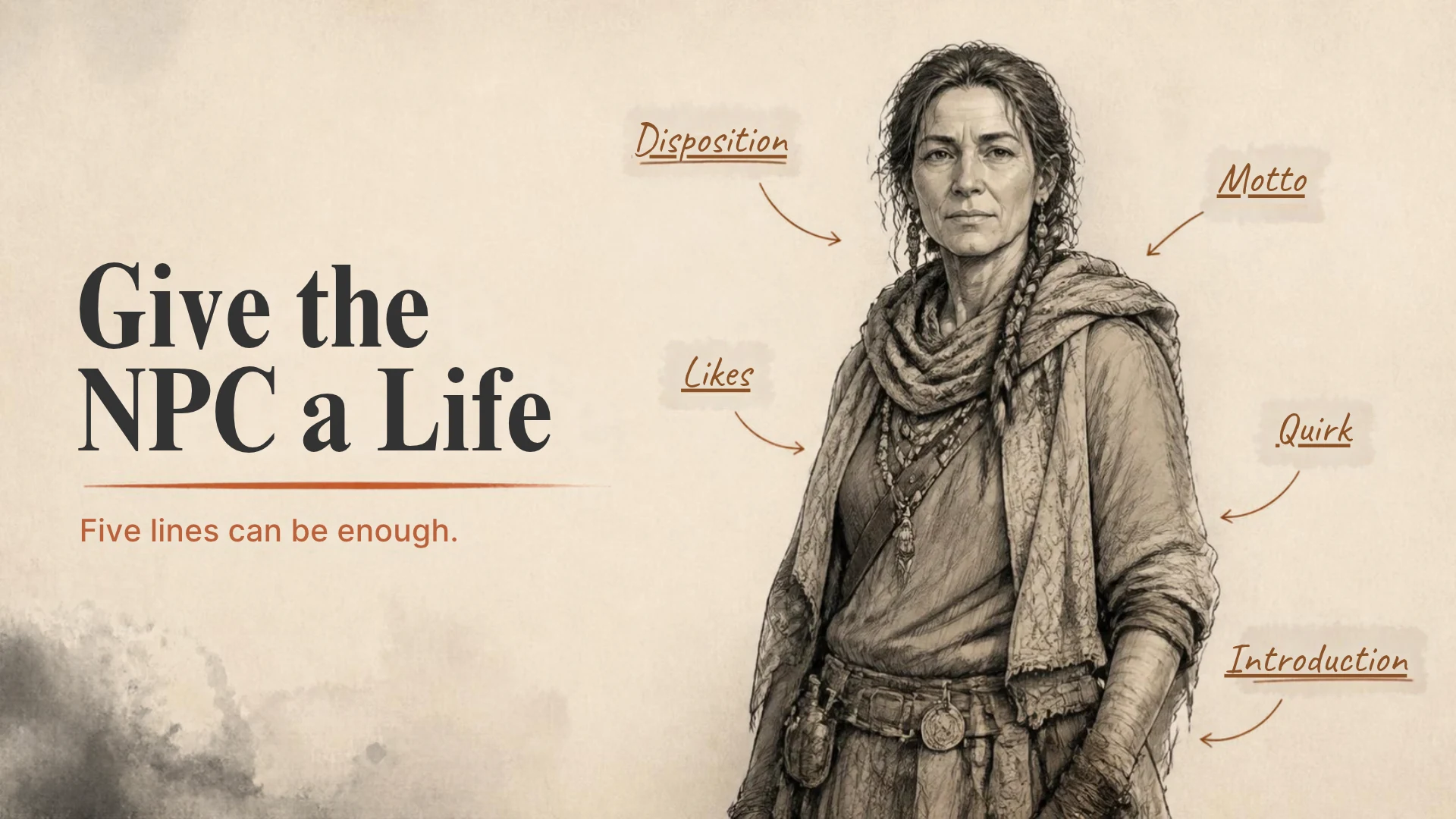
The NPC Exists Before the Players Arrive
When I prepared non-player characters, I used an NPC log that included several small prompts:
Disposition.
Motto.
Likes.
Quirks.
Introduction.
None required a detailed biography.
That was the point.
I didn't need to know where an innkeeper went to school, the names of every childhood friend, or what happened during every year of their life.
I needed enough information to answer a much simpler question:
Who is this person when the players meet them?
Those few details provided enough structure to improvise everything else.
Start With Disposition
Before deciding what an NPC says, decide how they generally approach other people.
Friendly.
Suspicious.
Impatient.
Curious.
Formal.
Nervous.
Boisterous.
Tired.
Disposition gives the Game Master a starting position.
Imagine two guards standing at identical gates.
The first is suspicious. Every question sounds like an interrogation. He wants to know where the travelers came from, why they are entering the city, and what is inside that suspicious-looking sack.
The second is bored. She has asked the same questions a hundred times today and would very much like everyone to keep moving.
Same job.
Same gate.
Completely different encounter.
Give Them Something They Believe
A motto doesn't have to be something the NPC literally repeats.
It can represent the idea guiding the character.
“Everything has a price.”
“Never trust anyone wearing clean boots.”
“A promise is a debt.”
“Tomorrow will probably be worse.”
A simple belief gives you something to return to when the players push the conversation somewhere you didn't anticipate.
What would this person think?
What would they advise?
What would make them uncomfortable?
What might convince them to help?
You don't need a script if you understand the person speaking.
Let Them Like Something
Characters are often built around conflict.
What do they fear?
What do they want?
Who do they hate?
What secret are they hiding?
Those questions are useful, but ordinary preferences can sometimes do more to humanize someone.
Maybe the intimidating mercenary loves pastries.
The priest enjoys terrible jokes.
The village elder collects unusual stones.
The apothecary stops whatever she is doing when migrating birds pass overhead.
These details don't need mechanical significance.
They don't need to become quests.
They don't need secret plot relevance.
People like things.
Allowing NPCs to do the same suggests lives that extend beyond whatever problem the adventurers happen to be solving.
Add One Quirk, Not Ten
Quirks are useful because they give the Game Master something immediately playable.
But too many quirks turn a character into a collection of gimmicks.
One is often enough.
Maybe the NPC constantly polishes their spectacles.
Perhaps they refuse to sit with their back toward a door.
They might answer questions while continuing to work.
Maybe they remember everyone's name but routinely forget why they walked into a room.
The goal isn't to make every NPC strange.
The goal is to give yourself a behavioral handle.
When that character returns six sessions later, one small recognizable behavior can help everyone remember who they are.
Decide How They Enter the Story
The introduction prompt in my old NPC log may have been one of the most useful.
How do the players first experience this person?
Not:
“The blacksmith is a level-five dwarf named Torren.”
Instead:
The party hears hammering before they enter the shop. Inside, a broad-shouldered smith is arguing with someone through an open doorway while continuing to work.
Without stopping, he looks toward the adventurers.
“You need something made, something fixed, or somewhere to stand out of my light?”
Now we have someone to interact with.
An introduction is the transition between your notes and the players' experience.
Make it something they can see, hear, or respond to.
Don't Write What You Can Discover During Play
There is a temptation in worldbuilding to answer every question before the game begins.
Resist it.
Suppose you know that an NPC is:
Disposition: Cheerful
Motto: “There's always another way.”
Likes: Old maps
Quirk: Talks while sketching
Introduction: Sitting outside an inn drawing the surrounding rooftops
That may be enough.
During play, a player asks where she learned to draw maps.
You hadn't considered it.
Now you make a decision.
Perhaps her father was a surveyor.
Another player asks whether he is still alive.
Another decision.
Yes—but they haven't spoken in years.
Why?
You don't know yet.
And suddenly a character who began as five lines in a notebook has a father, a profession, and a damaged relationship.
The players helped discover her.
That is one of the advantages of leaving room in a character.
Preparation gives you structure. Play gives you history.
Not Every NPC Needs to Matter
Giving an NPC a life doesn't mean turning everyone into a major character.
The baker can remain the baker.
The guard can appear once.
The traveler at the roadside may never be encountered again.
Depth is not measured by how much screen time someone receives.
Sometimes the only purpose of a detail is to create the impression that the world continues beyond the players' immediate field of view.
The adventurers leave town.
The baker still wakes before sunrise.
The guard eventually finishes her shift.
The merchant closes his shop.
Their lives continue, at least in our imagination.
That illusion is extraordinarily powerful.
When Players Decide Someone Matters
Then something wonderful happens.
The players become fascinated by someone you considered unimportant.
They return to the same shop.
They ask the guard's name.
They invite the traveler along.
They decide that the apothecary who watches migrating birds is clearly the most interesting person in the kingdom.
Don't fight it.
Promote the character.
The NPC doesn't become important because the Game Master decided they were important.
They become important because the table did.
Those original little prompts—disposition, motto, likes, quirks, introduction—give you enough foundation to build upon when that happens.
Five Lines Can Be Enough
You don't need pages of character history for every person inhabiting your world.
Try five lines:
Disposition: How do they generally approach others?
Motto: What belief guides them?
Likes: What ordinary thing gives them pleasure?
Quirk: What recognizable behavior makes them easier to portray?
Introduction: What do the players experience when they first meet?
Then stop.
Put the character into the world.
See what the players notice.
See what questions they ask.
See whether they ever return.
If they don't, you spent a few minutes creating someone who made the world slightly more believable.
If they do, you have the beginning of a character.
Either way, the NPC had a life before the players arrived.
And for a few moments around the table, it felt like they would have one after the players left.