Players Don't Know What You Prepared
The Game Master sees the adventure differently from everyone else at the table.
We know which village contains the important NPC.
We know which road leads toward the adventure.
We know where the clues are.
We know which ruined tower has a map sitting inside it.
The players don't.
They see possibilities.
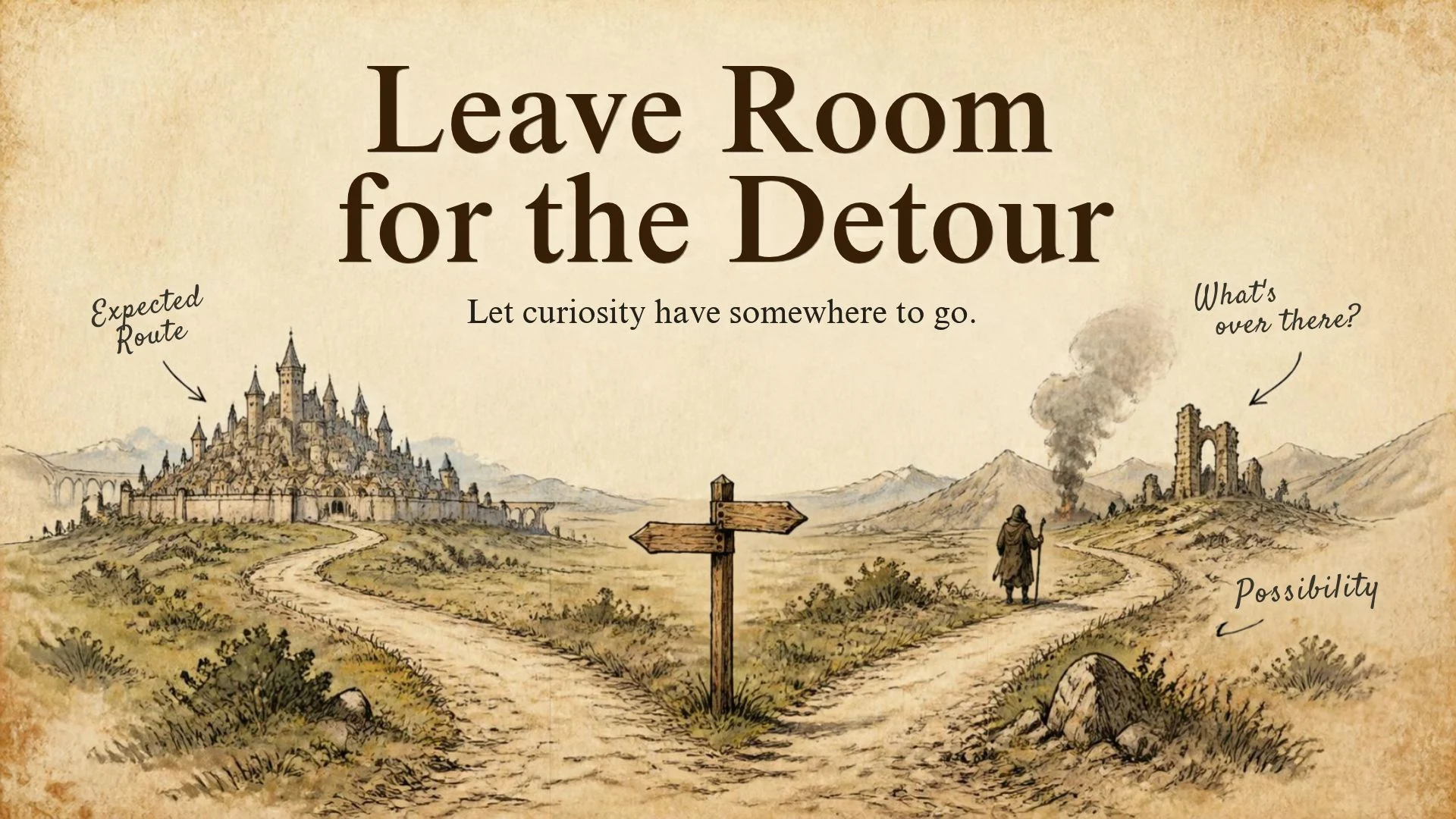
A trail through the woods might be just as interesting as the road toward the castle.
Smoke on the horizon might seem more important than the merchant waiting in town.
A traveler heading in the opposite direction might become more interesting than the person they were supposed to meet.
That's not necessarily the players abandoning the story.
It may be the players telling us where they think the story is.
The World Should Survive a Wrong Turn
If every interesting encounter exists only along the path we expect players to follow, then an unexpected choice creates a problem.
Nothing is there.
The Game Master has to force everyone back toward the prepared material or invent something from nothing.
There is another option.
Prepare possibilities rather than routes.
A roadside encounter doesn't necessarily belong to a particular road.
An abandoned shrine doesn't have to exist at one exact coordinate.
A frightened traveler can appear wherever travel makes sense.
A ruined farmhouse might be discovered when the players decide to leave the road.
These aren't necessarily complete adventures.
They're pieces of possibility.
Prepare Situations, Not Scripts
A useful encounter doesn't need three pages of boxed text.
Sometimes a few lines are enough.
What is happening?
Who or what is involved?
What makes the situation interesting?
What happens if the players ignore it?
Imagine this:
A wagon sits crooked beside the road.
One wheel is broken.
The merchant standing beside it insists nothing is wrong.
There are scratches on the inside of the wagon.
That's enough.
I don't necessarily need to know what the players will do.
Maybe they stop.
Maybe they don't.
Maybe they question the merchant.
Maybe someone looks inside the wagon.
Maybe they decide the whole thing looks suspicious and ride away.
The situation creates possibilities without requiring a predetermined outcome.
Give Curiosity Somewhere to Go
Players notice things.
That sounds obvious, but it has an important consequence for worldbuilding.
If I describe a tower in the distance, someone may eventually want to visit it.
If I mention a strange trail, someone may follow it.
If a traveler refuses to explain where he came from, the players may decide that question is suddenly the most important mystery in the campaign.
Description creates possibility.
That doesn't mean every tree needs a dungeon underneath it.
It means we should be careful about presenting something as interesting and then making curiosity feel like a mistake.
If the players investigate, give them something.
Information.
A person.
A complication.
A view of the world.
A resource.
A mystery.
A danger.
Sometimes the reward for exploration is simply discovering that something exists.
Not Every Detour Needs to Become a Quest
This is important.
If every strange traveler secretly starts a quest, players learn that everything unusual is a hook.
The world begins to feel constructed around them.
Sometimes the abandoned cottage really is abandoned.
But perhaps someone lived there once.
There are children's marks scratched into a doorframe.
A rusted tool hangs beside the hearth.
Wildflowers have overtaken what used to be a garden.
Nothing attacks.
Nobody asks for help.
There is no treasure chest hidden beneath the floor.
The players simply found evidence that someone once lived there.
That can be enough.
A world feels larger when not everything exists for the adventurers.
Let Small Encounters Become Large Ones
The opposite can also happen.
Something intended as a five-minute roadside encounter catches the players' attention.
They become fascinated by the merchant.
They want to know who damaged the wagon.
They follow the tracks.
They discover something you hadn't expected to become important.
This is where sandbox play becomes interesting.
You don't necessarily need to pull them back toward the original adventure.
Follow the energy.
The little encounter can grow.
The detour can become the story.
Reuse What the Players Never Saw
Preparation doesn't have to be wasted.
Suppose you prepared an abandoned watchtower east of town, but the players traveled west.
They never knew where the tower was.
Move it.
That isn't cheating.
The world exists in the players' experience, not in the pile of notes sitting behind the Game Master's screen.
Until something becomes established through play, much of your preparation remains flexible.
The same is true of encounters, rumors, travelers, weather, discoveries, and complications.
Prepare material that can move.
It makes improvisation much easier.
Build Connections Instead of Tracks
A railroad tells the players where the story must go.
A sandbox gives them places that connect to other places.
Those connections are more useful than a predetermined sequence.
The ruined shrine may connect to a local religion.
The religion connects to a nearby settlement.
The settlement has a dispute with another community.
The dispute involves an old road.
The road passes through dangerous territory.
Now the players aren't following a script.
They're moving through relationships.
Every decision reveals another part of the world.
Consequences Make Choices Matter
Freedom without consequence isn't much of a sandbox either.
If the players choose the detour, something else may continue without them.
The merchant they were supposed to meet leaves town.
The storm reaches the mountain pass.
Someone else finds the artifact.
The village prepares for the approaching army.
The world shouldn't punish players for exploring.
But it also shouldn't freeze while they do it.
Choices become meaningful when choosing one possibility means allowing another to change.
You Don't Need to Build Everything
A sandbox doesn't require preparing an entire continent before the first session.
That way lies madness.
Instead, prepare enough material that you can answer the next interesting question.
What's beyond the hill?
Enough to answer.
Who lives in that village?
Enough to answer.
Where does this road go?
Enough to answer.
What happens if we follow those tracks?
Enough to begin.
You can build the next layer when the players show you where they're going.
Leave Room
Good preparation gives the Game Master confidence.
Too much preparation can quietly become an expectation.
I built this encounter, therefore the players should encounter it.
I wrote this character, therefore the players should meet them.
I created this dungeon, therefore the players should enter it.
But preparation doesn't have to tell the players where to go.
It can make sure something interesting happens wherever they decide to go.
Keep a traveler ready.
Keep a strange place nearby.
Keep a rumor you haven't assigned to anyone yet.
Keep a complication that can enter when the journey becomes too comfortable.
And when the players look at the carefully prepared road north and decide to turn west instead—
let them.
There might be something interesting down that road too.
Leave room for the detour.