Start With The Decision
When we design magical equipment, it's easy to begin with the benefit.
How powerful is it?
What bonus does it provide?
How often can the character use it?
Those questions matter. They help the item fit the rules of the game.
But they don't necessarily tell us what happens around the table.
Try another question first.
When would the player hesitate?
If the answer is never, the item may still be useful. But using it probably doesn't create much of a choice.
A meaningful cost gives the player a reason to think.
Not because the Game Master wants to make possession unpleasant.
Because something desirable becomes more interesting when pursuing it asks something of us.
A Cost Can Be More Than A Price
Gold is an obvious cost.
Spend money. Receive power.
That can work, especially when the party needs the same money for food, travel, repairs, or another purpose.
But an item's cost can also involve time, opportunity, obligation, or exposure.
Imagine a lantern that reveals a hidden path but also makes its bearer visible to something watching from the darkness.
Or a charm that helps its owner hear a distant conversation, but requires them to remain still while their companions keep moving.
Or a relic whose use creates an obligation to someone the character would rather avoid.
Each imagined item gives its owner something useful to weigh against what it asks.
The point is that a cost changes the circumstances of a decision.
What do we gain?
What do we give up?
Who else becomes involved?
What Makes The Power Tempting?
A cost alone doesn't create an interesting item.
The benefit has to matter too.
If the power is trivial and the price is enormous, the decision may be easy.
Don't use it.
If the power solves every problem and the price is negligible, the decision may be equally easy.
Use it whenever possible.
Somewhere between those extremes is a more interesting space.
The players can see why they might want the power.
They can also see why they might wait.
Perhaps the lantern offers a way through dangerous terrain, but lighting it makes a quiet journey impossible.
Perhaps the party can reach its destination without the relic, but doing so takes time they may not have.
Now the object is part of the situation.
Its value depends on what is happening.
Let The Player Understand The Choice
An unexpected consequence can create a memorable discovery.
But a meaningful choice needs enough information to be a choice.
If the player has no reason to suspect that activating an item carries a cost, the first consequence is a revelation.
It isn't yet a tradeoff they knowingly accepted.
That distinction matters.
A mysterious relic can remain mysterious while still offering clues.
A warning carved into the clasp.
A story about its previous owner.
A visible change after its first use.
Someone who recognizes it and suddenly becomes cautious.
The players don't need to know everything.
They need enough to decide what they are willing to risk, investigate, or offer.
Consequences Should Connect To The World
An item's cost becomes more interesting when it connects to something beyond the item itself.
Suppose using a relic requires an offering.
Where does that offering come from?
What else might the character have done with it?
Does anyone care that it was given?
Does the act reveal something about the person making it?
You don't need to answer every question before play.
But these questions give the object somewhere to connect.
A possession can become part of a relationship. The person who asks for an offering can have beliefs and ordinary concerns of their own—the same approach explored in Give the NPC a Life.
A resource can become part of a promise.
A decision made during a difficult journey can matter again when the party returns home.
The item begins to belong to the world.
That connection is also part of leaving room for player choice: Leave Room for the Detour.
Not Every Magical Item Needs A Burden
Sometimes a useful sword should simply be a useful sword.
Not every discovery needs a hidden price.
If every gift becomes a trap, players may stop feeling excited when they find something valuable.
They may learn that accepting anything is a mistake.
That isn't the experience I'm describing.
A gift with a cost should offer a real possibility.
The player should be able to decide that the benefit is worth what it asks.
They should also be able to decide that it isn't.
Both decisions should remain playable.
Let The Answer Change
An item can become more interesting when the same player answers its question differently at different times.
Early in the campaign, the cost seems easy to pay.
Later, circumstances change.
The resource becomes scarce.
A relationship becomes important.
The character makes a promise.
The party finds another way to solve the problem.
Nothing about the item necessarily changed.
The world around it did.
That is one reason an object can remain interesting after its mechanical novelty wears off.
Its meaning develops through use.
A Small Design Check
Before adding an important item to the game, try answering five questions:
What does it make possible?
What does using it ask of its owner?
What can the player reasonably know about that cost?
When might using it be worth the price?
When might refusing it be the better choice?
If using the item is always the better answer, look again at the situations in which it will appear.
You may need a more useful benefit.
A more meaningful cost.
Or simply a world that gives the player more than one reason to act.
Give The Object Something To Ask
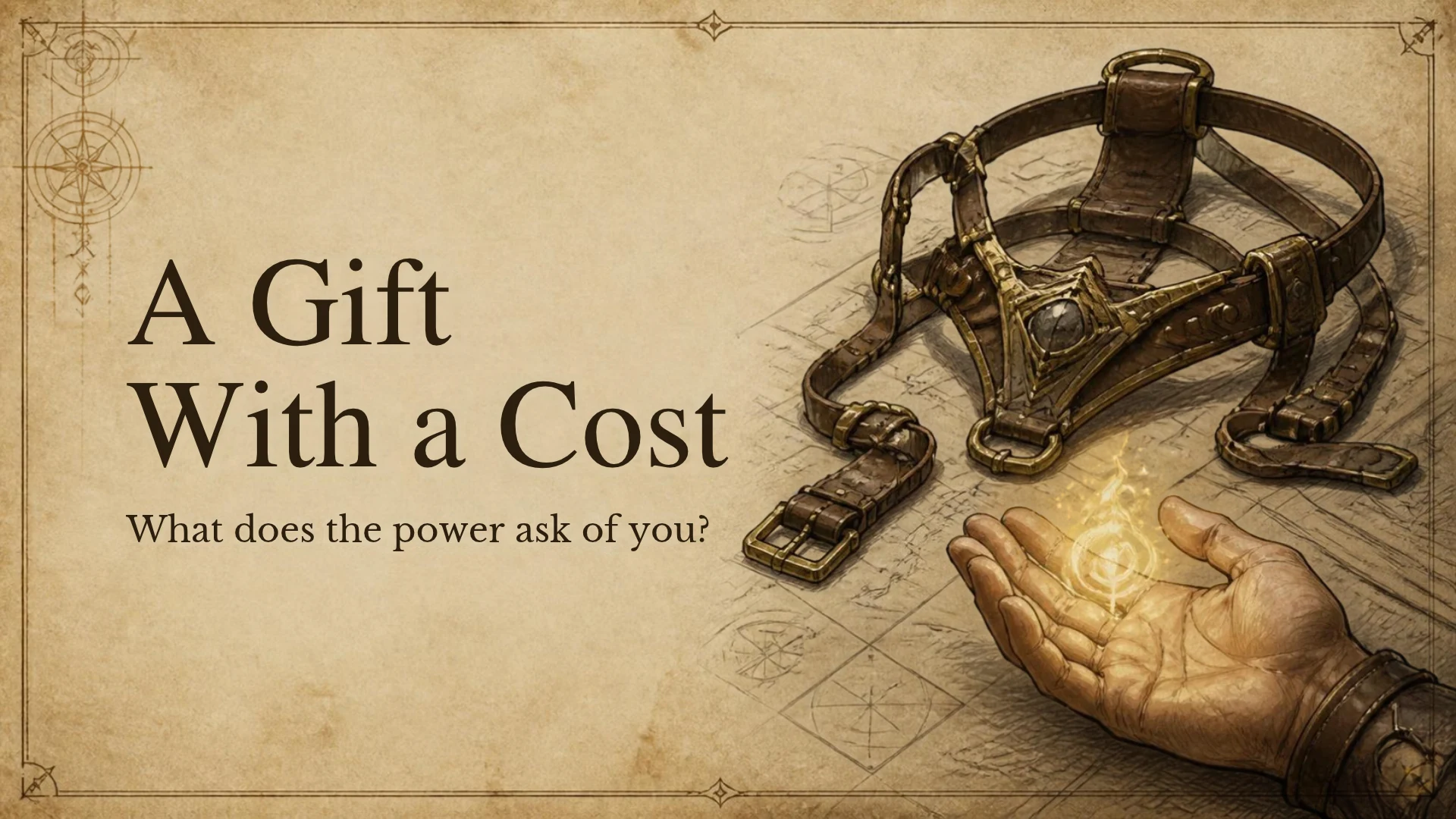
The Harness of the Seeker gave its owner an advantage, but the offering made that advantage something to consider.
That is the idea I want to carry forward.
A memorable object doesn't have to provide the largest bonus at the table.
It can offer temptation.
Create an obligation.
Complicate a journey.
Reveal what a character values.
Give the players something powerful.
Then give that power a question.
What are you willing to give for it?