Watch: How to Read an OSHA Standard
This article expands the video’s introduction with a citation breakdown and a practical reading process.
What Is an OSHA Standard?
An OSHA standard is an enforceable workplace safety or health regulation. Depending on the subject, it may establish requirements for equipment, protective measures, work practices, training, or other employer responsibilities.
The Occupational Safety and Health Act provides authority for issuing, modifying, and revoking occupational safety and health standards. These requirements serve a different purpose from optional recommendations or general educational guidance.
What Does CFR Mean?
CFR stands for Code of Federal Regulations. It organizes the general and permanent rules issued by federal agencies into 50 titles covering broad subject areas.
Titles contain chapters, chapters contain parts, and larger parts may contain subparts. Parts are organized into sections.
OSHA’s regulations appear in Title 29—Labor, Chapter XVII—Occupational Safety and Health Administration, Department of Labor.
How to Decode an OSHA Citation
Consider the example used in the video:
29 CFR 1910.146(c)(5)(ii)(G)(3)
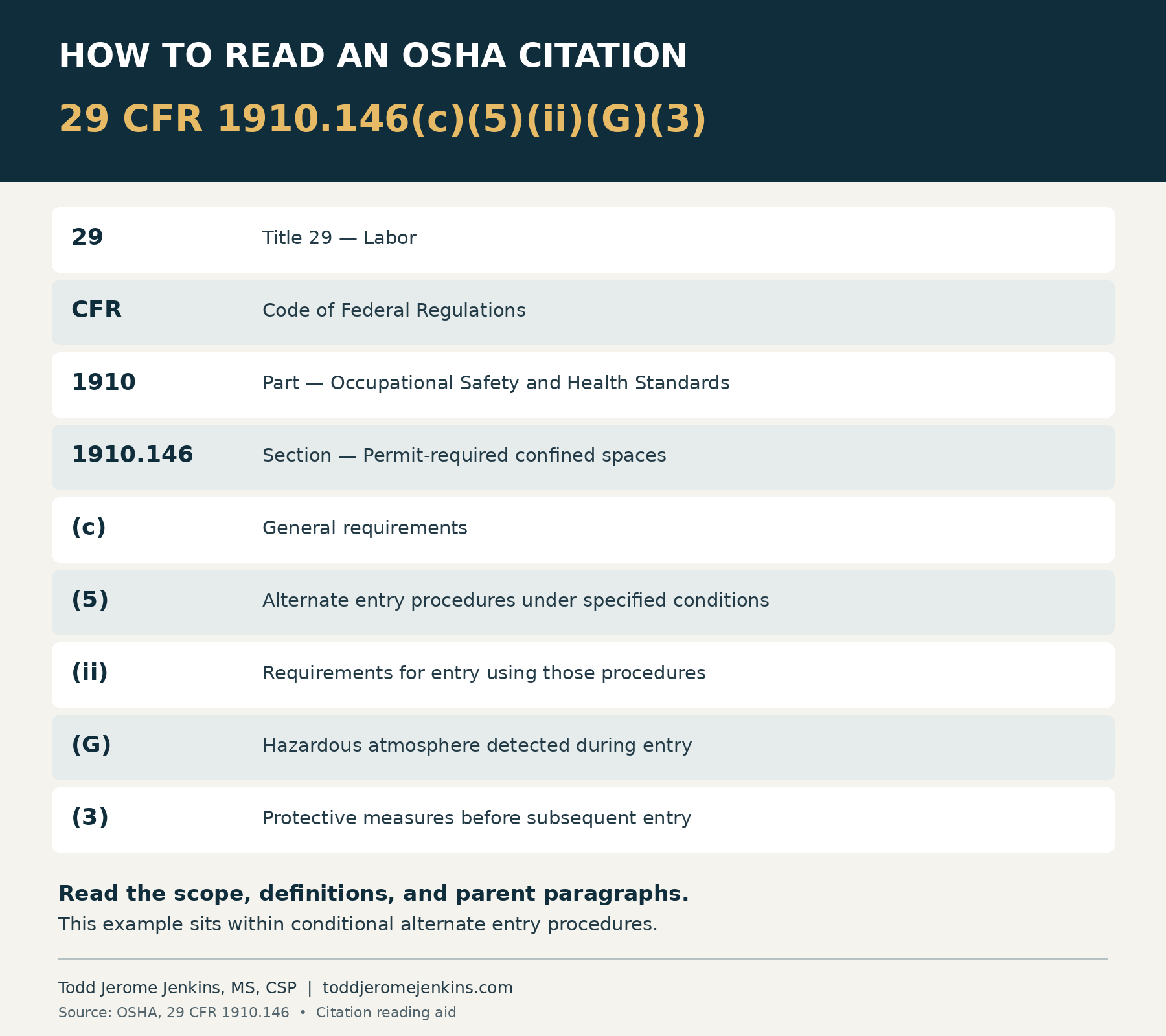
| Citation element | What it identifies |
|---|---|
| 29 | Title 29—Labor |
| CFR | Code of Federal Regulations |
| 1910 | Part 1910—Occupational Safety and Health Standards |
| 1910.146 | Section 1910.146—Permit-required confined spaces |
| (c) | General requirements |
| (5) | The provision allowing alternate entry procedures under specified conditions |
| (ii) | Requirements for entry under those procedures |
| (G) | Actions required when a hazardous atmosphere is detected during entry |
| (3) | Protective measures required before subsequent entry |
The 146 identifies the section within Part 1910. Subpart J—General Environmental Controls is the broader grouping containing this section. Subpart letters are not normally included in the section citation.
Read the citation from left to right, moving from the broader location to the specific provision.
Understand the Letters and Numbers
Nested paragraphs commonly follow this sequence:
(a) → (1) → (i) → (A) → (1) → (i)
The sequence uses lowercase letters, numbers, lowercase Roman numerals, uppercase letters, and then additional numbered and Roman-numeral levels. Formatting helps distinguish deeper levels.
You do not need to memorize every level. Follow the labels displayed in the regulation and preserve them when recording a citation.
Read the Surrounding Requirements
Finding the final paragraph is only the beginning.
In this example, paragraph (G)(3) requires protective measures before employees enter again following detection of a hazardous atmosphere. The surrounding provisions require employees to leave immediately and the space to be evaluated.
These provisions sit within alternate entry procedures that have specific eligibility conditions. Section 1910.146 also states that it does not apply to construction, agriculture, or shipyard employment. A sentence taken out of context can therefore lead to an incorrect conclusion about applicability.
A Practical Process for Reading a Standard
Use the following approach when researching a requirement:
- Describe the work. Identify the activity, equipment, hazard, and work setting.
- Locate the relevant regulation. Use OSHA’s standards pages or the eCFR rather than relying on a search-result excerpt.
- Read the scope and application. Check whether the provision covers the work you are researching.
- Review definitions. A defined term may have a more specific meaning than its everyday use.
- Read the parent paragraphs. Look for conditions, exceptions, and requirements that govern the paragraph you found.
- Follow cross-references. Review other provisions and appendices that the standard directs you to use.
- Record the complete citation. Include enough detail for another person to locate the same requirement.
- Translate the requirement into action. Identify who must do what, when it must happen, and how implementation will be checked.
For historical research, use the version applicable to the date being examined. The annual CFR and the regularly updated eCFR serve different reference needs.
Check State Requirements
Determine whether federal OSHA or an OSHA-approved State Plan covers the workplace. State Plans must be at least as effective as federal OSHA, and their requirements may differ. Check the applicable state program when researching obligations.
Put the Requirement to Work
Reading a standard should help you make a concrete decision about the job.
Ask: What does this provision require, under what conditions, and how will we put it into practice?
Then connect the applicable requirements to work planning, equipment selection, training, and the controls identified in your job safety analysis.