Watch: What Is an OSHA Competent Person?
This article expands the video’s introduction. Requirements depend on the applicable standard and the specific operation.
What Does “Competent Person” Mean?
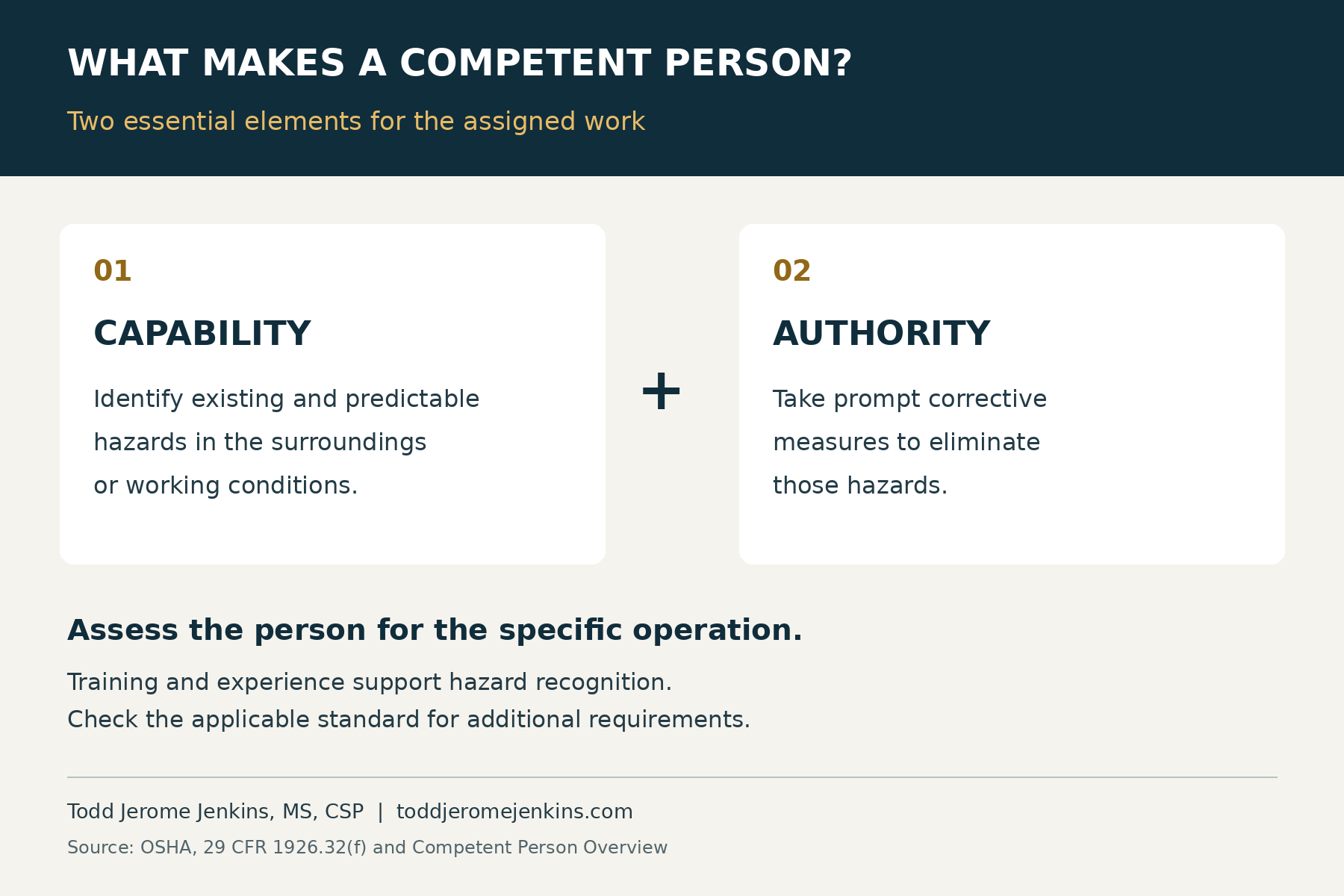
Under 29 CFR 1926.32(f), the construction definition has two essential elements:
- The ability to identify existing and predictable conditions that could endanger employees.
- Authorization to take prompt corrective measures to eliminate those hazards.
The definition addresses what the person can recognize and what they are empowered to do.
OSHA explains that training and/or experience provide the knowledge needed to understand applicable standards and identify hazards in the specific operation. Some standards establish additional requirements.
Competence Applies to Specific Work
Ask “Competent for which operation?” when assigning the role.
Someone with the knowledge to inspect a particular scaffold may need different training and experience before evaluating excavation hazards or performing shipyard atmospheric testing. Evaluate capability against the duties and hazards of the assignment.
A useful employer assessment asks whether the person can:
- Explain the applicable requirements.
- Recognize relevant hazards in actual working conditions.
- Identify changes that require reassessment.
- Select or direct appropriate corrective action.
- Recognize when additional expertise is needed.
Competent, Qualified, and Authorized: What Is the Difference?
These terms describe different requirements.
| Term | Meaning in the construction definitions |
|---|---|
| Competent person | Can identify existing and predictable hazards and has authority to take prompt corrective measures. |
| Qualified person | Has demonstrated the ability to solve problems related to the subject, work, or project through recognized credentials or extensive knowledge, training, and experience. |
| Authorized person | Has employer approval or assignment to perform specified duties or be at specified jobsite locations. |
A person may meet more than one definition. Employer authorization alone does not establish the required technical capability.
The scaffold standard illustrates the distinction: 1926.451(a)(6) requires a qualified person to design scaffolds, while 1926.451(f)(3) assigns inspections for visible defects to a competent person.
Does a Training Certificate Make Someone Competent?
A certificate can document training. The employer must still evaluate whether the person can identify the relevant hazards and has authority to correct them.
The general construction definition does not establish a universal certification exam or a fixed number of years of experience. Check the specific standard for additional requirements.
For example, shipyard requirements in 1915.7 address specific skills, designation, and records. They include the ability to use testing equipment and accurately interpret its results.
Authority Must Work in Practice
The employer should make the person’s authority clear to everyone involved.
As a practical implementation approach, define:
- When the person can stop the affected work or remove employees from exposure.
- How defective equipment will be isolated.
- Who will arrange repairs or other corrective measures.
- How unresolved issues will be escalated.
- What must be verified before work resumes.
These arrangements help make the required authority usable. A designation should be supported by the resources and organizational backing needed to act promptly.
When Is a Competent Person Required?
Read the standard covering the work. Duties and inspection timing vary.
The following examples are a starting point, rather than a complete list:
| Work or activity | Example requirement | Reference |
|---|---|---|
| Excavations | Inspect daily, before work, as needed during the shift, and after rainstorms or other events that increase hazards, when employee exposure can reasonably be anticipated. | 1926.651(k)(1) |
| Scaffolds | Inspect scaffolds and components for visible defects before each work shift and after events that could affect structural integrity. | 1926.451(f)(3) |
| Scaffold erection, moving, dismantling, or alteration | Use supervision and direction by a competent person qualified in those activities. | 1926.451(f)(7) |
| Shipyard operations covered by 1915.7 | Meet the applicable designation, skill, knowledge, and recordkeeping requirements. | 1915.7 |
Review the full provisions and their context before applying them.
OSHA’s competent-person standards page provides links across industry categories. Use it to locate requirements relevant to the operation.
Example: Conditions Change After Rain
An excavation was inspected before the shift. A rainstorm then changes conditions.
Under 1926.651(k), the inspection requirements include reassessment after rainstorms. If the competent person finds hazardous conditions, exposed employees must be removed until necessary precautions have been taken.
The initial inspection does not resolve hazards introduced later in the day.
Make the Assignment Clear
As a practical management record, document the person’s assigned scope, relevant training and experience, corrective authority, and required duties. Follow any specific documentation requirements in the applicable standard.
Before work begins, confirm:
Who is responsible, what are they competent to assess, and what can they do when they find a hazard?
Connect that assignment to the job safety analysis, and use the OSHA standards reading guide to check the governing provisions.