Selected excerpts from Module 1: The supervisor’s role in the safety system.
Frontline Safety Supervisor Foundations · Instructor kit in preparation
A look inside the developing kit
Explore five teaching slides, one instructor-notes example, and an ungraded practice worksheet. No account is needed.
The full kit is not yet available for purchase. This excerpt is not a complete course and does not award an Academy certificate. Timing shown in the materials is a planning estimate.
Selected teaching slides
Original slide numbers are retained. Readable slide text accompanies each image.
Slide 1
Read slide 1 text
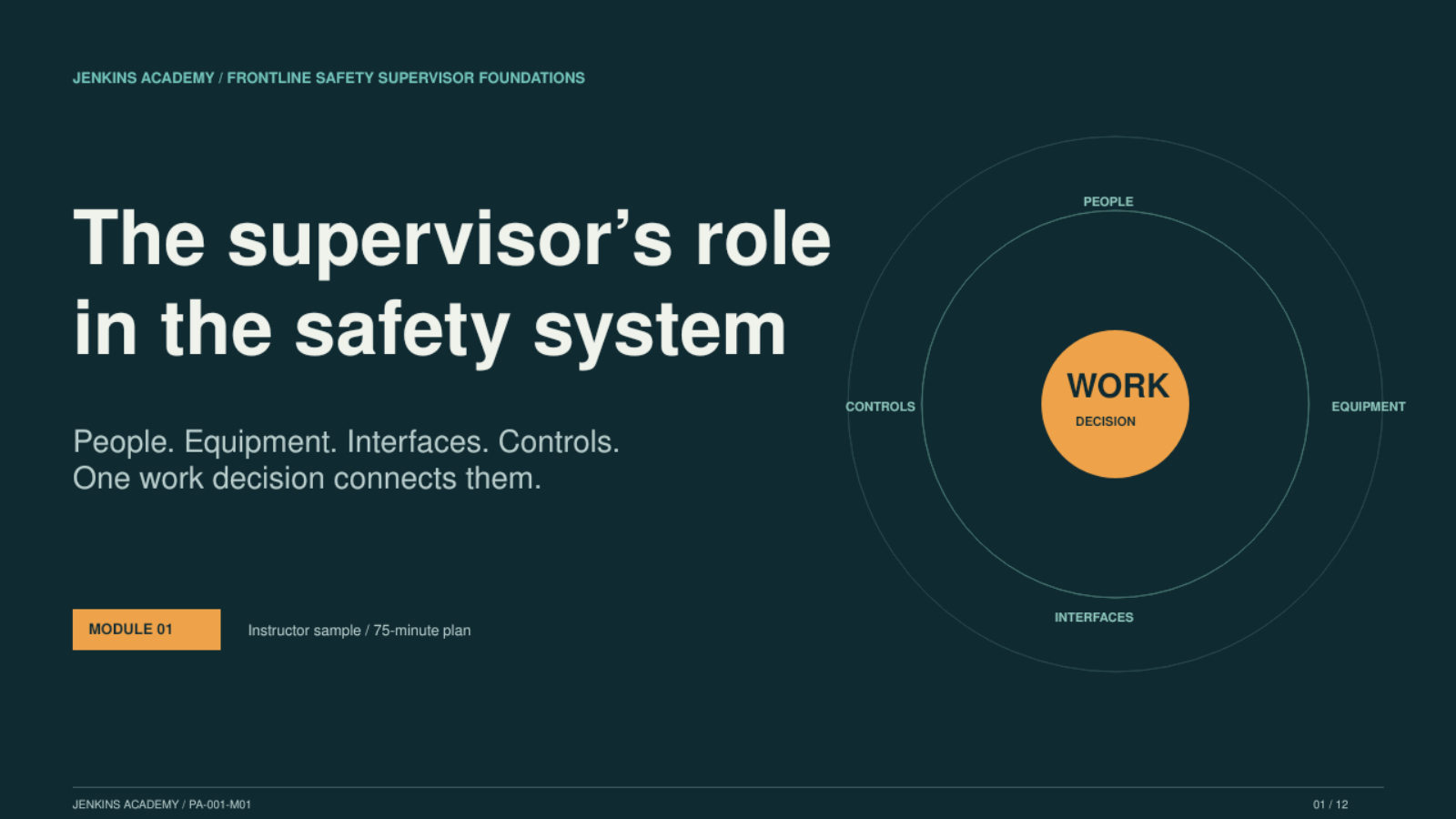
JENKINS ACADEMY / FRONTLINE SAFETY SUPERVISOR FOUNDATIONS
JENKINS ACADEMY / PA-001-M01
01 / 12
The supervisor’s role
in the safety system
People. Equipment. Interfaces. Controls.
One work decision connects them.
MODULE 01
Instructor sample / 75-minute plan
WORK
DECISION
PEOPLE
EQUIPMENT
INTERFACES
CONTROLS
Slide 2
Read slide 2 text
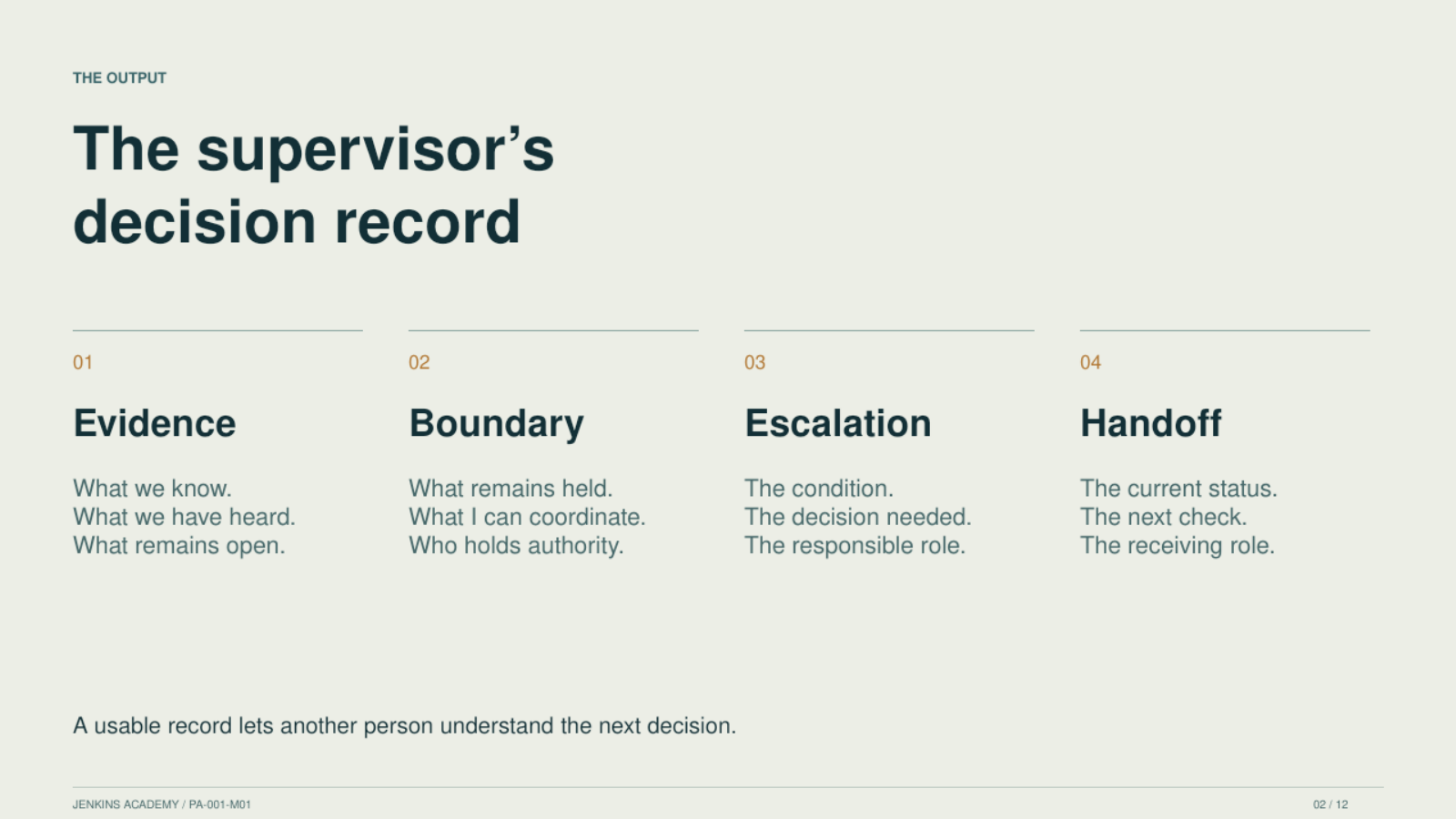
THE OUTPUT
The supervisor’s
decision record
JENKINS ACADEMY / PA-001-M01
02 / 12
01
Evidence
What we know.
What we have heard.
What remains open.
02
Boundary
What remains held.
What I can coordinate.
Who holds authority.
03
Escalation
The condition.
The decision needed.
The responsible role.
04
Handoff
The current status.
The next check.
The receiving role.
A usable record lets another person understand the next decision.
Slide 3
Read slide 3 text
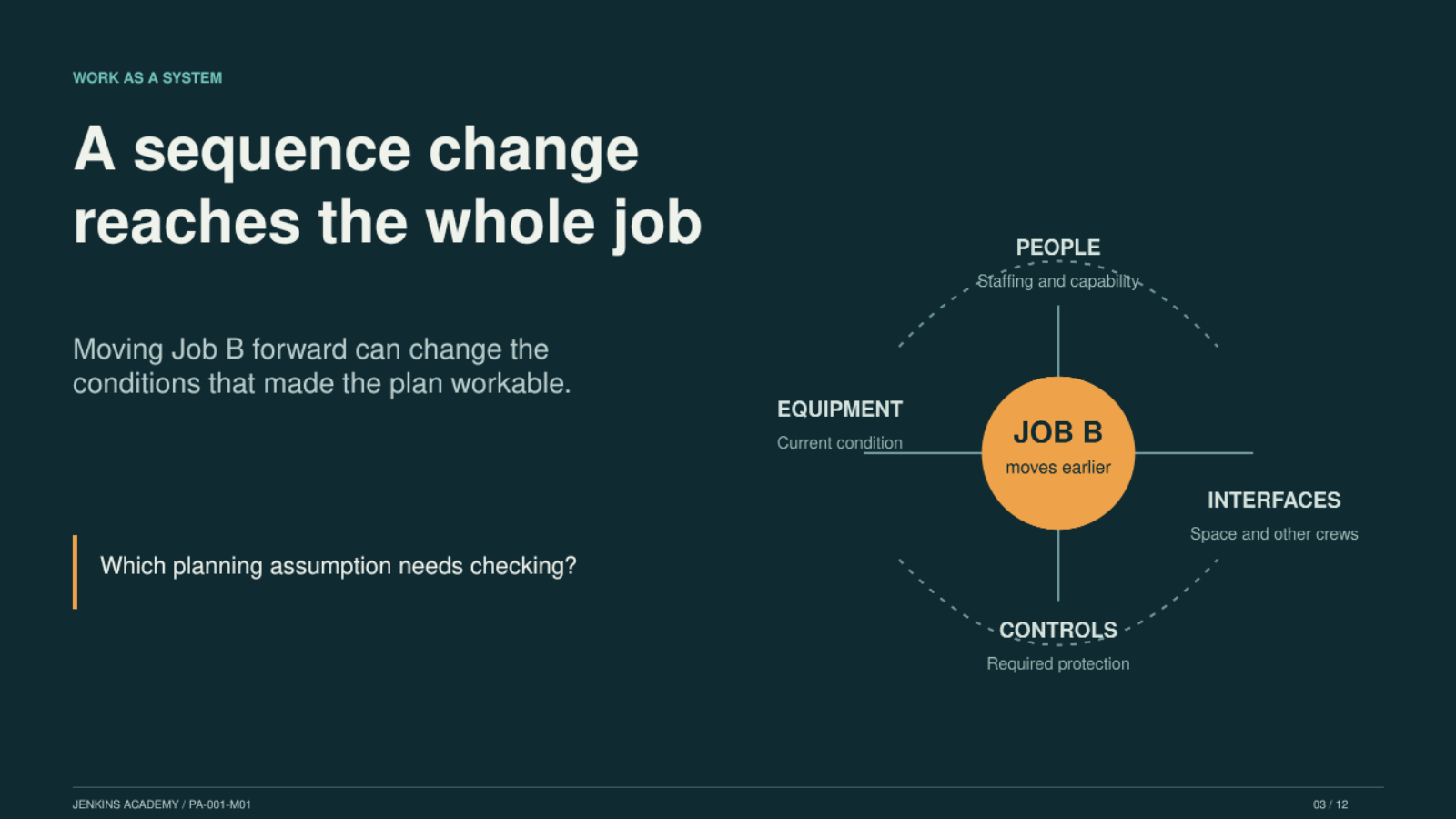
WORK AS A SYSTEM
A sequence change
reaches the whole job
JENKINS ACADEMY / PA-001-M01
03 / 12
Moving Job B forward can change the conditions that made the plan workable.
Which planning assumption needs checking?
Slide 6
Read slide 6 text
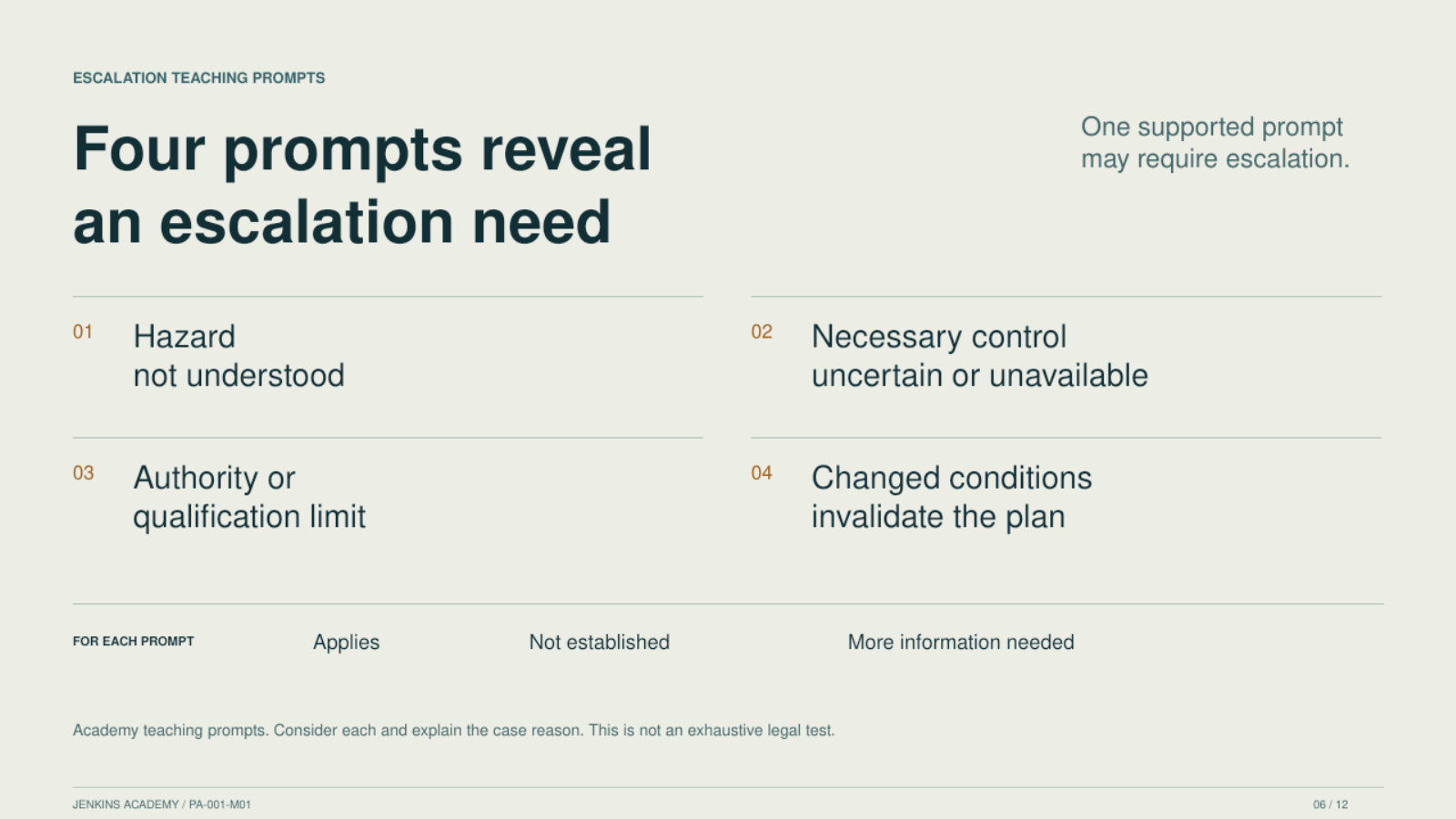
ESCALATION TEACHING PROMPTS
Four prompts reveal
an escalation need
JENKINS ACADEMY / PA-001-M01
06 / 12
One supported prompt may require escalation.
01
Hazard
not understood
02
Necessary control
uncertain or unavailable
03
Authority or
qualification limit
04
Changed conditions
invalidate the plan
FOR EACH PROMPT
Applies
Not established
More information needed
Academy teaching prompts. Consider each and explain the case reason. This is not an exhaustive legal test.
Slide 9
Read slide 9 text
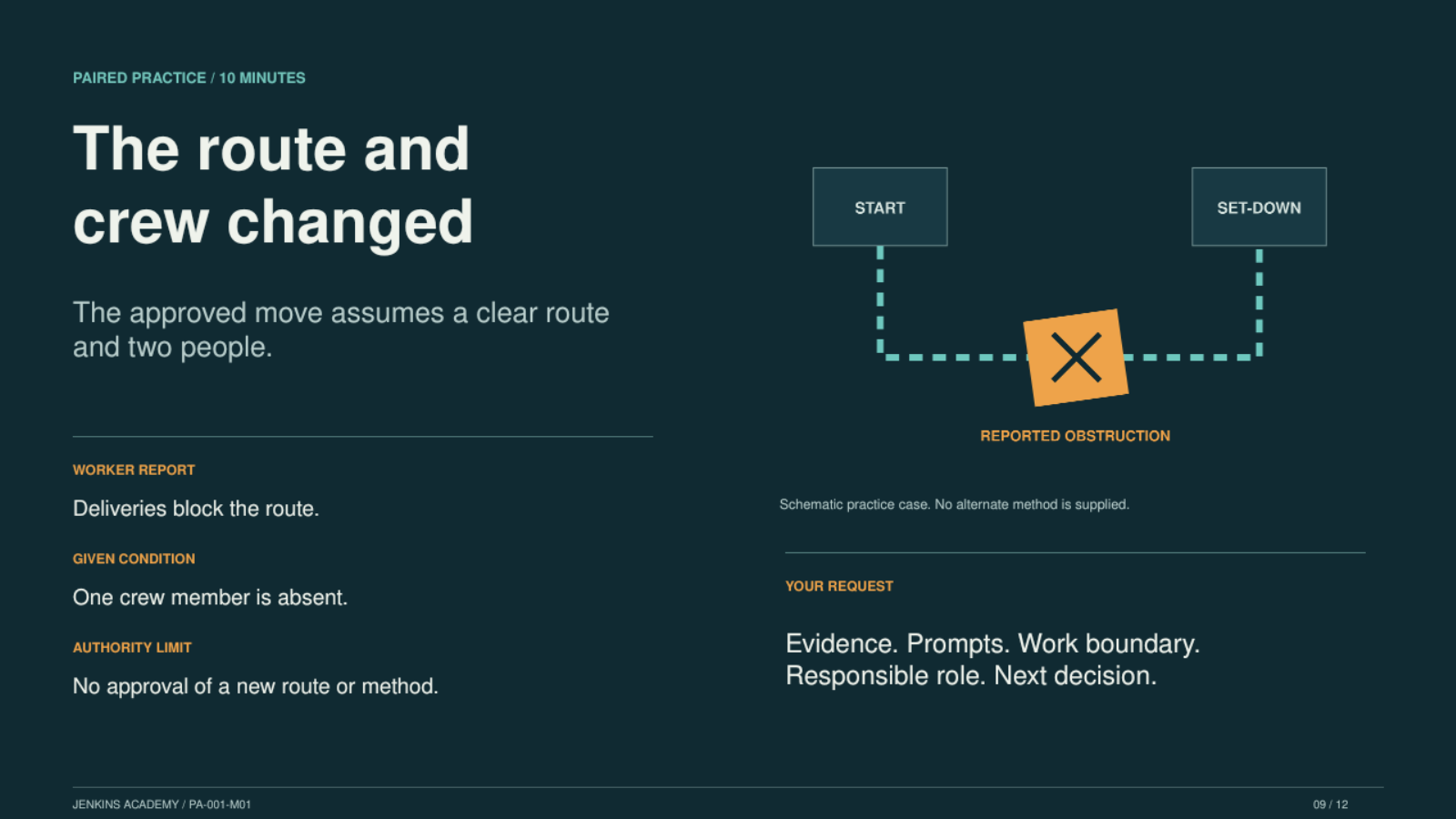
PAIRED PRACTICE / 10 MINUTES
The route and
crew changed
JENKINS ACADEMY / PA-001-M01
09 / 12
The approved move assumes a clear route and two people.
WORKER REPORT
Deliveries block the route.
GIVEN CONDITION
One crew member is absent.
AUTHORITY LIMIT
No approval of a new route or method.
Schematic practice case. No alternate method is supplied.
YOUR REQUEST
Evidence. Prompts. Work boundary.
Responsible role. Next decision.
Behind the teaching
Instructor notes: Slide 3
This example shows how an instructor can explain the system relationships, invite discussion, and respond to misunderstandings.
Slide 3. A sequence change reaches the whole job
M01-O1 · 3 minutes planned
INSTRUCTOR PREPARATION AND DELIVERY Sample v0.2
What this slide teaches
Teach the systems relationship among people, equipment, interfaces and controls through an ordinary planning decision.
Understand the subject before teaching it
People include staffing, task-specific capability, information and the roles assigned to the job. Equipment includes condition, availability and the protective features the approved method assumes. Interfaces include places where tasks, crews, contractors, routes or shifts overlap. Controls are the measures required to prevent or reduce the relevant exposure.
A production choice can affect several of these relationships at once. For example, moving one job earlier might place two crews in the same space, change access to a route or leave the expected support person unavailable. The original method may have depended on a condition that is no longer true.
Change does not automatically prove that a task is unsafe. It gives the supervisor a reason to check whether the assumptions supporting the approved plan still hold. When a necessary condition is uncertain or the decision exceeds assigned authority, the supervisor uses the established restriction and review route rather than treating an earlier signature as proof of current suitability.
Suggested spoken explanation
“Suppose you bring Job B forward because its material arrives early. The equipment may be ready, but the area may still be occupied by Job A. The people and access arrangements may also differ from the original plan. Ask what the change does to each relationship. The useful question is: what did the approved plan rely on, and is that still true now?”
How to use the visual
Begin at the central work decision and trace one connection at a time. Use the people, equipment, interfaces and controls labels as prompts, not as four isolated departments. The same changed condition may affect more than one relationship.
Question to ask
“If we swap the order of two jobs, what is one assumption that might need checking?”
What to listen for
Accept staffing availability, authorized operators, shared access, equipment condition, required controls, simultaneous work and communication. Ask the learner to explain the connection instead of giving only a category label.
Common misunderstanding and response
If someone says ‘Any change means shut down the whole site,’ distinguish the affected work from unrelated work and use the site process. If someone says ‘The procedure is signed,’ ask whether that signature establishes the current staffing, route and interfaces. Avoid prescribing an alternative technical method.
Pacing and delivery
Use about 90 seconds for the example, 60 seconds for discussion and 30 seconds to connect the answers.
Transition to the next activity
“To check those assumptions well, we need to keep facts, reports and unknowns distinct.”
Ungraded / Paired practice
The route and crew changed
Adapted public excerpt from the Module 1 participant workbook. Allow about 10 minutes for practice.
The approved move assumes a clear route and a two-person crew. A worker reports that deliveries now block the route; one crew member is absent. The supervisor cannot approve a new route or handling method. No alternative method is supplied.
Work with a partner. Identify facts, reports, and unknowns. Consider the four escalation prompts from slide 6 above, state the affected-work boundary, and draft the next request. This practice is ungraded.
What is given or reported, and what remains unknown?
Which escalation prompts matter, and why?
What remains restricted, and which role owns the next decision?
Draft a short escalation request.
Use your own paper or your browser’s Print command to work through these prompts. No responses are submitted or stored by this page.
Follow the kit’s release
Final contents, price, and instructor-use terms will be published before purchase opens.