

Confirm your role and local work limits
Learning objective: Know the assignment, the local contacts and what must be confirmed before work.
Workplace safety in education
Sector 61 includes schools, colleges, universities, training centers, other instruction and educational support services. Public and private workplaces, in-person and online teaching, have different tasks and hazards. This course is for employees, including new instructors and support staff. It is not a student-safety course. Establishments mainly providing child care or vocational rehabilitation are generally in a different sector; the actual service matters.
Choose the closest work setting
The five paths are overlapping examples, not official industry divisions or every job in education. Choose schools; colleges and universities; business, computer and trade schools; other instruction and tutoring; or educational support and visiting staff. A teaching title does not prepare someone for every lab, shop, grounds, transport or student-assistance task.
Check which requirements apply
Most private employees are covered by federal OSHA or an OSHA-approved State Plan. State and local government employees are not covered directly by federal OSHA; OSHA-approved State Plans cover public employees where those plans apply. Other state, local and employer requirements may also apply. Ask the employer which workplace-safety program and reporting route cover your assignment. Do not assume every public school follows the same rules.
Know the supervisor and host
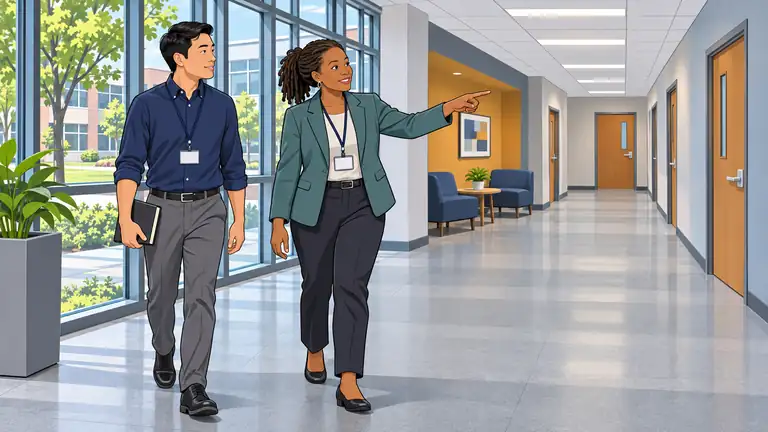
Confirm your duties, permitted areas, supervisor or department lead, and backup. A substitute, temporary employee, contractor or visiting instructor may also need a handoff from the host school or campus. Ask who resolves gaps between the employer and host. A room key, staff badge, timetable or lesson plan is not proof that you are prepared for an unfamiliar task.
Keep the limits clear
This is a general workplace-safety overview for employees in educational services. It does not replace employer, school, campus, host-site or task-specific instruction. It does not provide professional licensing, student safeguarding, mandated-reporting or student-privacy training, student transfer or restraint training, laboratory or shop qualifications, or preparation for medical, first-aid, CPR, AED, security or rescue duties. Equipment, electrical, driving, chemical, restricted-entry and other specialized work require their own preparation and permission. The quiz and worksheet grant no task qualification, student-care authorization or work authorization.
Explain the plan back
Have the responsible person explain the work and, where appropriate, demonstrate it. Repeat the assignment, limits and help route in your own words. Keep the affected task on hold if the instructions, controls or permission are unclear. Required safeguarding and student-support procedures must be learned separately through the employer.
Source context: See the U.S. sources linked in the course resources