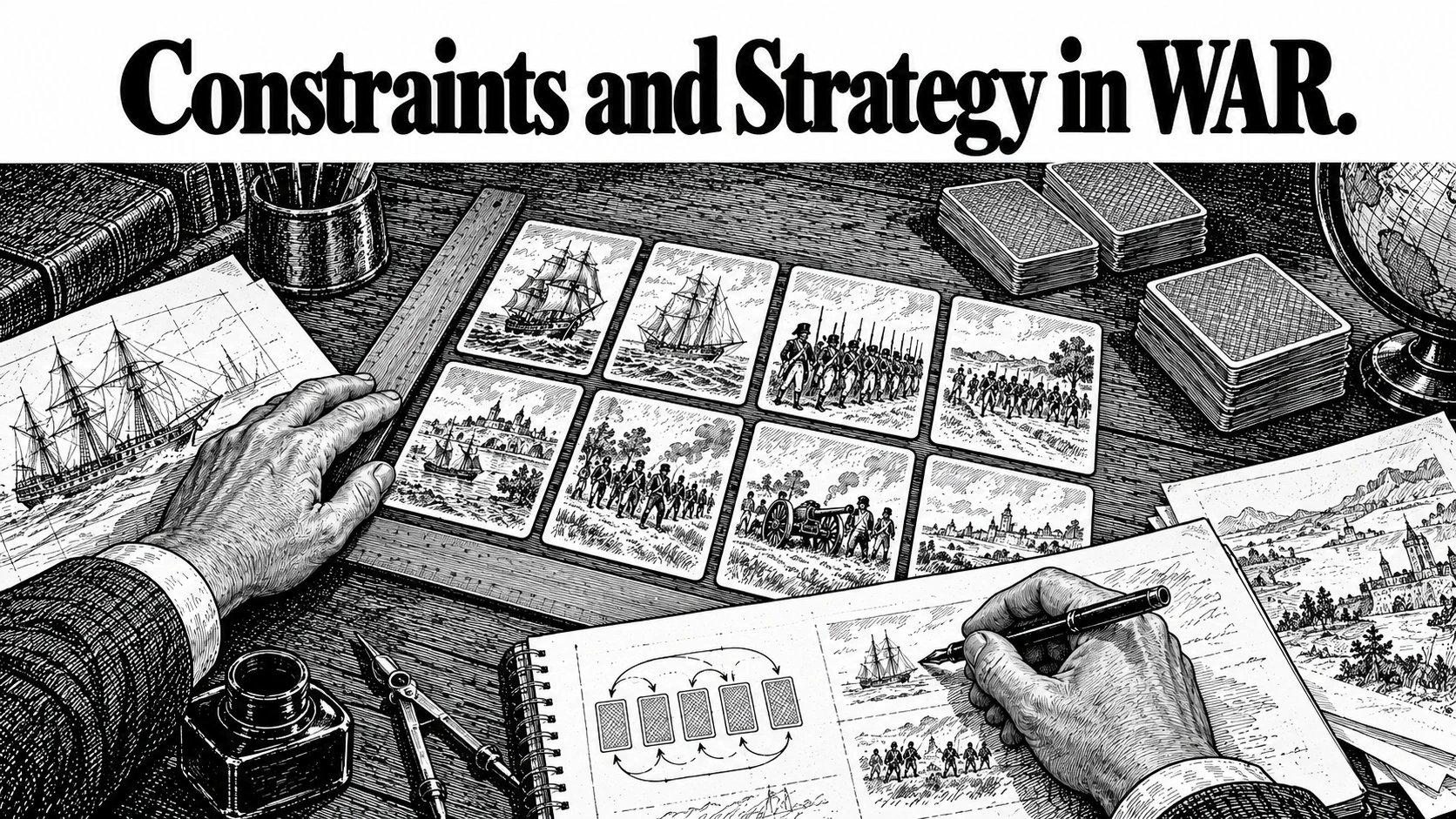
A Constraint Makes a Decision Before Play
A design constraint limits what we will build.
For WAR, familiar reveal-and-compare play is one starting point.
Automatic effects are another.
No deckbuilding.
No choosing which card to reveal.
No deciding whether to activate an effect after seeing the result.
Those limits remove possible features.
They also give the design a clear direction.
A proposed addition has to fit an experience in which the next reveal and the printed conditions drive resolution.
If an effect asks a player to choose a target, discard a card strategically, or save an ability for later, it changes that experience.
It might be an interesting idea for another game.
It would need deliberate review before becoming part of this one.
A constraint is useful when it helps us make those decisions consistently.
There Is Still Something to Follow
A lack of tactical choices does not mean the players cannot pay attention.
They can watch a tie develop.
Recognize a keyword.
Notice that an earlier result left a modifier for the next reveal.
Wonder which card will appear.
React when the comparison changes.
In the online preview, an unresolved highest-score tie continues through additional reveals by the tied players.
The cards already revealed remain part of the prize.
That creates a sequence people can follow.
Who is still in the tie?
What is now at stake?
Will the next reveal settle it?
The suspense concerns an outcome the players are discovering.
It does not require them to control that outcome through a tactical decision.
That is the experience the design should support clearly.
Reading an Effect Is Not Choosing a Move
Consider ESCALATE in the current online preview.
Its bonus applies when the card appears as an additional reveal during a tie.
The player does not hold the card until a favorable moment.
They do not spend a resource to activate it.
The condition either applies or it does not.
Understanding the effect helps the player follow the result.
It does not create a new choice about when to use it.
The same distinction matters for MOMENTUM and FATIGUE.
Their printed triggers can produce a change to the player’s next reveal.
A result can therefore affect what happens afterward.
That continuing relationship gives the sequence something to remember.
But remembering the modifier is rules execution, rather than evidence that the player selected a winning strategy.
We should describe participation accurately.
Uncertainty Is Different From Choice
Before a card is revealed, someone may not know what it will be.
That uncertainty can produce anticipation.
A shuffle changes the order in which cards appear.
Automatic effects can change a comparison.
Those features do not, by themselves, give a player a decision.
A useful question is:
What can the player choose that changes the permitted course of play?
If the answer is that they must reveal the next card and apply its effect, then describing that reveal as a tactical move would be misleading.
Another useful question is:
What can the player understand and respond to as the sequence unfolds?
That answer may include a great deal.
The distinction lets us appreciate anticipation without inventing agency the rules do not offer.
The Designer Works on the Relationships
The designer has decisions to make before the players sit down.
Which effects belong?
Which conditions trigger them?
How many cards occupy each score category?
How should a tie be resolved?
What information must be visible when resolving an effect?
WAR’s 72-card structure uses eight War Score categories, with nine cards in each.
That is a design commitment.
It establishes a framework within which individual cards need to work.
The equal category counts describe the deck’s construction. They do not prove that every shuffle produces an even contest or that every effect contributes equally.
Those relationships still need inspection and testing.
A simple foundation does not remove the need to understand how its parts interact.
Clarity Is Part of the Design
Automatic resolution depends on people knowing what to do.
An effect needs a clear trigger.
A modifier needs a clear duration.
A tie needs a clear procedure.
Two people should be able to read the same situation and arrive at the same required next step.
If they cannot, the designer has work to do.
For example, a domain label should matter when an effect refers to it. Players should not have to invent additional benefits merely because a card says NAVAL or LAND.
Likewise, an effect that changes the next reveal needs to say enough for people to know when that change has been used.
The goal is not to make the players stop noticing the cards.
It is to let them spend their attention on the sequence rather than repeatedly negotiating what the wording means.
Restraint Keeps the Game Recognizable
Historical material offers many tempting additions.
Supply lines.
Terrain.
Diplomacy.
Command decisions.
Technology.
Any of those could become part of a game design.
Adding all of them to WAR would create a different project.
As I discuss in Turning History Into a Card Game: WAR, the historical subject and the mechanical model do different work.
A card can invite interest in an event without reproducing every factor involved in it.
That gives the designer permission to keep the core procedure limited.
It also creates a responsibility to describe that limitation honestly.
The card’s historical subject does not make automatic play into a military simulation.
Test the Experience You Promise
Testing should follow the intended experience.
Can players tell which effect applies?
Can they continue a tie without losing track of the revealed cards?
Do they carry a modifier to the correct reveal?
Do they understand how cards move between piles?
Can they identify the finish used by the edition they are playing?
These are useful observations.
The online preview uses a race to 25 battle wins. That finish belongs to that implementation and should not be assumed to describe every physical edition.
A rules test should use one stated version, rather than mixing procedures from different drafts or formats.
Observing play can also reveal whether the sequence is easy to follow and whether the historical content catches people’s interest.
Those are questions to investigate, not results to claim before the evidence exists.
Choose the Experience Deliberately
The Designer Chooses the Boundary asks what belongs in the model and how its relationships work.
WAR gives that question a practical application.
Its constraints concentrate the game around reveal, comparison, automatic effects, and the sequence that follows.
A different design could give players card selection, resource allocation, or tactical positioning.
Then player strategy would become something to examine directly.
WAR’s identity does not depend on quietly adding those decisions to its description.
It depends on making its chosen experience coherent.
You can explore the illustrated cards and current online rules preview to see that experience in operation.
Design with intention. Describe the choices honestly. Let the game deliver the experience its rules actually support.