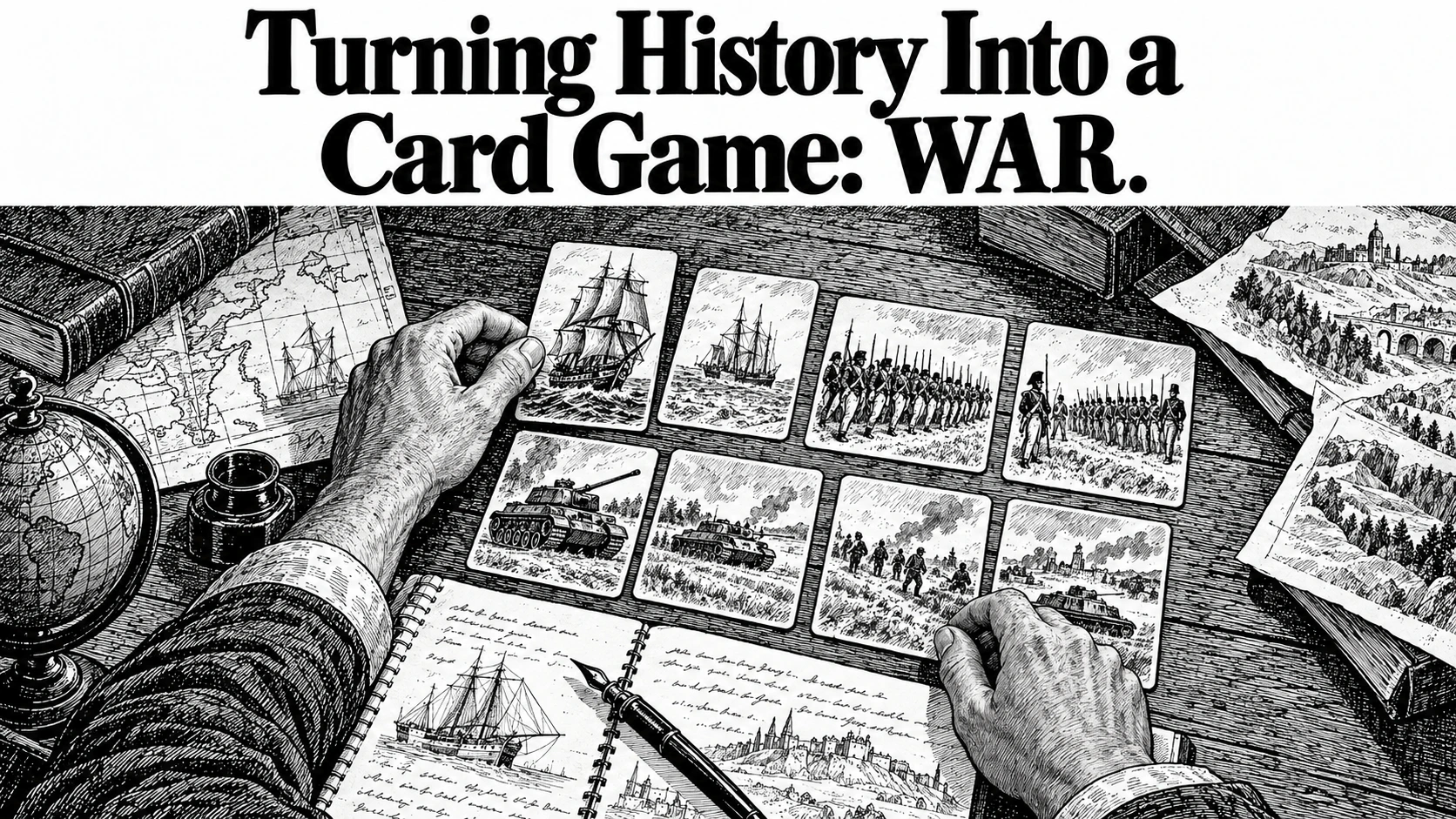
Begin With Something Familiar
WAR begins with the recognizable structure of the classic card game War.
Reveal cards.
Compare them.
Resolve the result.
Continue.
That familiar structure gives the design a starting point.
The player does not have to learn a campaign map, build an army, manage an economy, or choose a diplomatic policy before play begins.
WAR’s effects resolve automatically when their conditions apply.
That is a deliberate limit.
The design concentrates attention on the revealed cards and what follows from them.
There is room for anticipation, surprise, and recognition without requiring a tactical decision at every step.
A game does not have to offer the same kind of participation as every other game.
It does need to be clear about the experience it offers.
Choose a Manageable Historical Scope
The Modern deck uses the period 1500–1945.
That gives the content a defined scope.
It also leaves an enormous amount outside it.
Even within those years, a deck cannot represent every conflict, community, institution, or consequence.
Selecting events is an editorial decision.
So is deciding which kinds of events receive attention.
A list of famous battles can create the impression that history consists mainly of decisive moments on battlefields.
The surrounding conditions still matter.
How did people supply the forces involved?
What made movement possible?
What did geography constrain?
What changed afterward?
Those are useful questions when developing historical content, even when the final card cannot answer all of them.
The scope helps organize the work. It does not make the deck a complete account of the period.
Give the Deck a Structure
WAR’s deck contains 72 cards.
The structure uses eight War Score categories, from 2 through 9, with nine cards in each category.
That arrangement gives the content a consistent mechanical framework.
A historical subject must fit into a game whose components need to work together.
A card title cannot tell the rules engine everything it needs to know.
The card also needs a score, classification, and effect text that can be interpreted consistently.
This is where the designer’s work becomes especially visible.
We are translating selected aspects of historical material into a limited set of game relationships.
The translation should be understandable.
It should also be honest about being a translation.
A War Score Is a Game Value
A number on a card can easily appear more authoritative than it is.
A 9 looks greater than a 5.
Within the rules, that difference has a defined purpose.
Outside the rules, it does not establish that one event was more important to everyone, that one society was superior, or that one cause was morally justified.
A game value is not a verdict on history.
It also cannot meaningfully prove that forces separated by centuries would defeat one another in a real encounter.
WAR puts historical subjects into a shared mechanical framework.
That allows the cards to interact during play.
It does not turn the comparison into a historical experiment.
I want that distinction to remain clear whenever the game is described.
Effects Give Cards Different Roles
The score is only part of a card’s identity.
Printed effects can distinguish how cards behave.
In the current online preview, DOMINANT and VULNERABLE affect qualifying highest-score ties.
ESCALATE adds a bonus when its card appears as an additional reveal during a tie.
MOMENTUM and FATIGUE can affect the player’s next reveal when the printed condition is met.
These effects provide light mechanical differences within the familiar structure.
Players do not select them from a menu of abilities.
The relevant condition determines when they apply.
That matters to the design.
An effect should be readable enough that someone can recognize its trigger and resolve it without inventing a new procedure.
The historical material gives the card a subject.
The effect gives it a role in play.
Connecting those two is a design choice, not a claim that the effect reproduces every cause or consequence of the event.
Classification Needs a Purpose
WAR also uses domain labels, including LAND, NAVAL, SIEGE, DEFENSIVE, OPERATIONAL, and CHAOS.
A domain identifies a classification within the game.
It matters mechanically when an effect refers to it.
The label does not need to become a separate subsystem with additional resources and procedures.
That restraint is useful.
A classification can help an existing rule distinguish between cards without requiring a new game around each label.
But the designer still needs to check the relationship.
Is the classification clear?
Does the effect refer to it consistently?
Can the player understand why it matters in this particular comparison?
Every piece of information on a card uses space and attention.
Give it work to do.
Flavor Text Should Invite Curiosity
A short sentence cannot explain an entire historical event.
It can direct attention.
Toward coordination.
Timing.
A constraint.
A cost.
A consequence.
WAR’s development materials call for a restrained, documentary tone.
That means avoiding a celebration of suffering or turning the card into a statement of national superiority.
It also means resisting language that makes a complicated event seem inevitable or reduces it to one supposedly complete explanation.
A line of flavor text is a doorway.
Someone recognizes a name.
Someone asks what happened.
Someone decides to look further.
That is a useful possibility.
It is different from claiming that playing the deck, by itself, provides a complete history lesson.
Keep the System and the Content Distinct
There are two related tasks in this project.
Building a rules system people can follow.
Developing historical content that belongs within it.
Changing a card’s subject does not automatically require changing the core procedure.
Adding a new effect, however, can affect how the deck operates.
That distinction helps prevent every interesting historical detail from becoming another rule.
This connects with The Designer Chooses the Boundary.
The designer decides which relationships the game will represent and how outside material becomes part of the model.
For WAR, historical research informs content development. During play, the printed cards and agreed procedures determine their mechanical effects.
A fact discovered during a conversation does not silently rewrite a card’s score.
Players can discuss the history while keeping resolution consistent.
Let the Game Be What It Is
WAR does not need to become a detailed military simulation to justify its historical subjects.
Its design begins with a familiar card-game structure and gives the cards distinct content and automatic effects.
That is enough to evaluate on its own terms.
Can people read the cards?
Can they resolve the effects consistently?
Does the historical framing invite interest without presenting game abstractions as historical truth?
Does the deck remain coherent as a whole?
Those questions are more useful than expecting it to perform every task a history book or strategy game might perform.
The current website offers an illustrated card preview and an online version with its own stated finish: a race to 25 battle wins. That online finish should be read as part of that implementation, rather than assumed to describe every physical edition.
You can explore WAR’s cards and current rules preview.
History Continues Beyond the Card
A card can introduce an event.
It can place that event within a game.
It can give someone a reason to ask another question.
The larger history remains outside it.
That is where the people, conditions, disagreements, and consequences deserve further attention.
As a designer, I can choose what the card represents.
I also need to recognize what it cannot contain.
Make the game clear. Keep the history larger than the game. Leave curiosity somewhere to go.