What Continues Without Them?
A useful worldbuilding question is simple:
What would happen here if the adventurers never arrived?
Not because I want to make the players irrelevant.
Because their arrival becomes more interesting when there is something already happening for them to encounter, interrupt, support, or change.
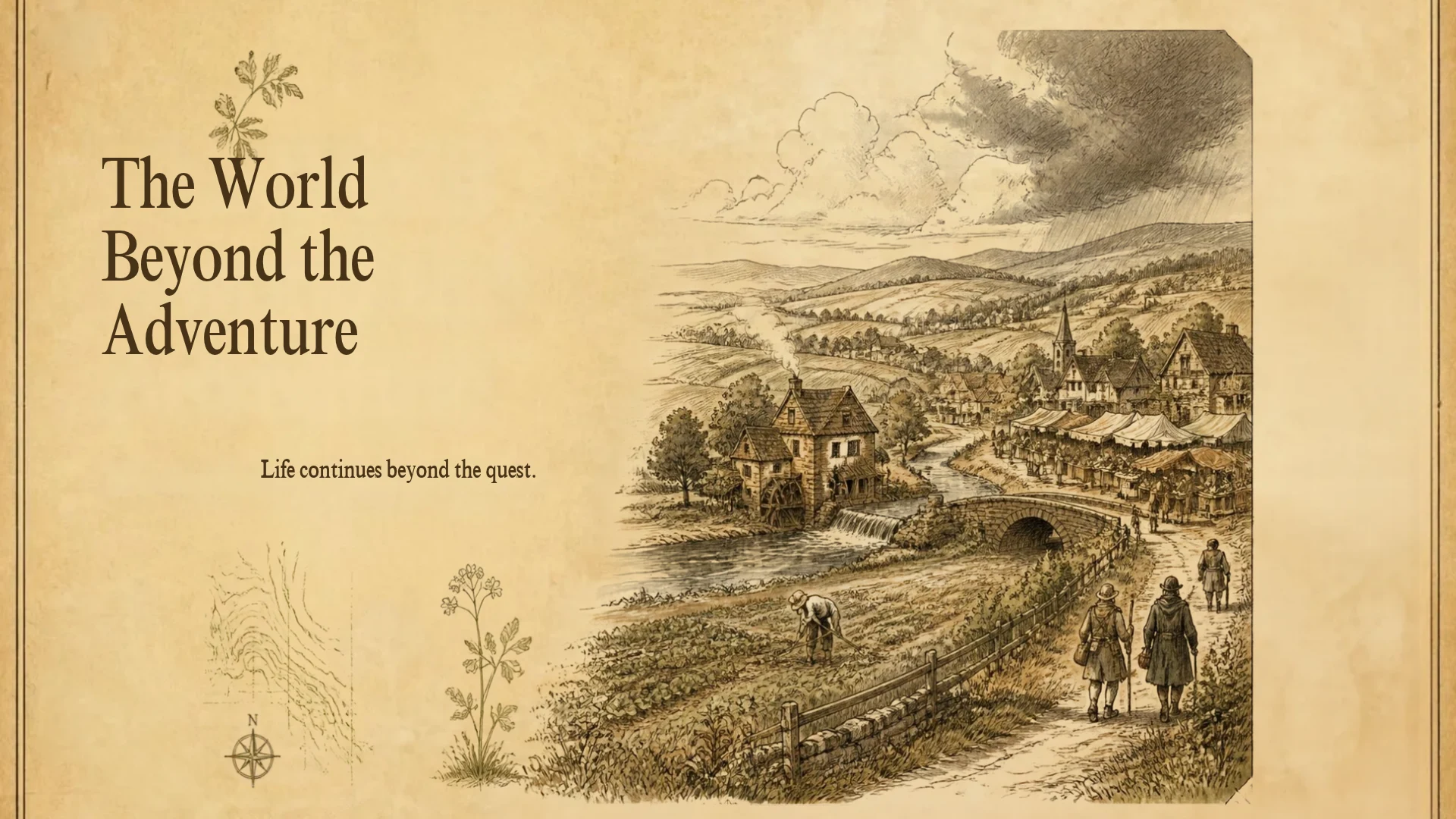
Imagine a village preparing for a market.
The innkeeper expects more guests than usual. A farmer hopes to sell enough grain to repair a roof. A trader is waiting for a delivery that should have arrived yesterday.
The party enters that situation.
Perhaps they buy supplies and leave.
Perhaps they discover why the delivery is late.
Perhaps they become interested in the roof.
The market doesn't need to have been organized for them.
Their choices can still matter to the people attending it.
Start With Ordinary Movement
A living world doesn't require a crisis everywhere.
People work.
They travel.
They make plans.
They disagree.
They wait for news.
They care for someone.
These ordinary movements give a place a sense of time.
The smith is busy in the morning and easier to speak with after the day's work. The ferry leaves when its operator is ready, rather than appearing whenever the players reach the bank. The village gathers for a meal that would have happened whether the adventurers attended or not.
You don't need an hourly schedule for everyone.
A few recurring patterns can be enough.
Who is usually here?
Who is usually elsewhere?
What are people expecting next?
The answers help you describe a place as something more than a collection of available services.
That begins with the people themselves. In Give the NPC a Life, I explored a few small prompts that make an NPC easier to portray. Here, the next question is where that person's life connects to the lives around them.
Let Needs Connect People
An inn needs food, fuel, repairs, and travelers.
A traveler needs a road that can be used.
A road may depend on a bridge.
Someone maintains the bridge.
Someone else thinks they should be paid less for doing it.
Now a place begins to have relationships.
Imagine heavy rain damages that bridge.
The immediate problem is crossing the river.
But the effects can reach farther.
Deliveries arrive late. The innkeeper uses what is already in the pantry. A merchant takes another route. Someone on the far bank misses an expected visit.
You don't need to calculate an entire economy.
Follow one change through two or three connections.
What depends on this?
Who notices first?
What do they do about it?
Those questions can turn a map feature into something the players experience.
Give Different People Different Concerns
The same event can mean different things to different people.
A festival is a celebration to one person.
Extra work to another.
An opportunity to sell something to a third.
A reminder of someone absent to a fourth.
That difference matters.
If everyone in town has the same opinion and wants the same thing, the settlement can feel like a single voice wearing several faces.
You don't need a political manifesto for every villager.
Give a few people different reasons to care.
One wants the bridge repaired quickly.
Another wants it repaired properly.
Another hopes travelers will use the road past their shop while the bridge is closed.
The disagreement doesn't have to become a villain's plot.
It can simply be people trying to live alongside one another.
Show Change When The Players Return
A world feels alive when returning reveals that time passed.
The unfinished roof is repaired.
The market stalls are gone.
The smith has an apprentice.
A familiar traveler has continued on.
Someone remembers a promise the party made.
These changes don't all need to be dramatic.
A small difference can do more than a speech announcing that the world is dynamic.
The players remember the place as it was.
Now they see it as it is.
That comparison makes the passage of time tangible.
Some changes may follow from their actions. Others may happen independently.
Both are useful.
The repaired bridge might be the result of their help. The new apprentice might have arrived while they were away.
The world can remember the adventurers without arranging every event around them.
Offstage Doesn't Mean Invisible Forever
Something happening beyond the party's immediate attention becomes playable when evidence reaches them.
A letter arrives.
A traveler brings news.
An empty stall suggests a merchant has left.
A different price starts a conversation.
A road that was open is now blocked.
The players don't need a report of every event occurring elsewhere.
Give them the part their characters could reasonably notice.
Then let them ask questions.
Maybe the news is relevant to their plans.
Maybe it isn't.
Either way, it suggests that the place they can see connects to places they cannot.
That is part of what makes exploration work. Leave Room for the Detour considers how to prepare for an unexpected direction. A world with ongoing activity gives those detours something to lead into.
Don't Turn Every Routine Into A Hook
There is a temptation to make every detail useful to the adventure.
The missing delivery must conceal a conspiracy.
The argument about the fence must reveal an ancient boundary.
The baker must know where the treasure is buried.
Sometimes those connections are interesting.
Sometimes the delivery is late because a wheel broke.
The neighbors disagree because the fence matters to them.
The baker knows how to bake.
Ordinary life gives extraordinary events something to stand against.
If everything is secretly part of the quest, the world can become smaller even while the plot becomes more complicated.
Allow some things to have meaning for the people living there without requiring meaning for the campaign.
Let The Players Alter What Continues
A world that moves independently still needs to respond.
If the party repairs the bridge, travel may resume.
If they persuade the merchant to stay, someone may receive an expected delivery.
If they make a promise and disappear for a month, the person waiting may find another solution.
Their actions enter an existing situation.
Then that situation changes.
I don't need every consequence to produce a reward or punishment.
Sometimes the consequence is a new relationship.
A different expectation.
A person who trusts them.
A person who has stopped waiting.
A choice matters when it changes what becomes possible for someone.
The same idea appears in A Gift With a Cost: an object becomes more interesting when its use connects to resources, obligations, and relationships. Those connections need a world around them.
Prepare A Little, Then Keep Notes
This can sound like an invitation to maintain an enormous simulation.
I would rather begin with a few things I can use.
For a settlement, try answering:
What ordinary activity is happening when the players arrive?
Who depends on someone else here?
What change is already underway?
What will probably happen if nobody intervenes?
How might the players learn about it?
Then play.
When something becomes established, write it down.
If the party learns that the ferry leaves at dawn, keep that fact consistent unless something changes it.
If they help someone repair a roof, remember the repaired roof.
If an improvised conversation creates an important relationship, keep the relationship.
You don't have to know everything in advance.
You do need enough continuity that discovery feels like learning about a place.
The Adventure Happens Somewhere
The ruin matters.
The missing person matters.
The danger waiting beneath the stones matters.
But so does the place the adventurers leave behind.
Who will notice if they don't return?
Who will be relieved if they do?
Who will keep working either way?
Those questions give the adventure a world to happen in.
Keep the baker opening the shutters.
Keep the cart moving when the wheel is repaired.
Keep someone making plans the party hasn't heard about yet.
The adventure may change their lives.
Their lives don't have to begin with the adventure.