

Know your assignment and venue boundaries
Learning objective: Confirm the actual task, safe access and help route before work.
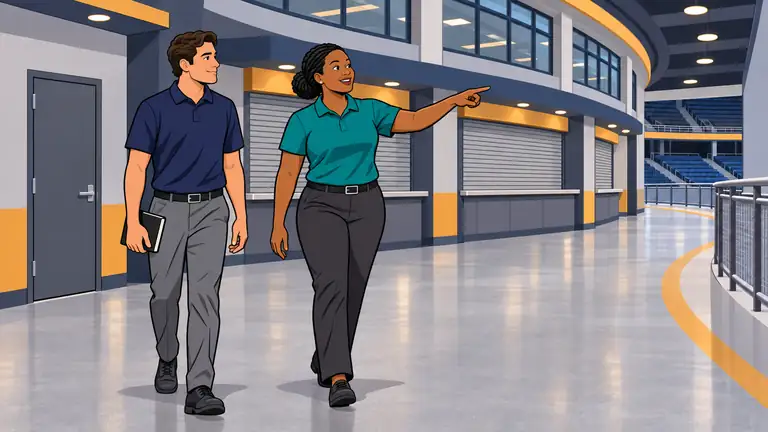
Different venues, different work
Sector 71 includes live arts and sports, museums and similar institutions, and amusement and recreation services. Work can involve guests, performances, collections, grounds, fitness, attractions or office duties. A shared venue does not give every employee the same skills or permission. This course is about worker safety, not how to run an attraction or deliver a specialist service.
Choose the closest work setting
The five paths are overlapping examples, not official industry divisions or a complete list of jobs. Choose live performances and events; sports and arenas; museums, historic sites, zoos and nature parks; amusement, attractions and gaming; or fitness and recreation. Some recreation businesses belong to other sectors, such as casino hotels and sightseeing transport. Your employer identifies the actual establishment and duties.
Meet the responsible lead
Confirm your supervisor, event lead, venue manager or other responsible contact and backup. Temporary and visiting workers may need a handoff between employer and host. Learn where you may go, what you may do, and which areas and controls are restricted. A badge, radio, uniform or guest request is not proof that you can operate equipment.
Check the local requirements
Federal OSHA or an OSHA-approved State Plan covers most private-sector employees. Federal OSHA does not directly cover state or local government employees; State Plans or other protections may apply. Ride, pool, fire, licensing and other rules depend on the actual work and jurisdiction. The employer must identify the requirements; do not assume a public venue has no worker protections.
Keep the course limits clear
This is a general workplace-safety overview for employees in arts, entertainment and recreation. It does not replace employer, venue, host or task-specific instruction. It does not qualify ride operation, lifeguarding, water rescue, rigging, work at height, electrical work, pyrotechnics, animal handling, security response or equipment maintenance. First aid, CPR, AED, safeguarding, reporting, food service, chemical handling and other specialized duties require their own preparation where applicable. The quiz and worksheet grant no occupational credential, specialized task qualification or work authorization.
Explain the plan back
Ask for instruction in words you understand and, when needed, a demonstration from a qualified person. Explain the task, boundaries and help route in your own words. Stop an unfamiliar task and ask. Use the backup contact if the usual lead is unavailable. Do not treat watching a coworker as the required training.
Source context: See the U.S. sources linked in the course resources