

Confirm your role and care boundaries
Learning objective: Know your assignment, limits and local help before starting unfamiliar work.
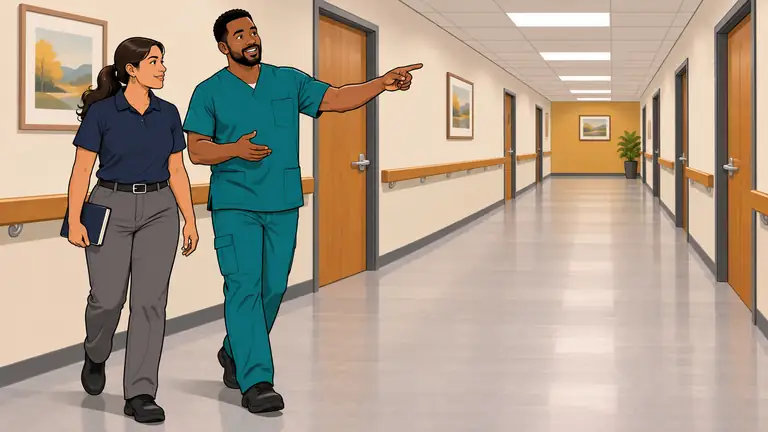
Many settings, different work
Sector 62 includes outpatient health services, hospitals, nursing and residential care, and social assistance. Social assistance includes services such as community support, vocational rehabilitation and child care. Some jobs involve direct care; others involve reception, supplies, cleaning, transport or office work. The actual service and task matter. This course is about employee workplace safety, not how to deliver care.
Choose the closest setting
The five paths are overlapping examples, not official industry divisions or a complete list of jobs. Home health is part of outpatient health services, while some nonmedical home support belongs to social assistance. Choose outpatient care; hospitals; nursing and residential care; home and community visits; or social assistance and child care. A shared building or job title does not make every task the same.
Confirm the assignment and help route
Know your supervisor, charge nurse, team lead, agency coordinator or other responsible contact and backup. Temporary and visiting staff may need a handoff between employer and host. Confirm permitted rooms, tasks, required qualifications and how to get help on your shift. A badge, schedule, credential or request from a patient or family does not authorize unfamiliar work.
Check local requirements
Most private employees are covered by federal OSHA or an OSHA-approved State Plan. Federal OSHA does not directly cover state or local government employees; approved State Plans and other requirements may apply. Health care, licensing and other rules can also impose duties. The employer must identify the requirements for the actual work. Do not assume a public facility has no worker protections.
Keep the limits clear
This is a general workplace-safety overview for employees in health care and social assistance. It does not replace employer, facility, agency, host or task-specific instruction. It does not provide clinical training, professional licensing, patient or client transfer or restraint training, infection-control or bloodborne-pathogen training, respirator qualification, safeguarding or mandated-reporting training, or required privacy instruction. First aid, CPR, AED, medication, equipment, security and rescue duties require their own preparation and assigned roles. The quiz and worksheet grant no clinical qualification, care-task authorization or work authorization.
Explain the plan back
Ask for instruction and, when appropriate, a demonstration from a qualified person. Explain the assignment, limits and help route in your own words. Keep an unfamiliar task on hold while the responsible people resolve it. Maintain assigned care and supervision through the local support plan; do not abandon someone or improvise a specialized procedure.
Source context: See the U.S. sources linked in the course resources