Watch: What Is OSHA?
This article expands the video’s introduction to OSHA’s history, responsibilities, and coverage. Use the linked official resources to check the requirements that apply to a particular workplace.
OSHA and the OSH Act: What Is the Difference?
The names are similar, but they refer to different things.
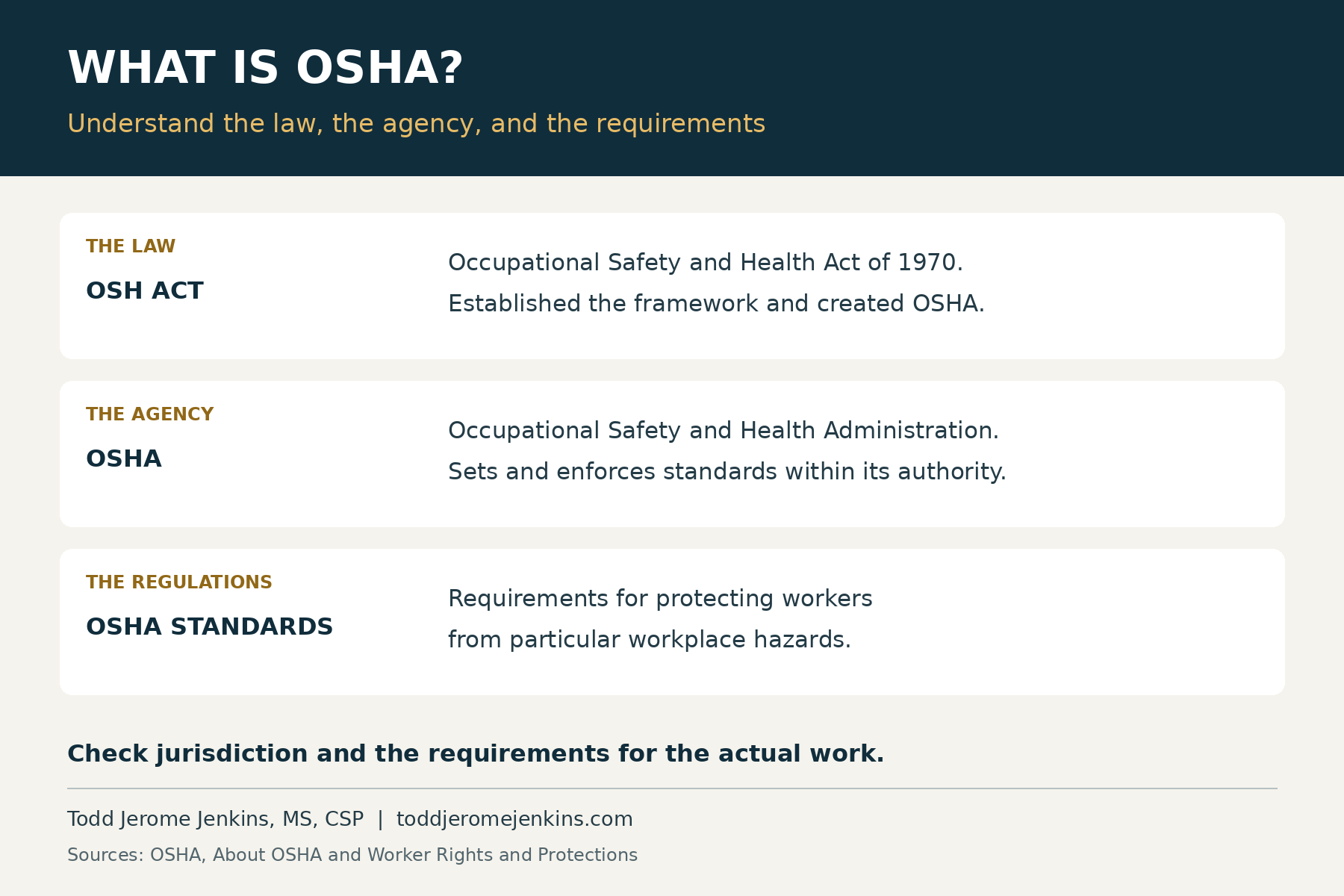
| Term | What it means |
|---|---|
| OSH Act | The Occupational Safety and Health Act of 1970—the federal law that created OSHA. |
| OSHA | The Occupational Safety and Health Administration—the agency responsible for administering and enforcing workplace protections within its authority. |
| OSHA standards | Regulations establishing requirements for protecting workers from particular hazards. |
The law provides the foundation, and the agency carries out its responsibilities under that framework.
When Was OSHA Established?
President Richard Nixon signed the Occupational Safety and Health Act on December 29, 1970. OSHA began operating on April 28, 1971.
The legislation established a national framework for addressing workplace injuries, illnesses, and deaths. OSHA’s early work included developing standards, training programs, State Plans, and assistance for employers.
What Does OSHA Do?
OSHA’s work includes:
- Establishing and enforcing workplace safety and health standards.
- Providing and supporting training, outreach, education, and assistance.
- Enforcing anti-retaliation provisions within its jurisdiction.
- Working with OSHA-approved state programs and monitoring their effectiveness.
These activities support a national system of worker protection.
Who Does OSHA Cover?
The OSH Act covers most private-sector employers and workers, along with some public-sector employment. Coverage depends on the employer, location, work, and applicable jurisdiction.
Private-Sector Workers
Most private-sector workers receive protection through federal OSHA or an OSHA-approved State Plan.
State Plans are workplace safety and health programs operated by states or territories. They must be at least as effective as federal OSHA, and their requirements may differ from federal requirements.
State and Local Government Workers
Federal OSHA generally does not cover employees of state and local governments. These workers receive OSH Act protections through an applicable OSHA-approved State Plan.
Some State Plans cover private-sector and public-sector employment. Others cover only state and local government workers, while private-sector employment remains under federal OSHA.
Federal Government Workers
Federal agencies have workplace safety and health responsibilities under Section 19 of the OSH Act. Agency heads must establish and maintain appropriate safety and health programs.
Federal employment follows a distinct framework; it should not be treated as identical to private-sector enforcement.
What Is Outside OSHA’s Coverage?
OSHA identifies several exclusions, including self-employed people and immediate family members of farm employers.
Another important limitation concerns working conditions regulated by other federal agencies. Under Section 4(b)(1), OSHA’s authority does not apply where another agency exercises statutory authority over the relevant occupational safety or health conditions.
The question is which agency regulates the particular working conditions. The presence of another regulator does not automatically remove an entire business from OSHA coverage.
What Must Employers Do?
Employers must comply with applicable standards and provide workplaces free from serious recognized hazards.
OSHA’s summary of employer responsibilities also includes examining workplace conditions, maintaining safe tools and equipment, and providing safety training in language and vocabulary employees can understand.
A practical starting point is to:
- Identify the work and its hazards.
- Determine which requirements apply.
- Put effective controls in place.
- Provide the training, equipment, and resources employees need.
- Check whether those controls work under actual conditions.
- Reassess when the work changes.
A job safety analysis can support this planning. The OSHA standards reading guide explains how to locate and read individual requirements.
What Rights Do Workers Have?
Workers have rights that include receiving understandable safety training, reporting hazards, requesting an OSHA inspection, and participating in inspections.
They also have protections against retaliation for exercising rights under the law. OSHA provides information about complaints and how to contact the appropriate office.
For a safety concern, consult OSHA’s worker rights resources or the applicable State Plan. OSHA’s published contact number is 1-800-321-6742.
Put the Basics Into Practice
Understanding OSHA helps you identify the requirements and protections that apply to the workplace.
Start with three questions:
- Which agency or State Plan has jurisdiction?
- Which standards apply to this work?
- How will the required protections be implemented and checked?
Then connect those answers to the equipment, conditions, and people involved in the job.