Download the free toolbox talk
The one-page talk, editable Word version, and guidance below are open to everyone. No account required.
One-page toolbox talk
Download one-page toolbox talk (PDF, 1 page)Editable one-page toolbox talk (Word)Preview the one-page toolbox talk
Supporting documents
Included with free Safety & Systems membership.
Supervisor field check
A separate check to verify conditions and controls before work. Includes a one-page PDF and editable Word file.
Attendance sheet
A separate sign-in sheet to record the crew discussion. Includes a one-page PDF and editable Word file.
Need the crew records? Join free to use these supporting documents and the Safety & Systems Academy. No payment details. Email updates are optional.
Get supporting documents — free membershipAlready a member? Use the same link to sign in.
Hazard-based toolbox talk 23 of 52, with a practical HOP exercise.
Plan a 5–10 minute toolbox discussion, plus time to verify the actual controls. The one-page toolbox talk and editable Word version are public. Separate supervisor and attendance records are included with free Safety & Systems membership.
Why this matters
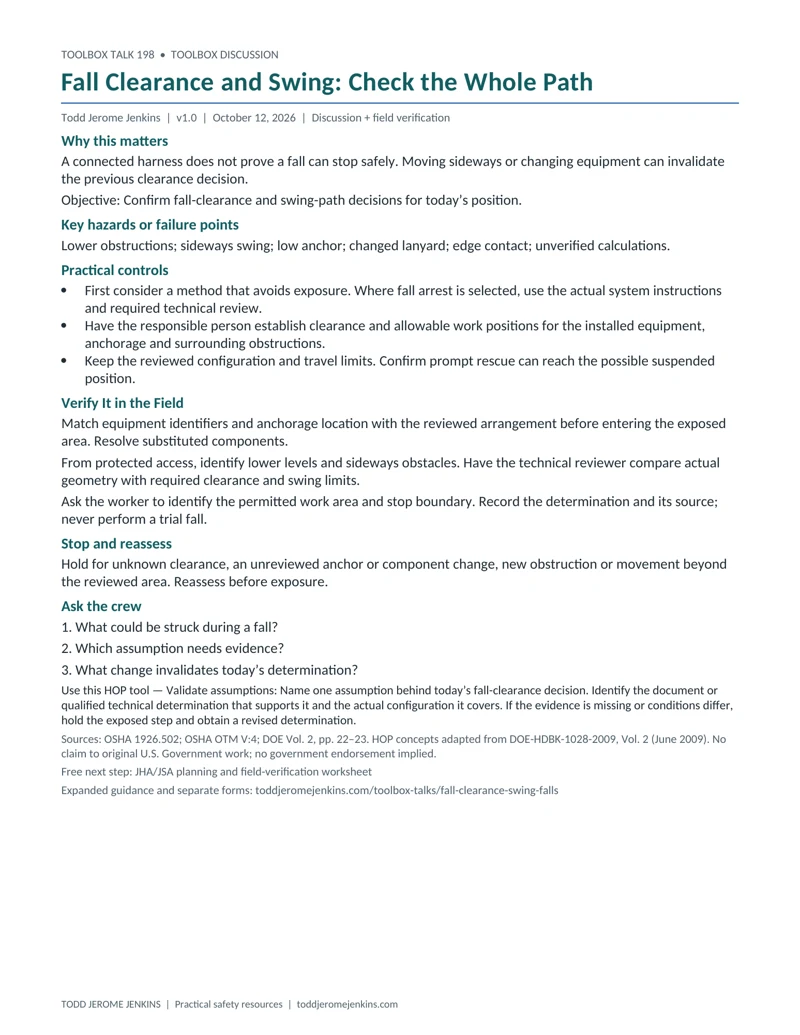
A connected harness does not prove a fall can stop safely. Moving sideways or changing equipment can invalidate the previous clearance decision.
Learning objective
Confirm fall-clearance and swing-path decisions for today’s position.
Key hazards or failure points
Lower obstructions; sideways swing; low anchor; changed lanyard; edge contact; unverified calculations.
Practical controls
- First consider a method that avoids exposure. Where fall arrest is selected, use the actual system instructions and required technical review.
- Have the responsible person establish clearance and allowable work positions for the installed equipment, anchorage and surrounding obstructions.
- Keep the reviewed configuration and travel limits. Confirm prompt rescue can reach the possible suspended position.
Verify It in the Field
- Match equipment identifiers and anchorage location with the reviewed arrangement before entering the exposed area. Resolve substituted components.
- From protected access, identify lower levels and sideways obstacles. Have the technical reviewer compare actual geometry with required clearance and swing limits.
- Ask the worker to identify the permitted work area and stop boundary. Record the determination and its source; never perform a trial fall.
Stop and reassess
Hold for unknown clearance, an unreviewed anchor or component change, new obstruction or movement beyond the reviewed area. Reassess before exposure.
Crew discussion questions
- What could be struck during a fall?
- Which assumption needs evidence?
- What change invalidates today’s determination?
For each required control, record its acceptance source and criterion, safe verification method, responsible verifier, actual result and time. Mark VERIFIED, HOLD/NOT VERIFIED, or N/A with a reason. Complete all required inspections; never enter danger or improvise a test to fill out a form.
Use this HOP tool
Validate assumptions
Name one assumption behind today’s fall-clearance decision. Identify the document or qualified technical determination that supports it and the actual configuration it covers. If the evidence is missing or conditions differ, hold the exposed step and obtain a revised determination.
This exercise supports hazard identification or control verification. It does not replace safeguards, required training, specialist decisions or work authorization.
Leader preparation and practical detail
Clearance belongs to a configuration
Illustrative situation: a worker keeps the same lanyard but moves to a lower attachment. Do not carry forward yesterday’s result. The reviewer needs actual system data and geometry, including worker/equipment factors required by the instructions. The OSHA Technical Manual explains clearance assessment; its example values do not certify a different product or installation.
Study the sideways path
A fall away from an overhead alignment can swing the worker toward an obstruction. Assess more than the vertical space immediately below the starting point. Use the manufacturer’s permitted working range and required technical design. The crew can identify changes and obstacles from safe access; it cannot approve an unknown range by walking farther out or testing the device with a fall.
Record what the determination covers
Construction 1926.502(d) supplies personal fall-arrest requirements, including avoiding lower-level contact. Record equipment, anchor, reviewed positions, clearance basis, relevant obstructions, technical reviewer and date. Keep uncertainty visible until resolved. Rescue readiness remains a separate requirement; a satisfactory clearance review does not demonstrate that rescue is available. Horizontal lifelines require their specified qualified-person oversight.
Short supervisor field check
- Actual equipment matched
- Anchorage reviewed
- Clearance established
- Swing path reviewed
- Rescue reachable
Use the separate sheet to document evidence, unresolved restrictions, correction owner, recheck and required release authority. Rebrief affected workers. This record does not replace specialist inspections, permits or engineering determinations.
Attendance and follow-through
Use the separate attendance record for participants, roles, questions, actions and late-arrival rebriefs. Attendance does not prove competence, functioning controls or authorization. Keep completed records private under employer procedures.
Source acknowledgment
HOP concepts are adapted from DOE-HDBK-1028-2009, Human Performance Improvement Handbook, Volume 2 (June 2009). Todd Jerome Jenkins makes no claim to authorship or copyright ownership of original U.S. Government work. The explanations and exercises are original adaptations; no endorsement by DOE or the U.S. Government is implied. Third-party material credited in the handbook retains its separate ownership.
HOP source: Volume 2/VOLUME 2 VALIDATE ASSUMPTIONS.pdf; Printed pp. 22–23. The handbook supplies concepts; task-specific technical references are listed below.
Technical scope and references
Technical sources inspected October 12, 2026; resource edition October 12, 2026. Apply current jurisdictional requirements, the actual task procedure, manufacturer instructions, permits and required competent or qualified decisions. This resource supplies no equipment-specific acceptance criteria.
- OSHA 29 CFR 1926.502 — Construction: guardrail, personal fall-arrest and hole-cover criteria; apply relevant subsection.
- OSHA Technical Manual, Section V, Chapter 4 — Technical guidance: fall-clearance and swing-hazard assessment. Illustrative calculations are not model-specific acceptance criteria.
- DOE-HDBK-1028-2009 Volume 2 — Validate assumptions — Printed pp. 22–23; historical HOP tool adapted to this exercise.
Connect this discussion to your JHA/JSA
Use the JHA/JSA planning and field-verification worksheet to connect this discussion to the actual task, controls and responsible people.
Related Todd Jerome Jenkins articles: How to Conduct a Job Safety Analysis and What Is Human and Organizational Performance?.
Related toolbox talks
- Fall Prevention: Verify the Controls
- Assumptions: Show What Is Known and What Is Not
- Fall Rescue: Can We Reach the Worker?
Continue the hazard series
Put one verification into practice
Record today’s change and evidence using the free JHA/JSA planning and field-verification worksheet.