Download the talk and separate crew records
Free to download without an account. Each PDF is one page. Use the Word version to adapt the record to your task and approved procedures.
Supervisor field check
Download supervisor field check (PDF, 1 page)Editable supervisor field check (Word)Preview the one-page crew talk
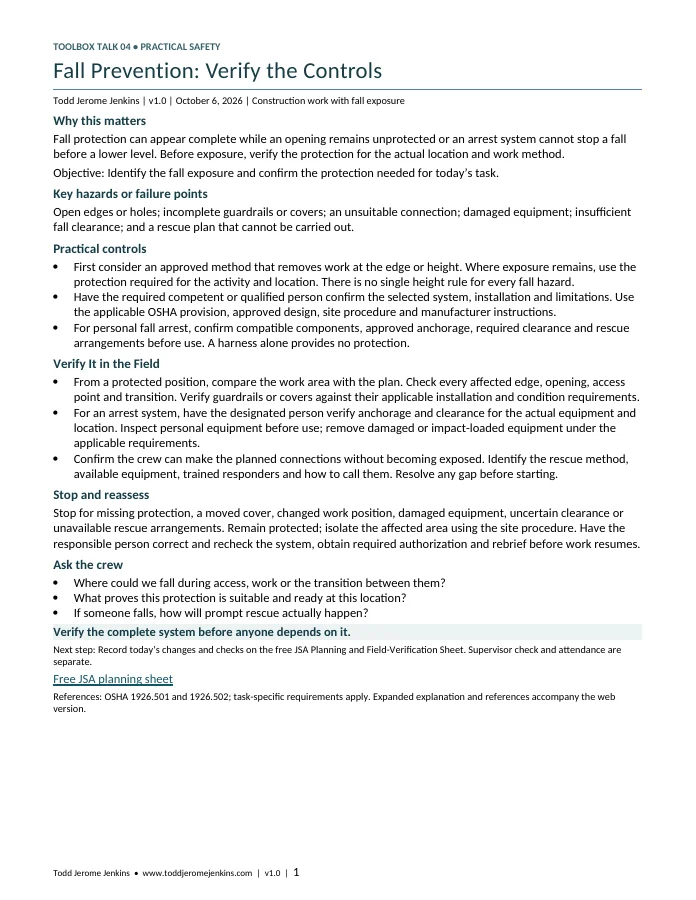
One-page crew talk, with separate supervisor and attendance sheets. Plan a 5–10 minute discussion and allow the time needed for field verification. All downloads are free; no account is required.
Learning objective
Identify the fall exposure and confirm the protection needed for today’s task.
Start with today’s work
Illustrative scenario: A crew moves from one roof area to another. The same harness and lanyard are available, but the new connection point is lower and equipment sits below the work. Stop before transferring. The previous clearance decision cannot simply be carried to the new location. The responsible person must verify the actual configuration and the rescue arrangements.
Key hazards or failure points
Open edges or holes; incomplete guardrails or covers; an unsuitable connection; damaged equipment; insufficient fall clearance; and a rescue plan that cannot be carried out.
Practical controls
- First consider an approved method that removes work at the edge or height. Where exposure remains, use the protection required for the activity and location. There is no single height rule for every fall hazard.
- Have the required competent or qualified person confirm the selected system, installation and limitations. Use the applicable OSHA provision, approved design, site procedure and manufacturer instructions.
- For personal fall arrest, confirm compatible components, approved anchorage, required clearance and rescue arrangements before use. A harness alone provides no protection.
Verify It in the Field
- From a protected position, compare the work area with the plan. Check every affected edge, opening, access point and transition. Verify guardrails or covers against their applicable installation and condition requirements.
- For an arrest system, have the designated person verify anchorage and clearance for the actual equipment and location. Inspect personal equipment before use; remove damaged or impact-loaded equipment under the applicable requirements.
- Confirm the crew can make the planned connections without becoming exposed. Identify the rescue method, available equipment, trained responders and how to call them. Resolve any gap before starting.
For each required control, identify the acceptance source and safe check method, assign a person with the required competence and authority, and record the actual result and time. Use VERIFIED, HOLD/NOT VERIFIED, or N/A with a reason. A checkmark alone does not demonstrate that protection works.
| Control | Safe verification | Criterion, evidence and response |
|---|---|---|
| Edge or opening protection | Compare the installed protection and each access point with the approved design and applicable criteria from a protected location. | 1926.501–502; design/site procedure. Record the inspected area and defects; restrict the exposed area if incomplete. |
| Arrest system clearance | Responsible person checks actual component data, anchorage position and lower obstructions using the specified method. | 1926.502(d), manufacturer instructions and required design. Record the configuration and determination; unknown clearance means HOLD. |
| Rescue readiness | Confirm named response roles, equipment location and a safe communication check under the plan. | 1926.502(d)(20) and site rescue procedure. Record availability; do not stage an exposed rescue demonstration. |
These are examples, not a complete task inspection. Check all required controls. Do not enter danger, defeat a safeguard or improvise a test. If the criterion, method or result is uncertain, hold affected work and get the appropriate technical help. No actual equipment model, product SDS or site permit was supplied for these examples; use the documents for your task.
Leader preparation and explanation
Choose protection for the activity
OSHA 1926.501 identifies construction fall-protection duties across different work situations; 1926.502 addresses system criteria. Thresholds and permitted methods vary. Holes and dangerous equipment are examples where a blanket “we are below six feet” decision can miss the applicable requirement. This page is not a substitute for selecting the correct provision.
Verify prevention and arrest differently
For a guardrail or cover, check the installed system against its approved criteria and inspect the actual exposure points. Do not improvise a load test. For personal arrest, compatibility, anchorage, free-fall limits, total clearance and the lower surface matter. Use the actual equipment instructions and any required qualified-person design; no universal clearance number is supplied here.
Plan for prompt rescue
A written rescue statement is useful only when it can be carried out at the location. Confirm access, equipment, communication and the people who will respond under the site plan. Do not assume calling an emergency number alone establishes a workable rescue arrangement. Verify the response plan before exposure.
Stop and reassess
Stop for missing protection, a moved cover, changed work position, damaged equipment, uncertain clearance or unavailable rescue arrangements. Remain protected; isolate the affected area using the site procedure. Have the responsible person correct and recheck the system, obtain required authorization and rebrief before work resumes.
When conditions change, return to Pre-Job JHA/JSA: What Changed Today? and revise the affected task plan with the crew.
Three crew discussion questions
- Where could we fall during access, work or the transition between them?
- What proves this protection is suitable and ready at this location?
- If someone falls, how will prompt rescue actually happen?
Short supervisor field check
- Actual edges, holes, access and transitions are addressed under the applicable fall-protection requirements.
- Installed guardrails, covers or other selected systems have verified acceptance criteria and condition.
- Where used, personal arrest components, anchorage and clearance are confirmed for this location.
- Required pre-use equipment inspections and protected connection methods are confirmed.
- Rescue method, people, equipment and communication are available and workable.
Use the separate supervisor sheet to record the task and change, JHA/JSA revision, acceptance source, safe method, verifier, actual result, unresolved items, corrective action, recheck and required restart authorization. Link specialist inspection records rather than copying private or unnecessary details.
Attendance and follow-through
Use the separate attendance sheet for participant names, roles and acknowledgment, meeting details, concerns, actions and rebriefs. Attendance is not proof of competence, functioning controls or permission to work. Keep completed records under the employer’s privacy and recordkeeping procedures; never post completed sign-in sheets publicly.
Related JHA/JSA resource and existing video
How to Conduct a Job Safety Analysis connects the task steps, hazards and controls. For related background, see At What Height Is Fall Protection Required?.
Related crew discussions
One next step
Use the free JSA Planning and Field-Verification Sheet to record today’s changes and checks with the crew.
Sources and references
Sources reviewed October 6, 2026. Apply each regulation’s industry and activity scope, and current state or local requirements where applicable. Guidance is identified separately. This discussion resource supports preparation; it does not replace task procedures, required training, permits or specialist decisions.
- OSHA 29 CFR 1926.501 — Construction fall-protection duties; requirements depend on the activity and exposure.
- OSHA 29 CFR 1926.502 — System criteria; personal arrest compatibility, anchorage, inspection, clearance and prompt rescue.