Download the talk and separate crew records
Free to download without an account. Each PDF is one page. Use the Word version to adapt the record to your task and approved procedures.
Supervisor field check
Download supervisor field check (PDF, 1 page)Editable supervisor field check (Word)Preview the one-page crew talk
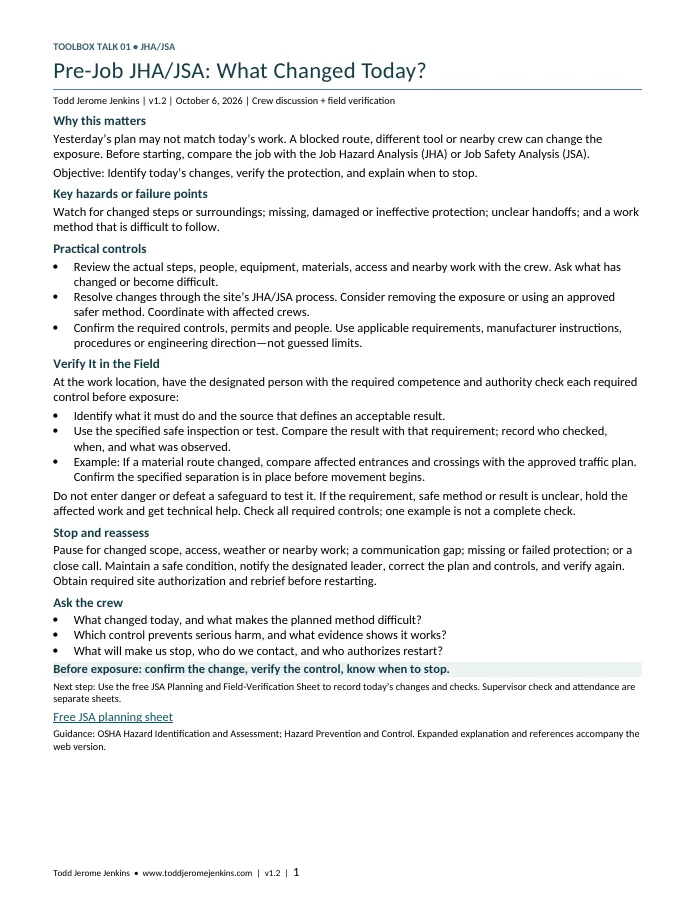
A 5–10 minute crew discussion, plus the time needed to verify controls at the work location. The talk, field check, and attendance record are free to use without an account.
Why this matters
The task may be familiar while the conditions are different. A delivery can block access, another crew can enter the area, or replacement equipment can change the work method. Before anyone is exposed, compare today’s job with the JHA/JSA and check the controls that protect people.
JHA means Job Hazard Analysis; JSA means Job Safety Analysis. Follow your organization’s terminology and process. This talk helps a crew review an existing task plan before starting or resuming work.
Learning objective
After this discussion, each crew member should be able to describe what changed—or what was checked and found unchanged—identify the controls that matter for today’s work, and explain when to pause and who to contact.
Start with today’s work
Illustrative example: A crew plans to move materials through a marked work area. Overnight, stored items narrow the route and pedestrians begin using a different entrance. The existing JHA/JSA still describes yesterday’s route. Before moving anything, the crew needs a reviewed plan for the changed route and evidence that the required separation is in place. This is a discussion example, not a material-handling procedure.
Key hazards or failure points
- Changed exposure: A new route, tool, material, work sequence, weather condition, or nearby activity creates a hazard the plan does not cover.
- Control missing or ineffective: A barrier, guard, isolation, support, or other required protection is listed but absent, damaged, unsuitable, or not functioning.
- Unclear handoff: A new worker, contractor, or relief operator has different information about roles, communication, or stop signals.
- Pressure to improvise: Missing equipment, difficult access, or schedule pressure makes the planned method hard to follow.
Practical controls
- Compare the plan with the work: Review the current JHA/JSA with the people doing the task, from a safe location. Check the steps, people, tools, materials, access, surroundings, and other work nearby. Ask what is difficult to carry out.
- Resolve the change: Update the affected steps and controls through the site’s review process. Consider removing the exposure or using an approved safer method before relying on reminders or PPE. Check that the change does not create another hazard.
- Get the right requirements: Identify the applicable procedure, permit, manufacturer instructions, engineering determination, and regulatory requirements. Confirm the people and authorizations the task requires. Do not invent a distance, capacity, test method, or pass/fail limit.
- Check before exposure: Assign a person with the required competence and authority to each check. Complete all required checks, starting with controls against serious harm. Resolve missing or uncertain protection before affected work starts; recheck when conditions change.
Planning and worker-participation guidance: OSHA references 1 and 4 below. Control selection and follow-through: references 2 and 3.
Verify It in the Field
For each important control, record: the exposure it prevents; the current source and acceptance criteria; who checks it and by what safe method; the actual result and time; and what change requires another check. A checkmark or signature alone is not evidence that protection works.
Inspect from a safe position. Only appropriately trained and authorized people carry out tests, following the applicable procedure. Do not enter a hazard area, defeat a safeguard, or energize equipment just to demonstrate a control. If the criterion or safe verification method is unclear, hold the affected work and get the right technical help.
| Control to check | Evidence to obtain | Source of criteria |
|---|---|---|
| People separated from moving equipment | Compare every affected entry and crossing with the approved traffic/site plan. Confirm the specified separation and access arrangements are in place; coordinate with other crews. A cone or sign alone does not prove physical separation. | Site/traffic plan and applicable requirements; do not invent barrier ratings or separation distances. |
| Equipment protection ready | Match the actual equipment to the plan. Have the designated person complete the manufacturer-required pre-use inspection and any specified safe function check. Record defects and results; appearance alone may not establish function. | Instructions for that model and configuration, plus applicable inspection requirements. |
| Hazardous energy controlled, where applicable | For general-industry servicing covered by 1910.147, the authorized employee verifies isolation and deenergization under the energy-control procedure before work. A visible lock alone is insufficient evidence. | Applicable standard and equipment-specific procedure. This row is not a lockout procedure or a rule for every industry. |
Examples only. Check all controls required for your actual task, including those not shown here. The isolation example is limited to work covered by 29 CFR 1910.147; its scope excludes construction and other specified activities. Use the standards and procedures applicable to your work.
For each check, use one of three outcomes: VERIFIED against the applicable criterion; HOLD because it failed or remains unverified; or NOT APPLICABLE with a documented reason. A blank box is not a pass. Record unresolved items, the person responsible, and what must happen before exposure.
Stop-and-reassess triggers
Pause the affected work if the scope or sequence changes; access, weather, traffic, or nearby work changes; a required control is missing, fails, or has an unknown status; a crew change creates a communication gap; or a close call or unexpected condition challenges the plan.
Move to or maintain a safe condition using the site procedure. Notify the designated leader, reassess with affected workers, correct the plan and protection, and verify again. Resume only after required site authorization and a clear rebrief. Stop contact and restart authority must be identified before work.
Three crew discussion questions
- What changed today, and what makes the planned method difficult?
- Which control prevents serious harm, and what evidence shows it works?
- What will make us stop, who do we contact, and who authorizes restart?
Short supervisor/leader field check
Before releasing the crew under the site’s process, confirm the following with evidence. Use the printable field-check component to record results.
- The actual task and surroundings match the current JHA/JSA.
- Changes and work involving other crews have been addressed.
- All required controls have acceptance criteria and completed checks by the appropriate people.
- Required permits, inspections, competence, authorizations, and emergency arrangements are confirmed.
- Workers can explain the stop trigger, contact, and restart process.
Record the task, location, date/time, JHA/JSA revision, control and exposure, source and criterion, check method, verifier, observed result, status, corrective action, and recheck trigger. Any unresolved required protection keeps the affected work on hold.
Attendance record
Record the date, task/location, facilitator, JHA/JSA revision, language support used, and each participant’s name, crew/role, and signature or attendance acknowledgment. Note concerns, action owners, and rebriefs for late arrivals or reassigned workers.
Attendance documents participation. It does not certify competence, prove that controls work, authorize work, or waive rights. Keep completed records under the employer’s privacy and recordkeeping procedures; do not post completed sign-in sheets publicly.
Close with a commitment
Before we begin, each of us should know the next step, the protection we rely on, and the condition that means we pause.
Related JHA/JSA reading and video
How to Conduct a Job Safety Analysis: A Practical Introduction
Job Safety Analysis: A Basic Overview — existing video
Use the companion article alongside the older video. Its lifting example is not a universal safe-weight limit; use task-specific assessment and applicable instructions.
One next step
Use the free JSA Planning and Field-Verification Sheet to record today’s changes and checks with your crew. Keep the completed record with the applicable JHA/JSA.
Open the free JSA Planning and Field-Verification Sheet
Sources and references
Reviewed October 6, 2026. OSHA/NIOSH program guidance supports the method; it does not make this handout a permit, certification, or complete compliance procedure.
1. OSHA — Hazard Identification and Assessment
Recommended Practices, action items 1–3 and 5. Supports reviewing actual conditions, worker input, changes, and nonroutine work. Guidance, not a universal JHA form requirement.
2. OSHA — Hazard Prevention and Control
Recommended Practices, action items 2, 3 and 6. Supports choosing controls, assigning responsibility, and checking implementation and effectiveness. Guidance.
3. NIOSH — Hierarchy of Controls
Page dated April 10, 2024; accessed October 6, 2026. Supports the five-level hierarchy and preference for controls less dependent on repeated human action. Guidance.
4. OSHA — Job Hazard Analysis, OSHA 3071
2002 revised edition, still hosted by OSHA when checked. Printed pages 4–5 and 13: worker involvement, job steps, review and communicating revisions. Historical publication used for stable method only; not evidence of a new 2026 rule.
Sections (a), (c)(4), and (d)(5)–(6). Supports the limited general-industry servicing/maintenance isolation example. Scope exclusions include construction; do not apply it as a universal rule for all readers.