Download the free crew talk
The one-page talk, editable Word version, and guidance below are open to everyone. No account required.
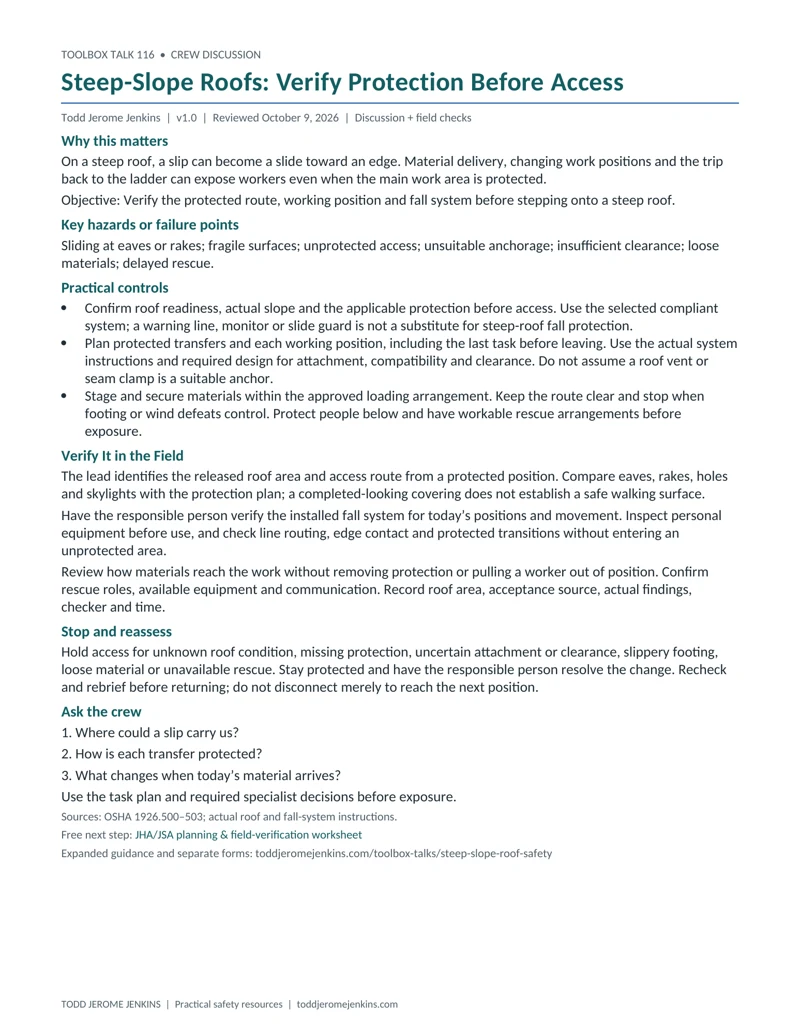
Preview the one-page crew talk
Supporting documents
Included with free Safety & Systems membership.
Supervisor field check
A separate check to verify conditions and controls before work. Includes a one-page PDF and editable Word file.
Attendance sheet
A separate sign-in sheet to record the crew discussion. Includes a one-page PDF and editable Word file.
Need the crew records? Join free to use these supporting documents and the Safety & Systems Academy. No payment details. Email updates are optional.
Get supporting documents — free membershipAlready a member? Use the same link to sign in.
A 5–10 minute crew discussion, plus time to verify the actual controls. The crew talk and Word version are public. Separate supervisor and attendance records are included with free Safety & Systems membership.
Why this matters
On a steep roof, a slip can become a slide toward an edge. Material delivery, changing work positions and the trip back to the ladder can expose workers even when the main work area is protected.
Learning objective
Verify the protected route, working position and fall system before stepping onto a steep roof.
Key hazards or failure points
Sliding at eaves or rakes; fragile surfaces; unprotected access; unsuitable anchorage; insufficient clearance; loose materials; delayed rescue.
Practical controls
- Confirm roof readiness, actual slope and the applicable protection before access. Use the selected compliant system; a warning line, monitor or slide guard is not a substitute for steep-roof fall protection.
- Plan protected transfers and each working position, including the last task before leaving. Use the actual system instructions and required design for attachment, compatibility and clearance. Do not assume a roof vent or seam clamp is a suitable anchor.
- Stage and secure materials within the approved loading arrangement. Keep the route clear and stop when footing or wind defeats control. Protect people below and have workable rescue arrangements before exposure.
Verify It in the Field
- The lead identifies the released roof area and access route from a protected position. Compare eaves, rakes, holes and skylights with the protection plan; a completed-looking covering does not establish a safe walking surface.
- Have the responsible person verify the installed fall system for today’s positions and movement. Inspect personal equipment before use, and check line routing, edge contact and protected transitions without entering an unprotected area.
- Review how materials reach the work without removing protection or pulling a worker out of position. Confirm rescue roles, available equipment and communication. Record roof area, acceptance source, actual findings, checker and time.
Stop and reassess
Hold access for unknown roof condition, missing protection, uncertain attachment or clearance, slippery footing, loose material or unavailable rescue. Stay protected and have the responsible person resolve the change. Recheck and rebrief before returning; do not disconnect merely to reach the next position.
Crew discussion questions
- Where could a slip carry us?
- How is each transfer protected?
- What changes when today’s material arrives?
For each required control, record its acceptance source and criterion, safe verification method, responsible checker, actual result and time. Use VERIFIED, HOLD/NOT VERIFIED, or N/A with a reason. A tick alone is not evidence. Complete all applicable task inspections; do not enter danger or improvise a test to fill out a form.
Leader preparation and practical detail
Start with the slope and activity
OSHA defines a steep roof as a slope greater than 4 in 12, vertical to horizontal. Under 1926.501(b)(11), employees on steep roofs with unprotected sides or edges six feet or more above lower levels need guardrails with toeboards, safety nets or personal fall arrest. Do not import the low-slope roofing warning-line options. Other exposures, including holes and dangerous equipment, require their own assessment.
A work aid is not the fall system
Roof brackets, walking boards, footwear and material restraints may help the work, but their presence does not establish compliance with the selected fall-protection arrangement. Have the employer’s responsible person determine protection for every position, access transition and installation stage. This briefing gives no bracket spacing, anchor-fastener pattern, universal clearance or wind limit.
Check the specific roof attachment
The related standing-seam example covers a supported, released roof assembly and excludes open-purlin structural erection. It does not establish that this roof is steep or that any seam clamp is a suitable fall anchor. Match the actual protection to the panel, seam, supporting structure and installation stage; protect lines against damaging contact as the work advances.
Do not confuse roof covering and deck construction
The roofing-work definition includes application and removal of roof materials but excludes construction of the roof deck. Deck placement, steel erection, scaffolds and ladder work need their applicable provisions. TBT04 covers general fall verification; TBT113 addresses skylight protection. Use those linked discussions for additional exposures rather than assuming steep-roof edge protection controls every hazard.
Make rescue and training practical
Under 1926.502(d), personal fall arrest requires prompt rescue or assured self-rescue. Verify the response for the actual slope and access, with trained personnel and suitable equipment. Section 1926.503 requires fall-hazard training and retraining when indicated. Attendance at this briefing does not establish skill in the actual system.
Short supervisor field check
- Roof readiness and slope established.
- Access and transfers protected.
- Selected system verified for actual positions.
- Material handling and footing controlled.
- Rescue arrangements and stop triggers understood.
Confirm the relevant trained/authorized people, unresolved items, interim protection, correction owner and recheck. Record required release authority and rebrief anyone affected. The separate sheet supports these records; it does not replace a specialist inspection, permit or engineering determination.
Attendance and follow-through
Use the separate attendance sheet for participants, roles, discussion concerns, actions and late-arrival rebriefs. Attendance is not proof of competence, functioning controls or authorization to work. Keep completed records private under employer procedures.
Technical scope and references
Reviewed October 9, 2026 for construction crew preparation. Apply the actual task, jurisdiction and relevant standard provisions. Manufacturer sources below are reference examples, not approval of your equipment. No site-specific design, permit, exposure assessment, product SDS or current model manual was supplied; obtain the applicable documents before work. This discussion does not replace required training.
- OSHA 1926.500 — Construction scope and definitions of low-slope roof, steep roof, roofing work and mechanical equipment.
- OSHA 1926.501 — Fall duties, including low-slope roofing (b)(10), steep roofs (b)(11), holes and hoist areas.
- OSHA 1926.502 — Selected system criteria, warning lines, monitors, PFAS and rescue.
- OSHA 1926.503 — Construction fall-hazard training, certification and retraining.
Connect this discussion to your JHA/JSA
Related reference: worked JHA/JSA/AHA example. The standing-seam example is a task-planning reference, not a determination of roof slope or anchor suitability. Establish protection for the actual roof, material and installation stage. Return to What Changed Today? when the plan or conditions change.
Related Todd Jerome Jenkins article: How to Conduct a Job Safety Analysis.
Related crew discussions
Put one check into practice
Use the free JHA/JSA planning and field-verification worksheet to record today’s change, the required protection and the evidence needed before exposure.