Download the talk and separate crew records
Free to download without an account. Each PDF is one page. Use the Word version to adapt the record to your task and approved procedures.
Supervisor field check
Download supervisor field check (PDF, 1 page)Editable supervisor field check (Word)Preview the one-page crew talk
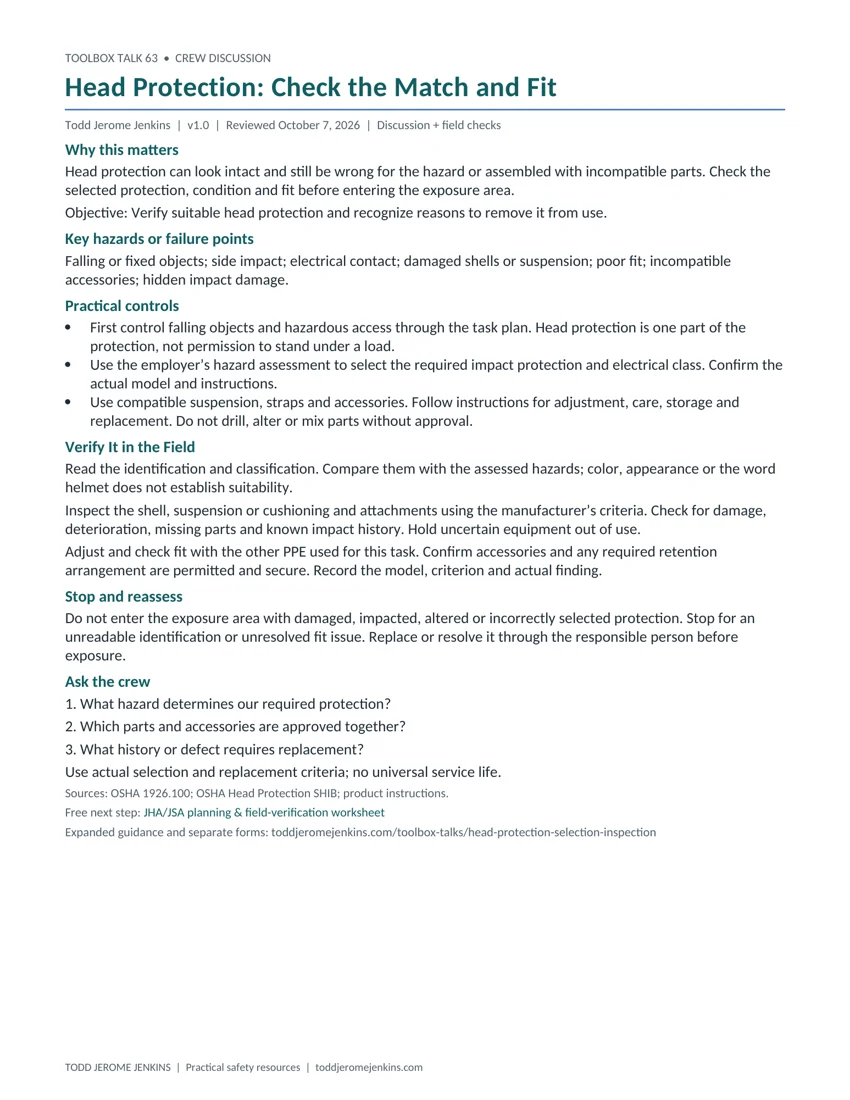
A 5–10 minute crew discussion, plus the time needed for field verification. All six downloads are free without a required signup.
Why this matters
Head protection can look intact and still be wrong for the hazard or assembled with incompatible parts. Check the selected protection, condition and fit before entering the exposure area.
Learning objective: Verify suitable head protection and recognize reasons to remove it from use.
Key hazards or failure points
Falling or fixed objects; side impact; electrical contact; damaged shells or suspension; poor fit; incompatible accessories; hidden impact damage.
Practical controls
- First control falling objects and hazardous access through the task plan. Head protection is one part of the protection, not permission to stand under a load.
- Use the employer’s hazard assessment to select the required impact protection and electrical class. Confirm the actual model and instructions.
- Use compatible suspension, straps and accessories. Follow instructions for adjustment, care, storage and replacement. Do not drill, alter or mix parts without approval.
Verify It in the Field
Read the identification and classification. Compare them with the assessed hazards; color, appearance or the word helmet does not establish suitability.
Inspect the shell, suspension or cushioning and attachments using the manufacturer’s criteria. Check for damage, deterioration, missing parts and known impact history. Hold uncertain equipment out of use.
Adjust and check fit with the other PPE used for this task. Confirm accessories and any required retention arrangement are permitted and secure. Record the model, criterion and actual finding.
Use the separate field check to record the acceptance source and criterion, safe method, checker, actual result and time. Mark VERIFIED, HOLD/NOT VERIFIED, or N/A with a reason. A checkmark alone is not evidence that protection works. Complete all required task checks; do not enter danger or improvise a test.
| Control | Safe verification | Evidence |
|---|---|---|
| Correct selection | Read model and classification against the assessment. | Required protection and actual product match. |
| Sound assembly | Inspect all components under the instructions. | Defects, impact history and disposition. |
| Usable fit | Adjust with the actual compatible PPE and accessories. | Fit result, compatibility source and correction. |
Stop and reassess
Do not enter the exposure area with damaged, impacted, altered or incorrectly selected protection. Stop for an unreadable identification or unresolved fit issue. Replace or resolve it through the responsible person before exposure.
Crew discussion questions
- What hazard determines our required protection?
- Which parts and accessories are approved together?
- What history or defect requires replacement?
A situation to discuss
Illustrative situation: a worker transfers an accessory from an old hard hat to a new helmet. The connection appears to fit, but compatibility is unknown. The worker holds the combination out of use until the permitted assembly is confirmed.
Leader preparation and practical detail
Selection comes before fit
OSHA’s head-protection bulletin explains impact types and electrical classes. Type I addresses top impact; Type II also addresses side impact. Class C does not provide electrical contact protection. Selection must address the task’s actual hazards. A classification test voltage is not a working clearance or permission to contact energized equipment. [2]
Recommendations are not universal mandates
Construction head protection is addressed by 1926.100. The OSHA bulletin provides selection and care recommendations; it does not make one helmet type or chinstrap configuration mandatory for every task. Apply the hazard assessment, relevant requirements and actual product instructions. [1, 2]
Record condition and history
Inspection includes the parts that absorb or manage impact, not only the visible shell. Retire head protection immediately after an impact or significant force, even when damage is not obvious. Use manufacturer replacement instructions and resolve unknown history; do not invent a blanket replacement age for every product. [2]
Short supervisor field check
- Task hazards and required protection identified.
- Model, impact type and electrical class match.
- Shell and internal components inspected.
- Compatible accessories and fit verified.
- Impact history and replacement questions resolved.
Record unresolved items, restrictions, correction owner, recheck result and required restart authorization. Reference permits and specialist inspections rather than treating this form as a replacement. Rebrief workers affected by a change.
Attendance and follow-through
Use the separate attendance sheet for participants, discussion concerns, actions and late-arrival rebriefs. Attendance does not establish competence, verify controls or authorize work. Keep completed records private under the employer’s recordkeeping procedures.
Technical scope and references
Construction head-protection awareness under 1926.100. OSHA’s SHIB is guidance. This talk does not select a product for an unassessed exposure or replace manufacturer instructions. [1, 2]
References reviewed October 7, 2026. Apply the industry, activity and jurisdiction that govern the work. No actual site permit, equipment manual, exposure assessment or engineering determination was supplied for this general discussion.
- OSHA 1926.100 — Head protection — Construction requirements and accepted protection criteria.
- OSHA — Head Protection SHIB — 2024 guidance on selection, classification, inspection, care and replacement.
Connect this discussion to your JHA/JSA
Use How to Conduct a Job Safety Analysis to connect task steps, hazards and controls. Revisit Pre-Job JHA/JSA: What Changed Today? when conditions change.
Related crew discussions
- Hierarchy of Controls: Verify the Protection
- Fall Prevention: Verify the Controls
- Eye & Face Protection
- Line of Fire: Swing Radius & Suspended Loads
Put one check into practice
Use the free JHA/JSA planning and field-verification worksheet to record today’s changes, important controls and the evidence needed before exposure.