Download the talk and separate crew records
Free to download without an account. Each PDF is one page. Use the Word version to adapt the record to your task and approved procedures.
Supervisor field check
Download supervisor field check (PDF, 1 page)Editable supervisor field check (Word)Preview the one-page crew talk
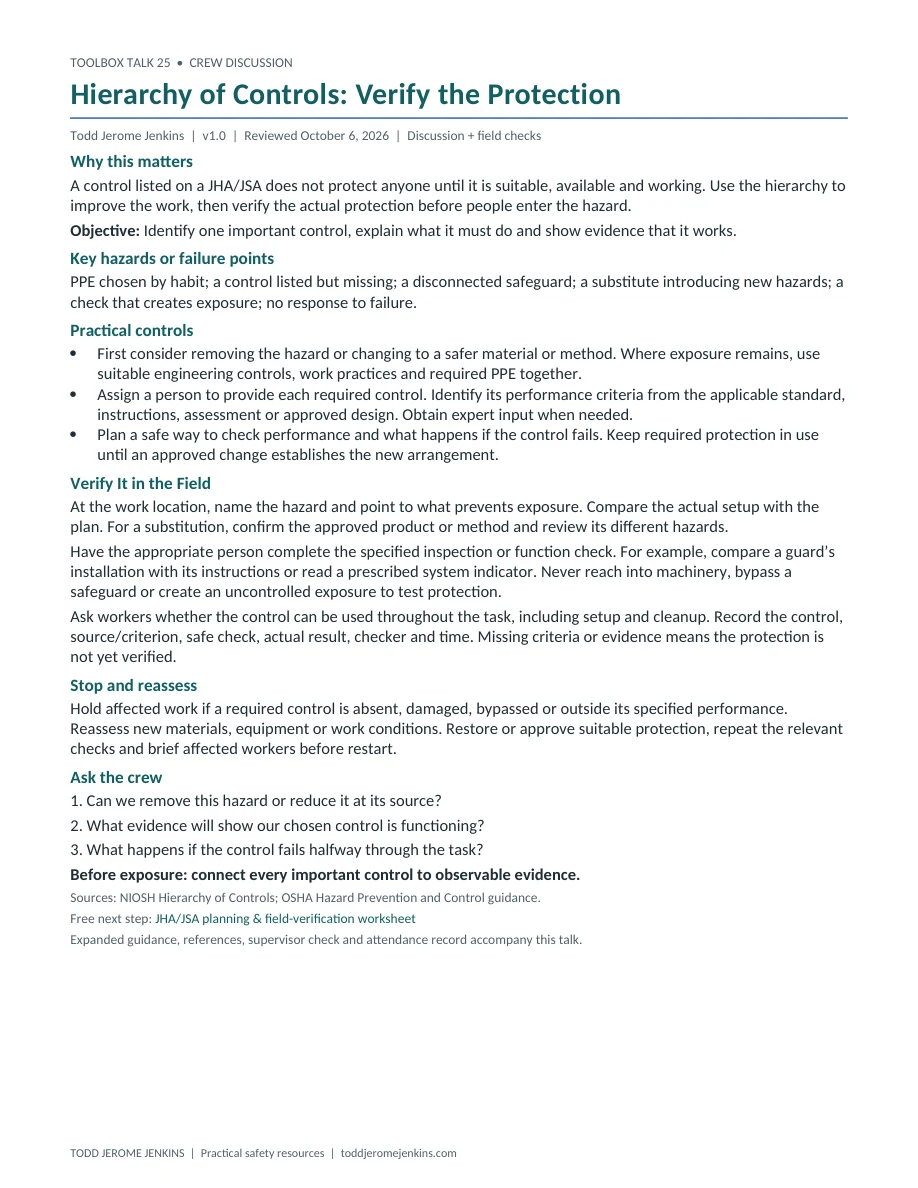
A 5–10 minute crew discussion, plus the time needed for field verification. All six downloads are free without a required signup.
Why this matters
A control listed on a JHA/JSA does not protect anyone until it is suitable, available and working. Use the hierarchy to improve the work, then verify the actual protection before people enter the hazard.
Learning objective: Identify one important control, explain what it must do and show evidence that it works.
Key hazards or failure points
PPE chosen by habit; a control listed but missing; a disconnected safeguard; a substitute introducing new hazards; a check that creates exposure; no response to failure.
Practical controls
- First consider removing the hazard or changing to a safer material or method. Where exposure remains, use suitable engineering controls, work practices and required PPE together.
- Assign a person to provide each required control. Identify its performance criteria from the applicable standard, instructions, assessment or approved design. Obtain expert input when needed.
- Plan a safe way to check performance and what happens if the control fails. Keep required protection in use until an approved change establishes the new arrangement.
Verify It in the Field
At the work location, name the hazard and point to what prevents exposure. Compare the actual setup with the plan. For a substitution, confirm the approved product or method and review its different hazards.
Have the appropriate person complete the specified inspection or function check. For example, compare a guard’s installation with its instructions or read a prescribed system indicator. Never reach into machinery, bypass a safeguard or create an uncontrolled exposure to test protection.
Ask workers whether the control can be used throughout the task, including setup and cleanup. Record the control, source/criterion, safe check, actual result, checker and time. Missing criteria or evidence means the protection is not yet verified.
Use the separate field check to record the source and criterion, safe method, checker, actual result and time. Mark VERIFIED, HOLD/NOT VERIFIED, or N/A with a reason. Check every required control; the examples below do not clear the whole task.
| Control | Safe verification | Evidence to record |
|---|---|---|
| Hazard removed | Compare the revised scope with the physical work remaining. | No remaining exposure from the removed task; related hazards still assessed. |
| Engineering control | Use the prescribed installation and safe function checks. | Actual result compared with the source criterion; unresolved failures held. |
| Work practice/PPE | Check staffing, sequence, equipment selection and usability with the crew. | Required arrangements available for the full task, including cleanup. |
Stop and reassess
Hold affected work if a required control is absent, damaged, bypassed or outside its specified performance. Reassess new materials, equipment or work conditions. Restore or approve suitable protection, repeat the relevant checks and brief affected workers before restart.
Crew discussion questions
- Can we remove this hazard or reduce it at its source?
- What evidence will show our chosen control is functioning?
- What happens if the control fails halfway through the task?
Before exposure: connect every important control to observable evidence.
A situation to discuss
Illustrative situation: the JHA/JSA lists dust extraction, but the delivered tool cannot connect to the specified collector. The crew records the mismatch and holds dust-producing work while the approved setup is restored or an acceptable alternative is established.
Leader preparation and practical detail
Use the order to improve the job
The hierarchy prioritizes elimination, substitution and engineering ahead of administrative measures and PPE. Lower-level measures can still be necessary, and more than one control may be needed. Review substitutes for new hazards and make changes through the employer’s process. The hierarchy does not authorize removal of required PPE or bypass of a task standard. [1]
Separate presence from performance
A control can be installed but unsuitable for the exposure, or suitable but not functioning. Write a check that distinguishes these questions. For a guarded tool, that may require matching the installed guard to the tool and prescribed configuration, then completing only the safe checks allowed by its instructions. A photograph of the guard does not establish every aspect of performance.
Plan the evidence and the failure response
Before the check, identify the expected result and the source that defines it. OSHA’s recommended practices include verifying that controls are installed, tested, used and maintained. The evidence fields in this resource are a practical way to organize that follow-through; they are not a new regulatory inspection form. [2]
Short supervisor field check
- Hazard and options for removal/substitution considered.
- Required controls and responsible people identified.
- Criteria and safe verification methods drawn from actual sources.
- Installation, function and practical usability checked.
- Failure response, corrective owner and recheck agreed.
Use the separate form to document evidence, restrictions, corrective-action owner, recheck and required restart approval. An unresolved required control means hold the affected work. Missing evidence is not a pass. Complete all task-specific inspections and permits.
Attendance and follow-through
The separate attendance sheet records participants, language support, questions, actions and late-arrival rebriefs. Attendance does not establish competence or prove controls function. Keep completed records private under the employer’s procedures.
Technical scope and references
The hierarchy is a decision framework. Task-specific OSHA requirements, equipment instructions, engineering decisions and exposure assessments still determine acceptable controls and verification methods. No universal airflow, force, clearance or exposure threshold is supplied here. [1], [2]
References checked October 6, 2026. Apply the jurisdiction, task, employer program and equipment instructions that govern the work. No site-specific manual, permit, engineering determination or product SDS has been approved by this general resource.
- NIOSH — Hierarchy of Controls — Preferred control order and the need to assess new risks introduced by substitutes. Guidance.
- OSHA — Hazard Prevention and Control — Recommended practices: control selection, implementation, follow-up and maintenance.
Connect this discussion to your JHA/JSA
Use How to Conduct a Job Safety Analysis to connect today’s work steps, hazards and controls. Revisit Pre-Job JHA/JSA: What Changed Today? whenever conditions change.
Related Todd Jerome Jenkins article: Hierarchy of Controls and Knowledge Check.
Related Todd Jerome Jenkins video: What Is the Hierarchy of Controls? | Workplace Safety Explained.
Related published crew resources: Respiratory Hazards: Know What You’re Breathing.
Put one check into practice
Download the free JHA/JSA planning and field-verification worksheet. For today’s task, record an important control, its source and the evidence needed before exposure. Complete the remaining required checks through your task plan.