Download the talk and separate crew records
Free to download without an account. Each PDF is one page. Use the Word version to adapt the record to your task and approved procedures.
Supervisor field check
Download supervisor field check (PDF, 1 page)Editable supervisor field check (Word)Preview the one-page crew talk
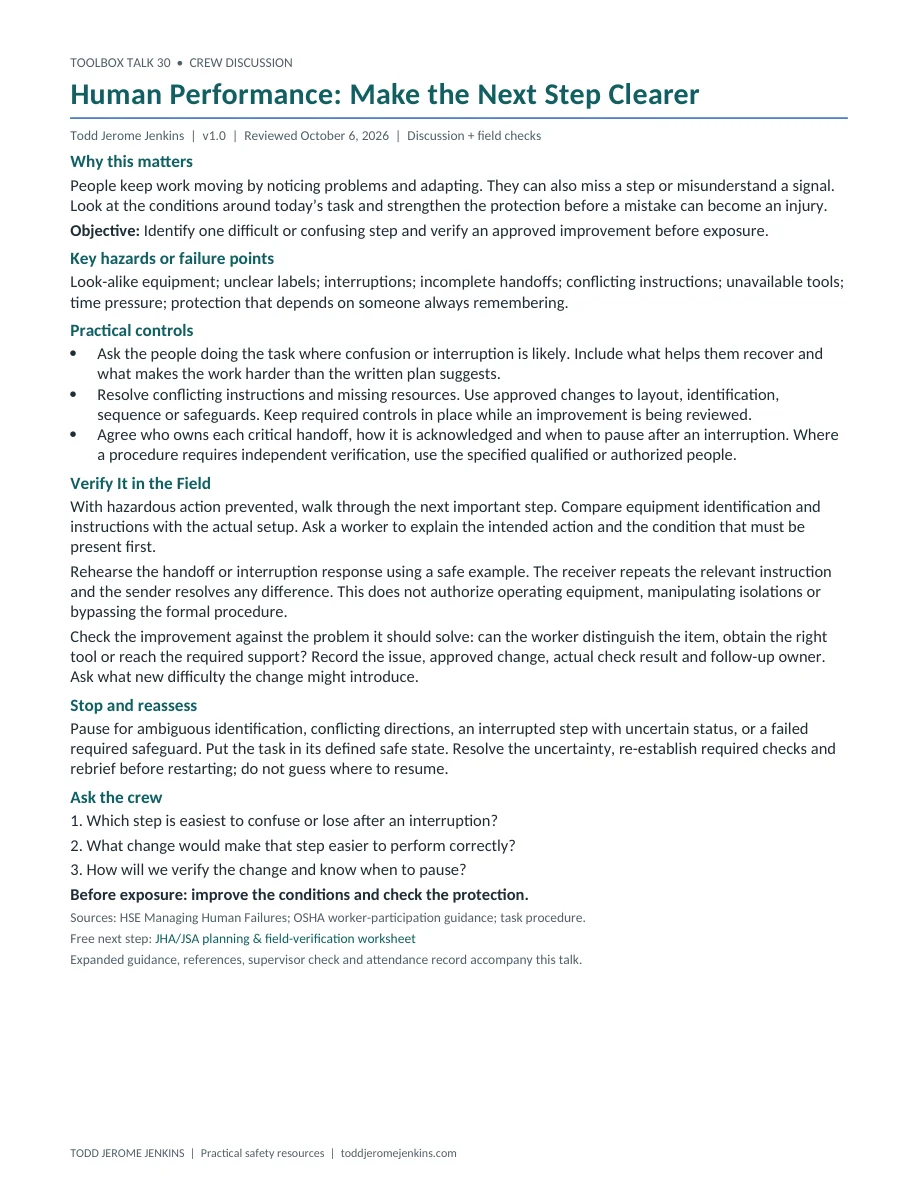
A 5–10 minute crew discussion, plus the time needed for field verification. All six downloads are free without a required signup.
Why this matters
People keep work moving by noticing problems and adapting. They can also miss a step or misunderstand a signal. Look at the conditions around today’s task and strengthen the protection before a mistake can become an injury.
Learning objective: Identify one difficult or confusing step and verify an approved improvement before exposure.
Key hazards or failure points
Look-alike equipment; unclear labels; interruptions; incomplete handoffs; conflicting instructions; unavailable tools; time pressure; protection that depends on someone always remembering.
Practical controls
- Ask the people doing the task where confusion or interruption is likely. Include what helps them recover and what makes the work harder than the written plan suggests.
- Resolve conflicting instructions and missing resources. Use approved changes to layout, identification, sequence or safeguards. Keep required controls in place while an improvement is being reviewed.
- Agree who owns each critical handoff, how it is acknowledged and when to pause after an interruption. Where a procedure requires independent verification, use the specified qualified or authorized people.
Verify It in the Field
With hazardous action prevented, walk through the next important step. Compare equipment identification and instructions with the actual setup. Ask a worker to explain the intended action and the condition that must be present first.
Rehearse the handoff or interruption response using a safe example. The receiver repeats the relevant instruction and the sender resolves any difference. This does not authorize operating equipment, manipulating isolations or bypassing the formal procedure.
Check the improvement against the problem it should solve: can the worker distinguish the item, obtain the right tool or reach the required support? Record the issue, approved change, actual check result and follow-up owner. Ask what new difficulty the change might introduce.
Use the separate field check to record the source and criterion, safe method, checker, actual result and time. Mark VERIFIED, HOLD/NOT VERIFIED, or N/A with a reason. Check every required control; the examples below do not clear the whole task.
| Control | Safe verification | Evidence to record |
|---|---|---|
| Clear identification | Compare the actual identifier with the task instruction from a safe position. | Mismatch corrected through the approved process; identity established before action. |
| Complete handoff | Rehearse sender/receiver confirmation with no hazardous operation. | Responsibility, task status and next required check understood. |
| Usable improvement | Walk through the approved change with affected workers. | Original difficulty addressed; new problems, owner and follow-up recorded. |
Stop and reassess
Pause for ambiguous identification, conflicting directions, an interrupted step with uncertain status, or a failed required safeguard. Put the task in its defined safe state. Resolve the uncertainty, re-establish required checks and rebrief before restarting; do not guess where to resume.
Crew discussion questions
- Which step is easiest to confuse or lose after an interruption?
- What change would make that step easier to perform correctly?
- How will we verify the change and know when to pause?
Before exposure: improve the conditions and check the protection.
A situation to discuss
Illustrative situation: two nearby equipment identifiers are difficult to distinguish from the normal working position. The crew holds the affected operation and requests an approved identification improvement. A safe walkthrough checks whether the change resolves the confusion without obscuring other required information.
Leader preparation and practical detail
Describe the condition precisely
Useful observations name the task difficulty: two instructions conflict, a necessary tool is unavailable or an interruption leaves no clear record of the last completed step. Avoid closing the discussion with a label such as careless. HSE guidance identifies task design, communication, workload and distraction as factors that can influence errors. [1]
Keep the formal safety process intact
A HOP conversation can reveal why a control is hard to use; it does not authorize a workaround. Submit changes through the appropriate review and retain required safeguards. For energy isolation, permits and other specialized work, follow the prescribed identification, verification and restart process. A conversational repeat-back is not a substitute for a required technical test.
Check the effect with the people doing the work
Ask the worker to explain or demonstrate the approved improvement without exposure. Capture both the intended benefit and any new difficulty. HSE emphasizes designing for human limitations; OSHA’s worker-participation guidance supports involving workers in improving the safety program. The example checks here turn that intent into practical questions for this briefing. [1], [2]
Short supervisor field check
- Crew identifies a specific difficulty and useful existing practices.
- Conflicting instructions/resources resolved before the affected step.
- Proposed change approved through the appropriate process.
- Safe walkthrough/handoff check demonstrates the intended improvement.
- Interruption response, change risks and follow-up owner agreed.
Use the separate form to document evidence, restrictions, corrective-action owner, recheck and required restart approval. An unresolved required control means hold the affected work. Missing evidence is not a pass. Complete all task-specific inspections and permits.
Attendance and follow-through
The separate attendance sheet records participants, language support, questions, actions and late-arrival rebriefs. Attendance does not establish competence or prove controls function. Keep completed records private under the employer’s procedures.
Technical scope and references
HSE is the UK regulator; its human-factors material is used here as guidance, not as a U.S. legal requirement. HOP informs the conversation and design of work. It does not replace competence, permits, engineering review, required checks or evidence-based investigation. [1], [2]
References checked October 6, 2026. Apply the jurisdiction, task, employer program and equipment instructions that govern the work. No site-specific manual, permit, engineering determination or product SDS has been approved by this general resource.
- HSE — Managing human failures: Overview — UK regulator guidance on task design, performance conditions and error-tolerant systems; not a U.S. legal requirement.
- OSHA — Worker Participation — Recommended practices: meaningful worker input, reporting, feedback and removing participation barriers.
Connect this discussion to your JHA/JSA
Use How to Conduct a Job Safety Analysis to connect today’s work steps, hazards and controls. Revisit Pre-Job JHA/JSA: What Changed Today? whenever conditions change.
Related Todd Jerome Jenkins article: What Is Human and Organizational Performance (HOP)?.
Related Todd Jerome Jenkins video: Job Safety Analysis: A Basic Overview.
Put one check into practice
Download the free JHA/JSA planning and field-verification worksheet. For today’s task, record an important control, its source and the evidence needed before exposure. Complete the remaining required checks through your task plan.
Continue the crew discussion
- Pre-Job JHA/JSA: What Changed Today?
- New to the Job: Show the Work Before You Start
- Hierarchy of Controls: Verify the Protection
- Learning Teams: Ask What Makes Work Difficult
- Learning from Incidents: Verify the Fix