Download the free crew talk
The one-page talk, editable Word version, and guidance below are open to everyone. No account required.
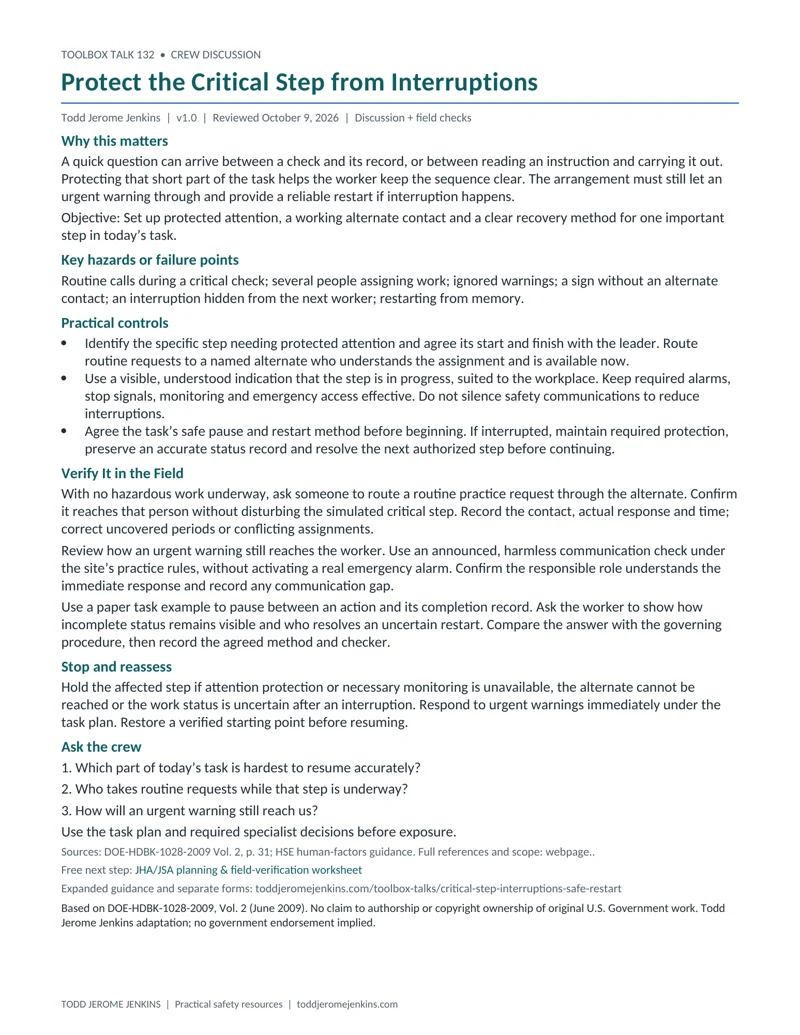
Preview the one-page crew talk
Supporting documents
Included with free Safety & Systems membership.
Supervisor field check
A separate check to verify conditions and controls before work. Includes a one-page PDF and editable Word file.
Attendance sheet
A separate sign-in sheet to record the crew discussion. Includes a one-page PDF and editable Word file.
Need the crew records? Join free to use these supporting documents and the Safety & Systems Academy. No payment details. Email updates are optional.
Get supporting documents — free membershipAlready a member? Use the same link to sign in.
Human Performance weekly series: lesson 9 of 52.
A 5–10 minute crew discussion, plus time to verify the actual controls. The crew talk and Word version are public. Separate supervisor and attendance records are included with free Safety & Systems membership.
Why this matters
A quick question can arrive between a check and its record, or between reading an instruction and carrying it out. Protecting that short part of the task helps the worker keep the sequence clear. The arrangement must still let an urgent warning through and provide a reliable restart if interruption happens.
Learning objective
Set up protected attention, a working alternate contact and a clear recovery method for one important step in today’s task.
Key hazards or failure points
Routine calls during a critical check; several people assigning work; ignored warnings; a sign without an alternate contact; an interruption hidden from the next worker; restarting from memory.
Practical controls
- Identify the specific step needing protected attention and agree its start and finish with the leader. Route routine requests to a named alternate who understands the assignment and is available now.
- Use a visible, understood indication that the step is in progress, suited to the workplace. Keep required alarms, stop signals, monitoring and emergency access effective. Do not silence safety communications to reduce interruptions.
- Agree the task’s safe pause and restart method before beginning. If interrupted, maintain required protection, preserve an accurate status record and resolve the next authorized step before continuing.
Verify It in the Field
- With no hazardous work underway, ask someone to route a routine practice request through the alternate. Confirm it reaches that person without disturbing the simulated critical step. Record the contact, actual response and time; correct uncovered periods or conflicting assignments.
- Review how an urgent warning still reaches the worker. Use an announced, harmless communication check under the site’s practice rules, without activating a real emergency alarm. Confirm the responsible role understands the immediate response and record any communication gap.
- Use a paper task example to pause between an action and its completion record. Ask the worker to show how incomplete status remains visible and who resolves an uncertain restart. Compare the answer with the governing procedure, then record the agreed method and checker.
Stop and reassess
Hold the affected step if attention protection or necessary monitoring is unavailable, the alternate cannot be reached or the work status is uncertain after an interruption. Respond to urgent warnings immediately under the task plan. Restore a verified starting point before resuming.
Crew discussion questions
- Which part of today’s task is hardest to resume accurately?
- Who takes routine requests while that step is underway?
- How will an urgent warning still reach us?
For each required control, record its acceptance source and criterion, safe verification method, responsible checker, actual result and time. Use VERIFIED, HOLD/NOT VERIFIED, or N/A with a reason. A tick alone is not evidence. Complete all applicable task inspections; do not enter danger or improvise a test to fill out a form.
Leader preparation and practical detail
A sign needs a working arrangement behind it
Illustrative situation: a reviewer posts a do-not-disturb notice, but its alternate contact is absent. Routine questions accumulate and colleagues start interrupting anyway. The leader provides actual coverage, explains which requests can wait and identifies the route for urgent issues. The DOE excerpt originally addresses concentration during technical preparation and review. This crew application uses the same planning idea without assuming every task can be isolated or every worker can stop monitoring the surrounding operation.
Never protect attention by blocking a warning
Illustrative situation: a worker tries to finish a difficult check while an adjacent crew needs to report a changing condition. The protected-attention arrangement must allow that information through. Required radios, alarms, observers and emergency access stay effective. Announce any rehearsal so a practice message cannot be mistaken for a real operational command. If routine messages and urgent warnings cannot be distinguished reliably, improve the communication arrangement before assigning the critical work.
Recover the sequence rather than testing memory
Illustrative situation: an interruption occurs after a physical action but before its completion is recorded. The worker cannot confidently establish whether every required part was finished. The leader maintains the task’s safe hold, preserves the honest incomplete status and obtains the required review. Do not instruct the worker to repeat an action automatically; repetition itself may change equipment or defeat a check. Use the approved restart method, and address the interruption source so the same problem does not recur on the next cycle.
Short supervisor field check
- Specific protected step and start/finish boundaries agreed.
- Available alternate receives routine requests in a safe rehearsal.
- Required warnings, monitoring and emergency access remain effective.
- Interruption status and restart method match the governing procedure.
- Crew knows when to hold, seek help and remove the in-progress indication.
Confirm the relevant trained/authorized people, unresolved items, interim protection, correction owner and recheck. Record required release authority and rebrief anyone affected. The separate sheet supports these records; it does not replace a specialist inspection, permit or engineering determination.
Attendance and follow-through
Use the separate attendance sheet for participants, roles, discussion concerns, actions and late-arrival rebriefs. Attendance is not proof of competence, functioning controls or authorization to work. Keep completed records private under employer procedures.
Source acknowledgment
This resource draws on the U.S. Department of Energy’s DOE-HDBK-1028-2009, Human Performance Improvement Handbook, Volume 2 (June 2009). Todd Jerome Jenkins makes no claim of authorship or copyright ownership in the original U.S. Government work. New explanations, examples, exercises and layouts are Todd Jerome Jenkins adaptations. No endorsement by DOE or the U.S. Government is implied. Third-party material credited in the handbook remains attributed to its source; this notice does not claim rights in that material.
Source excerpt: Volume 2/VOLUME 2 Do Not Disturb Sign.pdf; Printed pp. 31. The June 2009 handbook supplies concepts; this lesson uses original explanations and exercises.
Technical scope and references
References reviewed October 9, 2026. DOE human-performance tools and OSHA recommended practices support preparation and discussion; they do not establish universal technical acceptance criteria. Apply the current task procedure, manufacturer instructions, permit and required competent or qualified decisions. A successful exercise does not replace required training, technical verification or work authorization.
- DOE-HDBK-1028-2009, Volume 2 — Do Not Disturb Sign, printed p. 31 — June 2009 guidance originally focused on technical preparation/review; crew interruption scenario is an original application, not an equipment instruction.
- HSE — Managing Human Failures — Current UK regulator guidance on task design, distraction, workload and error-tolerant systems; not a U.S. legal standard.
- HSE — Safety Critical Communications — Guidance supporting communication arrangements beyond a sign alone; urgent warnings remain effective.
Connect this discussion to your JHA/JSA
Use the JHA/JSA planning and field-verification worksheet to record the actual task steps, hazards, responsible roles and controls. No task-specific worked example is linked for this topic yet. Return to What Changed Today? when the plan or conditions change.
Related Todd Jerome Jenkins articles: How to Conduct a Job Safety Analysis and What Is Human and Organizational Performance?.
Related crew discussions
Continue the weekly series
- Lesson 8: Similar-Sounding Identifiers: Say Exactly Which One
- Lesson 10: Place-Keeping: Know Where to Resume
Put one check into practice
Use the free JHA/JSA planning and field-verification worksheet to record today’s change, the required protection and the evidence needed before exposure.