Download the free crew talk
The one-page talk, editable Word version, and guidance below are open to everyone. No account required.
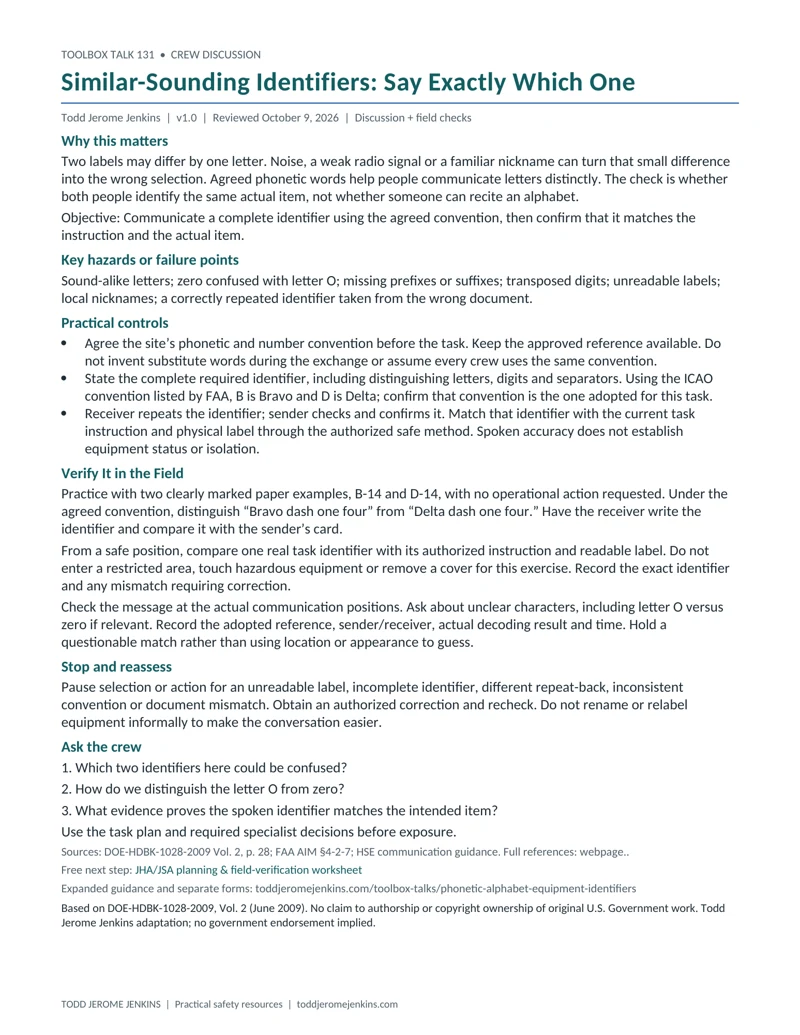
Preview the one-page crew talk
Supporting documents
Included with free Safety & Systems membership.
Supervisor field check
A separate check to verify conditions and controls before work. Includes a one-page PDF and editable Word file.
Attendance sheet
A separate sign-in sheet to record the crew discussion. Includes a one-page PDF and editable Word file.
Need the crew records? Join free to use these supporting documents and the Safety & Systems Academy. No payment details. Email updates are optional.
Get supporting documents — free membershipAlready a member? Use the same link to sign in.
Human Performance weekly series: lesson 8 of 52.
A 5–10 minute crew discussion, plus time to verify the actual controls. The crew talk and Word version are public. Separate supervisor and attendance records are included with free Safety & Systems membership.
Why this matters
Two labels may differ by one letter. Noise, a weak radio signal or a familiar nickname can turn that small difference into the wrong selection. Agreed phonetic words help people communicate letters distinctly. The check is whether both people identify the same actual item, not whether someone can recite an alphabet.
Learning objective
Communicate a complete identifier using the agreed convention, then confirm that it matches the instruction and the actual item.
Key hazards or failure points
Sound-alike letters; zero confused with letter O; missing prefixes or suffixes; transposed digits; unreadable labels; local nicknames; a correctly repeated identifier taken from the wrong document.
Practical controls
- Agree the site’s phonetic and number convention before the task. Keep the approved reference available. Do not invent substitute words during the exchange or assume every crew uses the same convention.
- State the complete required identifier, including distinguishing letters, digits and separators. Using the ICAO convention listed by FAA, B is Bravo and D is Delta; confirm that convention is the one adopted for this task.
- Receiver repeats the identifier; sender checks and confirms it. Match that identifier with the current task instruction and physical label through the authorized safe method. Spoken accuracy does not establish equipment status or isolation.
Verify It in the Field
- Practice with two clearly marked paper examples, B-14 and D-14, with no operational action requested. Under the agreed convention, distinguish “Bravo dash one four” from “Delta dash one four.” Have the receiver write the identifier and compare it with the sender’s card.
- From a safe position, compare one real task identifier with its authorized instruction and readable label. Do not enter a restricted area, touch hazardous equipment or remove a cover for this exercise. Record the exact identifier and any mismatch requiring correction.
- Check the message at the actual communication positions. Ask about unclear characters, including letter O versus zero if relevant. Record the adopted reference, sender/receiver, actual decoding result and time. Hold a questionable match rather than using location or appearance to guess.
Stop and reassess
Pause selection or action for an unreadable label, incomplete identifier, different repeat-back, inconsistent convention or document mismatch. Obtain an authorized correction and recheck. Do not rename or relabel equipment informally to make the conversation easier.
Crew discussion questions
- Which two identifiers here could be confused?
- How do we distinguish the letter O from zero?
- What evidence proves the spoken identifier matches the intended item?
For each required control, record its acceptance source and criterion, safe verification method, responsible checker, actual result and time. Use VERIFIED, HOLD/NOT VERIFIED, or N/A with a reason. A tick alone is not evidence. Complete all applicable task inspections; do not enter danger or improvise a test to fill out a form.
Leader preparation and practical detail
Use one agreed reference
Keep the site’s adopted phonetic and number convention available during the briefing. FAA’s Aeronautical Information Manual section 4-2-7 lists the ICAO convention: Bravo for B, Delta for D and Oscar for O; the digit 0 is Zero. Use those examples only where that convention is adopted for the task. The aviation reference verifies the words; it does not set construction operating rules. Agree how prefixes, digits and separators will be spoken, then practice a complete identifier.
Check the label as well as the message
Illustrative situation: sender and receiver both say the same identifier correctly, but the work package refers to the adjacent unit. The communication loop succeeds while the task selection remains wrong. The authorized worker compares the current instruction, equipment label and work scope before any action. Keep the affected step held when those sources disagree. A phonetic alphabet helps transmit characters; it cannot repair a deficient work package or establish that equipment is safe to operate or service.
Make the practice useful for the actual crew
Use paper examples that reflect a real distinguishing feature without copying confidential plant information. Let workers use the reference card and explain which part is difficult to hear. If the crew uses more than one language, verify shared meaning rather than rating accents or memory. Avoid taking the exercise into a hazardous area to obtain realistic noise. Check the communication arrangement from authorized safe positions and correct equipment, format or location problems before the operational task.
Short supervisor field check
- Site-approved phonetic and number convention identified and available.
- Full identifier includes each required prefix, suffix and separator.
- Practice receiver records the same identifier the sender intended.
- Current instruction and actual label agree through a safe check.
- Label/document mismatches held for authorized correction and recheck.
Confirm the relevant trained/authorized people, unresolved items, interim protection, correction owner and recheck. Record required release authority and rebrief anyone affected. The separate sheet supports these records; it does not replace a specialist inspection, permit or engineering determination.
Attendance and follow-through
Use the separate attendance sheet for participants, roles, discussion concerns, actions and late-arrival rebriefs. Attendance is not proof of competence, functioning controls or authorization to work. Keep completed records private under employer procedures.
Source acknowledgment
This resource draws on the U.S. Department of Energy’s DOE-HDBK-1028-2009, Human Performance Improvement Handbook, Volume 2 (June 2009). Todd Jerome Jenkins makes no claim of authorship or copyright ownership in the original U.S. Government work. New explanations, examples, exercises and layouts are Todd Jerome Jenkins adaptations. No endorsement by DOE or the U.S. Government is implied. Third-party material credited in the handbook remains attributed to its source; this notice does not claim rights in that material.
Source excerpt: Volume 2/VOLUME 2 EFFECTIVE COMMUNICATION Phonetic Alphabet.pdf; Printed pp. 28. The June 2009 handbook supplies concepts; this lesson uses original explanations and exercises.
Technical scope and references
References reviewed October 9, 2026. DOE human-performance tools and OSHA recommended practices support preparation and discussion; they do not establish universal technical acceptance criteria. Apply the current task procedure, manufacturer instructions, permit and required competent or qualified decisions. A successful exercise does not replace required training, technical verification or work authorization.
- DOE-HDBK-1028-2009, Volume 2 — Phonetic Alphabet, printed p. 28 — Historical concept source inspected; apparent table/example errors identified and not reproduced.
- FAA Aeronautical Information Manual — §4-2-7, Phonetic Alphabet — Current official ICAO alphabet reference used to verify the small letter/digit examples only; not imposed as a construction operating rule.
- HSE — Safety Critical Communications — UK regulator guidance on appropriate terminology, workforce language and communication methods.
Connect this discussion to your JHA/JSA
Use the JHA/JSA planning and field-verification worksheet to record the actual task steps, hazards, responsible roles and controls. No task-specific worked example is linked for this topic yet. Return to What Changed Today? when the plan or conditions change.
Related Todd Jerome Jenkins articles: How to Conduct a Job Safety Analysis and What Is Human and Organizational Performance?.
Related crew discussions
Continue the weekly series
- Lesson 7: Three-Way Communication: Close the Loop Before Acting
- Lesson 9: Protect the Critical Step from Interruptions
Put one check into practice
Use the free JHA/JSA planning and field-verification worksheet to record today’s change, the required protection and the evidence needed before exposure.