Download the talk and separate crew records
Free to download without an account. Each PDF is one page. Use the Word version to adapt the record to your task and approved procedures.
Supervisor field check
Download supervisor field check (PDF, 1 page)Editable supervisor field check (Word)Preview the one-page crew talk
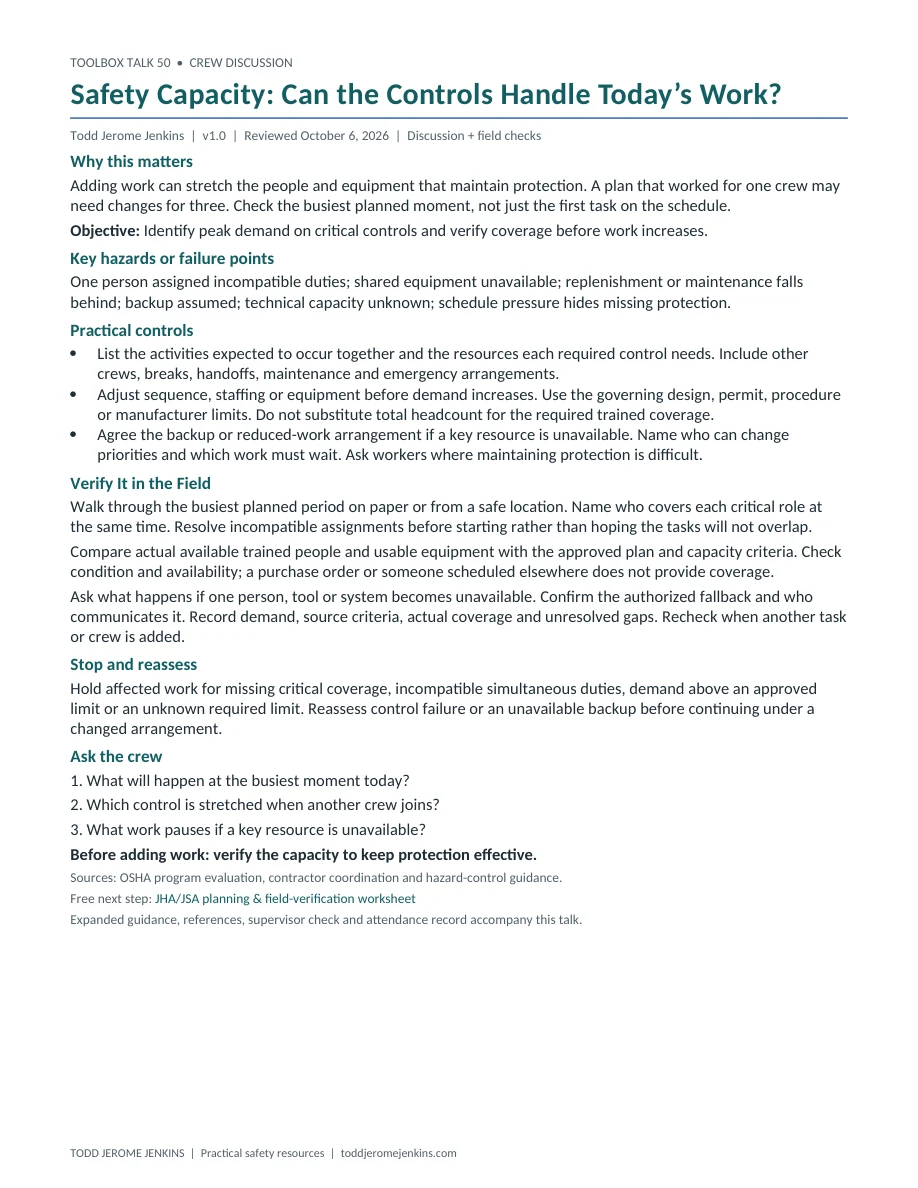
A 5–10 minute crew discussion, plus the time needed for field verification. All six downloads are free without a required signup.
Why this matters
Adding work can stretch the people and equipment that maintain protection. A plan that worked for one crew may need changes for three. Check the busiest planned moment, not just the first task on the schedule.
Learning objective: Identify peak demand on critical controls and verify coverage before work increases.
Key hazards or failure points
One person assigned incompatible duties; shared equipment unavailable; replenishment or maintenance falls behind; backup assumed; technical capacity unknown; schedule pressure hides missing protection.
Practical controls
- List the activities expected to occur together and the resources each required control needs. Include other crews, breaks, handoffs, maintenance and emergency arrangements.
- Adjust sequence, staffing or equipment before demand increases. Use the governing design, permit, procedure or manufacturer limits. Do not substitute total headcount for the required trained coverage.
- Agree the backup or reduced-work arrangement if a key resource is unavailable. Name who can change priorities and which work must wait. Ask workers where maintaining protection is difficult.
Verify It in the Field
Walk through the busiest planned period on paper or from a safe location. Name who covers each critical role at the same time. Resolve incompatible assignments before starting rather than hoping the tasks will not overlap.
Compare actual available trained people and usable equipment with the approved plan and capacity criteria. Check condition and availability; a purchase order or someone scheduled elsewhere does not provide coverage.
Ask what happens if one person, tool or system becomes unavailable. Confirm the authorized fallback and who communicates it. Record demand, source criteria, actual coverage and unresolved gaps. Recheck when another task or crew is added.
Use the separate field check to record the source and criterion, safe method, checker, actual result and time. Mark VERIFIED, HOLD/NOT VERIFIED, or N/A with a reason. Check every required control; the examples below do not clear the whole task.
| Control | Safe verification | Evidence to record |
|---|---|---|
| Role coverage | Review concurrent duties against actual qualified availability. | Time/task conflict and agreed coverage. |
| Technical capacity | Compare usable equipment and demand with governing limits. | Source, available capacity and finding. |
| Fallback plan | Rehearse the response to loss of a critical resource. | Work held, decision owner and communication. |
Stop and reassess
Hold affected work for missing critical coverage, incompatible simultaneous duties, demand above an approved limit or an unknown required limit. Reassess control failure or an unavailable backup before continuing under a changed arrangement.
Crew discussion questions
- What will happen at the busiest moment today?
- Which control is stretched when another crew joins?
- What work pauses if a key resource is unavailable?
Before adding work: verify the capacity to keep protection effective.
A situation to discuss
Illustrative situation: a schedule change assigns one person to two tasks that each require continuous attention at different locations. The leader sequences the work or provides suitable coverage before either task starts. The person is not told to watch both and do their best.
Leader preparation and practical detail
Capacity is about maintaining protection
Here, capacity means the ability to keep required controls effective under actual demand. It is not a safety score or a claim that more staffing always solves the problem. Examine the specific duty, equipment capability and time needed to perform the check or maintain protection. No universal staffing ratio or spare-capacity percentage is supplied.
Study the peak, not the average
A control may be available at the briefing and unavailable when simultaneous work begins. Map the actual sequence and shared resources. Coordinate affected employers and ask workers where the schedule assumes a person or tool can be in two places at once. A safe sequence may remove the conflict without creating a new one. [2], [3]
Review after changes
OSHA’s program-evaluation guidance calls for reviewing changes in equipment, facilities, materials, personnel and work practices. Use those changes to revisit control coverage. A period without reported injuries does not establish that capacity is adequate for a larger or different operation. Verify the planned arrangement and check how it works after implementation. [1]
Short supervisor field check
- Peak simultaneous demand identified.
- Critical roles have available suitable coverage.
- Equipment/control limits and condition checked.
- Fallback or sequence change authorized and understood.
- Added demand triggers review before exposure.
Use the separate form to document evidence, restrictions, corrective-action owner, recheck and required restart approval. An unresolved required control means hold the affected work. Missing evidence is not a pass. Complete all task-specific inspections and permits.
Attendance and follow-through
The separate attendance sheet records participants, language support, questions, actions and late-arrival rebriefs. Attendance does not establish competence or prove controls function. Keep completed records private under the employer’s procedures.
Technical scope and references
This is an original practical application of work-system thinking supported by OSHA recommended practices. It does not set staffing ratios, technical capacity or emergency-response limits. Those come from the applicable plan, engineering, permit, regulation and equipment instructions. [1], [2], [3]
References checked October 6, 2026. Apply the jurisdiction, task, employer program and equipment instructions that govern the work. No site-specific manual, permit, engineering determination or product SDS has been approved by this general resource.
- OSHA Recommended Practices — Program Evaluation and Improvement — Recommended practices; no universal staffing ratio, workload maximum, or redundancy specification.
- OSHA Recommended Practices — Communication and Coordination — Recommended practices for multiemployer/staffing arrangements, not a claim every job requires a document titled SSSP.
- OSHA Recommended Practices — Hazard Prevention and Control — Recommended practices, not a standalone technical acceptance standard. Site-specific criteria must come from applicable authoritative sources.
Connect this discussion to your JHA/JSA
Use How to Conduct a Job Safety Analysis to connect today’s work steps, hazards and controls. Revisit Pre-Job JHA/JSA: What Changed Today? whenever conditions change.
Related Todd Jerome Jenkins article: What Is Human and Organizational Performance?.
Related Todd Jerome Jenkins video: What Is the Hierarchy of Controls? | Workplace Safety Explained.
Related published crew resources: New to the Job: Show the Work Before You Start; Hierarchy of Controls: Verify the Protection; Human Performance: Make the Next Step Clearer; Learning Teams: Ask What Makes Work Difficult.
Put one check into practice
Download the free JHA/JSA planning and field-verification worksheet. For today’s task, record an important control, its source and the evidence needed before exposure. Complete the remaining required checks through your task plan.