Download the talk and separate crew records
Free to download without an account. Each PDF is one page. Use the Word version to adapt the record to your task and approved procedures.
Supervisor field check
Download supervisor field check (PDF, 1 page)Editable supervisor field check (Word)Preview the one-page crew talk
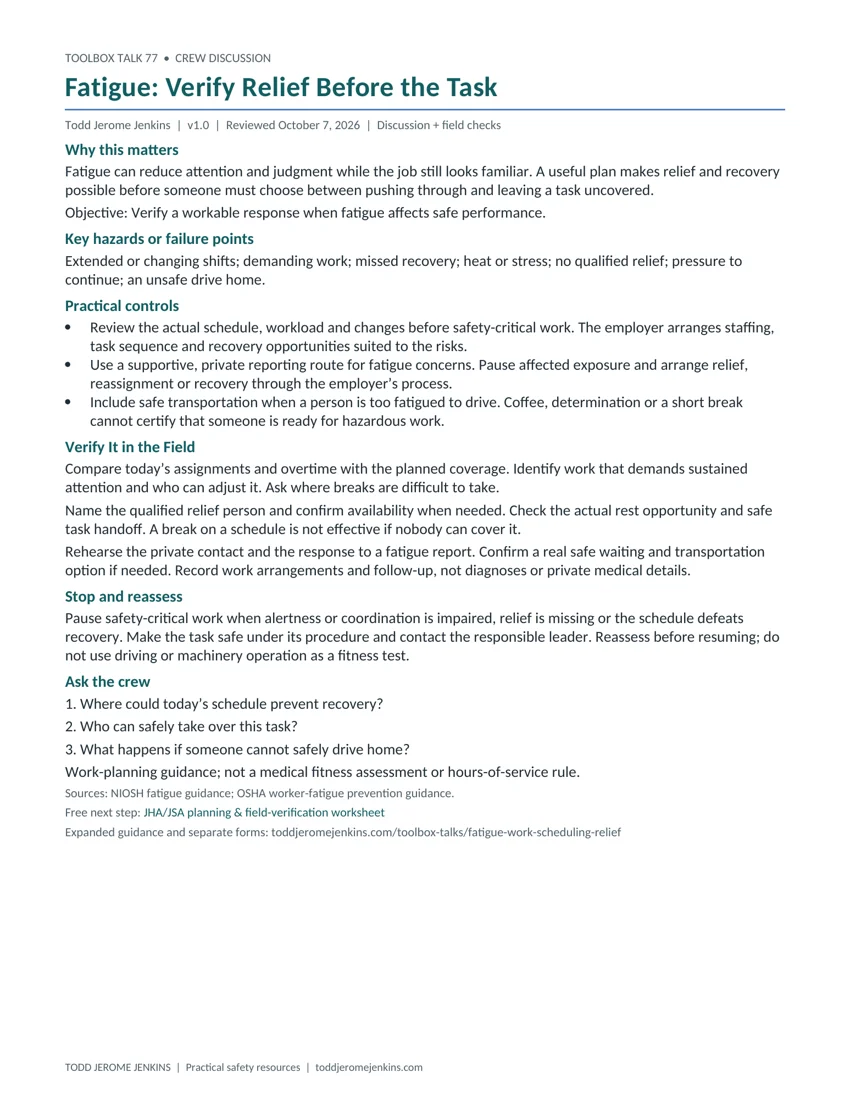
A 5–10 minute crew discussion, plus the time needed for field verification. All six downloads are free without a required signup.
Why this matters
Fatigue can reduce attention and judgment while the job still looks familiar. A useful plan makes relief and recovery possible before someone must choose between pushing through and leaving a task uncovered.
Learning objective: Verify a workable response when fatigue affects safe performance.
Key hazards or failure points
Extended or changing shifts; demanding work; missed recovery; heat or stress; no qualified relief; pressure to continue; an unsafe drive home.
Practical controls
- Review the actual schedule, workload and changes before safety-critical work. The employer arranges staffing, task sequence and recovery opportunities suited to the risks.
- Use a supportive, private reporting route for fatigue concerns. Pause affected exposure and arrange relief, reassignment or recovery through the employer’s process.
- Include safe transportation when a person is too fatigued to drive. Coffee, determination or a short break cannot certify that someone is ready for hazardous work.
Verify It in the Field
Compare today’s assignments and overtime with the planned coverage. Identify work that demands sustained attention and who can adjust it. Ask where breaks are difficult to take.
Name the qualified relief person and confirm availability when needed. Check the actual rest opportunity and safe task handoff. A break on a schedule is not effective if nobody can cover it.
Rehearse the private contact and the response to a fatigue report. Confirm a real safe waiting and transportation option if needed. Record work arrangements and follow-up, not diagnoses or private medical details.
Use the separate field check to record the acceptance source and criterion, safe method, checker, actual result and time. Mark VERIFIED, HOLD/NOT VERIFIED, or N/A with a reason. A checkmark alone is not evidence that protection works. Complete all required task checks; do not enter danger or improvise a test.
| Control | Safe verification | Evidence |
|---|---|---|
| Achievable recovery | Compare actual assignments with available qualified coverage. | Coverage conflict, revised sequence and named relief. |
| Safe handoff | Confirm replacement qualifications and transfer restrictions. | Task status, person accepting and remaining controls. |
| Supported reporting | Rehearse private contact and confirm a safe alternative. | Available contact, work arrangement and transport owner. |
Stop and reassess
Pause safety-critical work when alertness or coordination is impaired, relief is missing or the schedule defeats recovery. Make the task safe under its procedure and contact the responsible leader. Reassess before resuming; do not use driving or machinery operation as a fitness test.
Crew discussion questions
- Where could today’s schedule prevent recovery?
- Who can safely take over this task?
- What happens if someone cannot safely drive home?
A situation to discuss
Illustrative situation: overtime extends a task beyond the planned relief shift. A worker reports trouble concentrating. The leader pauses the affected work and arranges qualified coverage instead of treating another coffee as evidence of readiness.
Leader preparation and practical detail
Review the work conditions
NIOSH identifies schedules, demanding work, stress and heat among contributors to fatigue, with effects on reaction, attention, memory and judgment. The crew discussion should examine what makes the actual work difficult rather than assign blame for someone’s private life. Persistent sleep concerns can be discussed with an appropriate clinician. [1, 2]
Check that recovery is possible
OSHA’s prevention guidance addresses staffing, workload, work hours and rest opportunities. Translate those recommendations into today’s assignments: who covers a pause, which task can be moved and what happens when the planned relief is absent? The employer must also apply any sector-specific work-hour requirements. This page supplies no universal shift limit. [2]
Verify arrangements rather than certify fitness
A field check can show that qualified relief, a safe handoff and transportation exist. It cannot establish that every worker is medically fit or that a fixed rest period restores performance. Keep personal health information out of the crew record and use the employer’s appropriate process for an individual concern. Avoid hazardous demonstrations of alertness.
Short supervisor field check
- Actual schedule, workload and fatigue concerns reviewed.
- Critical tasks and authority to adjust them identified.
- Qualified relief and usable recovery available.
- Private reporting and safe transport arrangements clear.
- Changed assignment and follow-up recorded without health details.
Record unresolved items, restrictions, correction owner, recheck result and required restart authorization. Reference permits and specialist inspections rather than treating this form as a replacement. Rebrief workers affected by a change.
Attendance and follow-through
Use the separate attendance sheet for participants, discussion concerns, actions and late-arrival rebriefs. Attendance does not establish competence, verify controls or authorize work. Keep completed records private under the employer’s recordkeeping procedures.
Technical scope and references
NIOSH and OSHA fatigue-prevention guidance, not a numerical fitness test or a complete fatigue-management program. Apply any industry-specific hours-of-service rules and the employer’s appropriate health and work processes. No personal medical information is needed on this crew sheet. [1, 2]
References reviewed October 7, 2026. Apply the industry, activity and jurisdiction that govern the work. No actual site permit, equipment manual, exposure assessment or engineering determination was supplied for this general discussion.
- NIOSH — Fatigue and work — Contributors and effects of work-related fatigue.
- OSHA — Preventing worker fatigue — Employer scheduling, workload, recovery and education recommendations.
Connect this discussion to your JHA/JSA
Use How to Conduct a Job Safety Analysis to connect task steps, hazards and controls. Revisit Pre-Job JHA/JSA: What Changed Today? when conditions change.
Related crew discussions
- Working Alone: Check In and Get Help
- Distracted Driving: Set Up Before Moving
- Medication and Safe Work: Check Before the Task
- Safety Capacity: Can the Controls Handle Today’s Work?
- Bad-Weather Driving: Decide Before You Go
Put one check into practice
Use the free JHA/JSA planning and field-verification worksheet to record today’s changes, important controls and the evidence needed before exposure.