Download the talk and separate crew records
Free to download without an account. Each PDF is one page. Use the Word version to adapt the record to your task and approved procedures.
Supervisor field check
Download supervisor field check (PDF, 1 page)Editable supervisor field check (Word)Preview the one-page crew talk
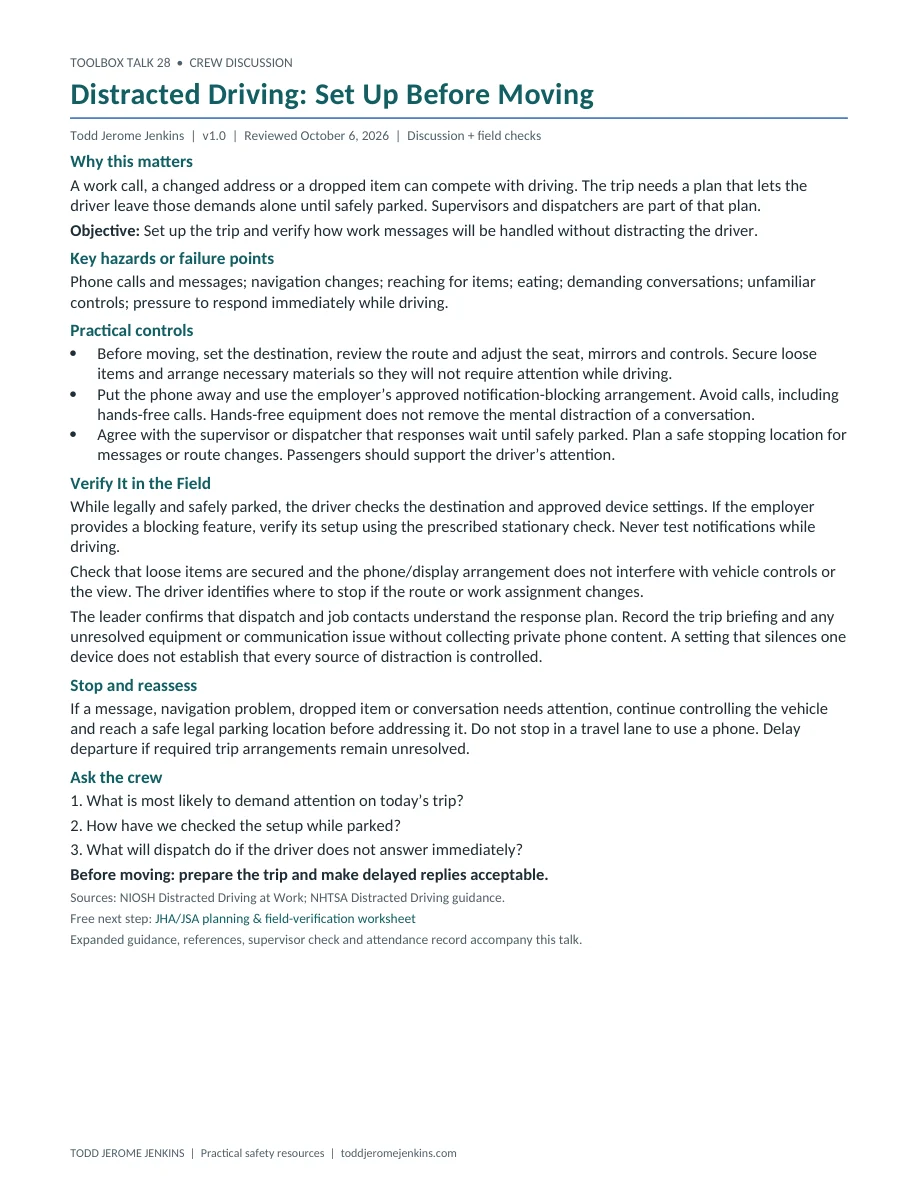
A 5–10 minute crew discussion, plus the time needed for field verification. All six downloads are free without a required signup.
Why this matters
A work call, a changed address or a dropped item can compete with driving. The trip needs a plan that lets the driver leave those demands alone until safely parked. Supervisors and dispatchers are part of that plan.
Learning objective: Set up the trip and verify how work messages will be handled without distracting the driver.
Key hazards or failure points
Phone calls and messages; navigation changes; reaching for items; eating; demanding conversations; unfamiliar controls; pressure to respond immediately while driving.
Practical controls
- Before moving, set the destination, review the route and adjust the seat, mirrors and controls. Secure loose items and arrange necessary materials so they will not require attention while driving.
- Put the phone away and use the employer’s approved notification-blocking arrangement. Avoid calls, including hands-free calls. Hands-free equipment does not remove the mental distraction of a conversation.
- Agree with the supervisor or dispatcher that responses wait until safely parked. Plan a safe stopping location for messages or route changes. Passengers should support the driver’s attention.
Verify It in the Field
While legally and safely parked, the driver checks the destination and approved device settings. If the employer provides a blocking feature, verify its setup using the prescribed stationary check. Never test notifications while driving.
Check that loose items are secured and the phone/display arrangement does not interfere with vehicle controls or the view. The driver identifies where to stop if the route or work assignment changes.
The leader confirms that dispatch and job contacts understand the response plan. Record the trip briefing and any unresolved equipment or communication issue without collecting private phone content. A setting that silences one device does not establish that every source of distraction is controlled.
Use the separate field check to record the source and criterion, safe method, checker, actual result and time. Mark VERIFIED, HOLD/NOT VERIFIED, or N/A with a reason. Check every required control; the examples below do not clear the whole task.
| Control | Safe verification | Evidence to record |
|---|---|---|
| Prepared trip | Check destination and vehicle adjustments before movement. | Destination confirmed; items and controls ready. |
| Device arrangement | Use the prescribed stationary setup/check for the approved system. | Settings checked; limitations and unresolved alerts addressed. |
| Dispatch expectations | Driver and dispatcher confirm the parked-response process. | Alternate contact or delay arrangement agreed; no immediate-reply demand. |
Stop and reassess
If a message, navigation problem, dropped item or conversation needs attention, continue controlling the vehicle and reach a safe legal parking location before addressing it. Do not stop in a travel lane to use a phone. Delay departure if required trip arrangements remain unresolved.
Crew discussion questions
- What is most likely to demand attention on today’s trip?
- How have we checked the setup while parked?
- What will dispatch do if the driver does not answer immediately?
Before moving: prepare the trip and make delayed replies acceptable.
A situation to discuss
Illustrative situation: dispatch sends a revised delivery location while the vehicle is moving. The agreed process allows the driver to reach safe parking before reviewing it. Dispatch does not repeatedly call to obtain an immediate response, and the delivery schedule is adjusted when needed.
Leader preparation and practical detail
Attention is part of the driving task
Distraction includes demands on vision, hands and thought. NHTSA identifies activities such as device use, eating and adjusting navigation as potential distractions. Preparing these matters before departure reduces the need to divide attention once moving. [2]
Make the employer’s expectations workable
NIOSH recommends avoiding phone use while driving, including hands-free use, and stopping in a safe place before handling calls or directions. Apply that approach to dispatch procedures: designate an alternate contact, agree how delays are communicated and avoid incentives that require an immediate reply. [1]
Verify settings without creating another risk
The crew check is performed while parked. It verifies the setup, not the driver’s ability to multitask. Follow the device or fleet-system instructions rather than promising that a generic do-not-disturb setting blocks every alert. If a setting behaves unexpectedly, resolve it before departure or use another approved arrangement. Device settings support the plan; they do not justify handling a phone at a signal or while creeping in traffic.
Short supervisor field check
- Route, destination and vehicle adjustments prepared while parked.
- Loose items secured and view/controls unobstructed.
- Approved phone/notification arrangement checked safely.
- Dispatch and job contacts accept parked-only responses.
- Safe stopping plan and unresolved departure issues addressed.
Use the separate form to document evidence, restrictions, corrective-action owner, recheck and required restart approval. An unresolved required control means hold the affected work. Missing evidence is not a pass. Complete all task-specific inspections and permits.
Attendance and follow-through
The separate attendance sheet records participants, language support, questions, actions and late-arrival rebriefs. Attendance does not establish competence or prove controls function. Keep completed records private under the employer’s procedures.
Technical scope and references
This is practical driving guidance, not a state-by-state legal summary. Employers must check applicable jurisdiction and vehicle-specific rules and their fleet policy. Commercial motor vehicles have additional requirements. A legal allowance for a device does not establish that its use is free of distraction. [1], [2]
References checked October 6, 2026. Apply the jurisdiction, task, employer program and equipment instructions that govern the work. No site-specific manual, permit, engineering determination or product SDS has been approved by this general resource.
- NIOSH — Distracted Driving at Work — Employer/worker prevention and hands-free distraction. Guidance.
- NHTSA — Distracted Driving — Examples of distraction, employer role and guidance to drive without phone use.
Connect this discussion to your JHA/JSA
Use How to Conduct a Job Safety Analysis to connect today’s work steps, hazards and controls. Revisit Pre-Job JHA/JSA: What Changed Today? whenever conditions change.
Related Todd Jerome Jenkins video: Job Safety Analysis: A Basic Overview.
Put one check into practice
Download the free JHA/JSA planning and field-verification worksheet. For today’s task, record an important control, its source and the evidence needed before exposure. Complete the remaining required checks through your task plan.
Continue the crew discussion
- Pre-Job JHA/JSA: What Changed Today?
- Mobile Equipment: Separate People from Movement
- Work Zones: Verify the Traffic Setup
- Human Performance: Make the Next Step Clearer