Download the talk and separate crew records
Free to download without an account. Each PDF is one page. Use the Word version to adapt the record to your task and approved procedures.
Supervisor field check
Download supervisor field check (PDF, 1 page)Editable supervisor field check (Word)Preview the one-page crew talk
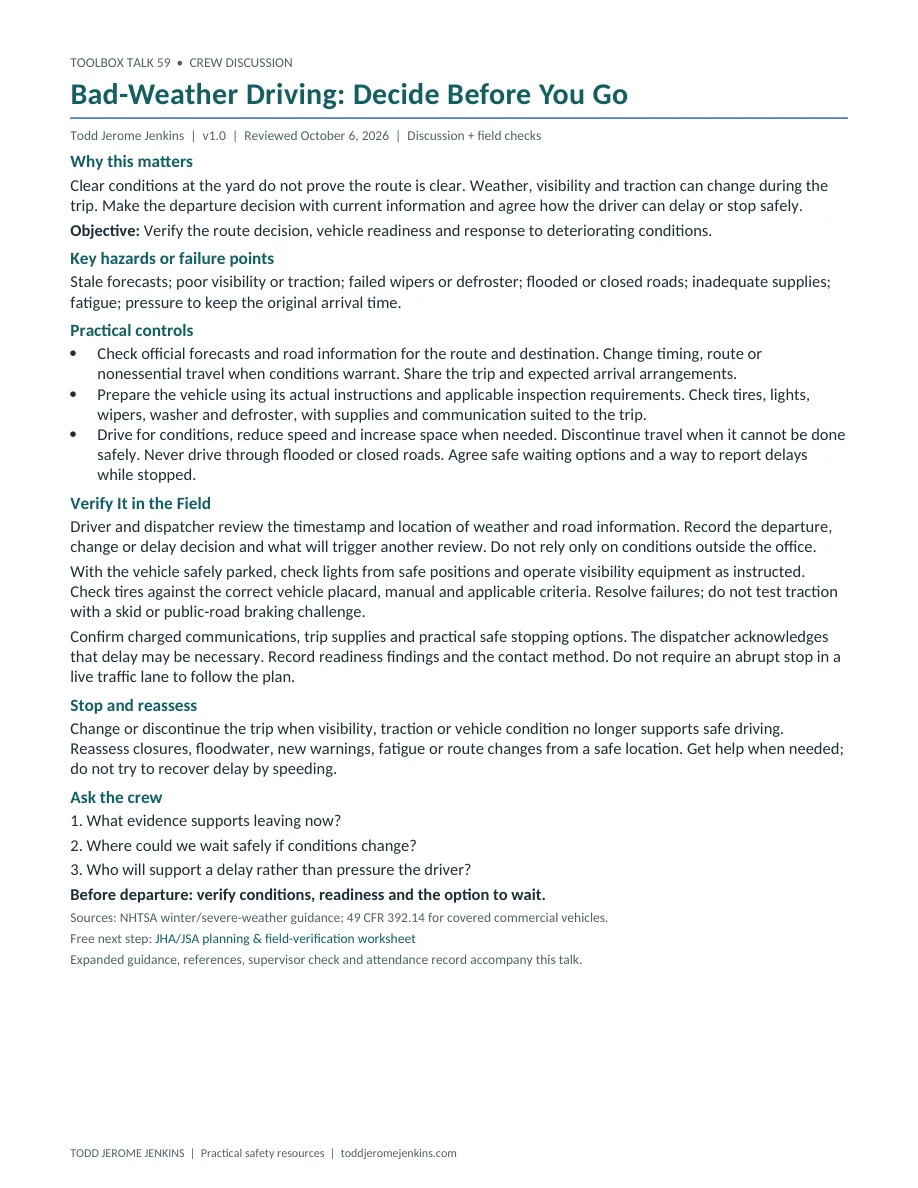
A 5–10 minute crew discussion, plus the time needed for field verification. All six downloads are free without a required signup.
Why this matters
Clear conditions at the yard do not prove the route is clear. Weather, visibility and traction can change during the trip. Make the departure decision with current information and agree how the driver can delay or stop safely.
Learning objective: Verify the route decision, vehicle readiness and response to deteriorating conditions.
Key hazards or failure points
Stale forecasts; poor visibility or traction; failed wipers or defroster; flooded or closed roads; inadequate supplies; fatigue; pressure to keep the original arrival time.
Practical controls
- Check official forecasts and road information for the route and destination. Change timing, route or nonessential travel when conditions warrant. Share the trip and expected arrival arrangements.
- Prepare the vehicle using its actual instructions and applicable inspection requirements. Check tires, lights, wipers, washer and defroster, with supplies and communication suited to the trip.
- Drive for conditions, reduce speed and increase space when needed. Discontinue travel when it cannot be done safely. Never drive through flooded or closed roads. Agree safe waiting options and a way to report delays while stopped.
Verify It in the Field
Driver and dispatcher review the timestamp and location of weather and road information. Record the departure, change or delay decision and what will trigger another review. Do not rely only on conditions outside the office.
With the vehicle safely parked, check lights from safe positions and operate visibility equipment as instructed. Check tires against the correct vehicle placard, manual and applicable criteria. Resolve failures; do not test traction with a skid or public-road braking challenge.
Confirm charged communications, trip supplies and practical safe stopping options. The dispatcher acknowledges that delay may be necessary. Record readiness findings and the contact method. Do not require an abrupt stop in a live traffic lane to follow the plan.
Use the separate field check to record the source and criterion, safe method, checker, actual result and time. Mark VERIFIED, HOLD/NOT VERIFIED, or N/A with a reason. Check every required control; the examples below do not clear the whole task.
| Control | Safe verification | Evidence to record |
|---|---|---|
| Supported route decision | Review current official route/closure information while parked. | Source/time, decision and next review trigger. |
| Ready vehicle | Complete applicable stationary and prescribed safe checks. | Actual functions, defects and correction. |
| Safe delay plan | Confirm stopping options and dispatcher communication. | Option, contact and changed arrival arrangements. |
Stop and reassess
Change or discontinue the trip when visibility, traction or vehicle condition no longer supports safe driving. Reassess closures, floodwater, new warnings, fatigue or route changes from a safe location. Get help when needed; do not try to recover delay by speeding.
Crew discussion questions
- What evidence supports leaving now?
- Where could we wait safely if conditions change?
- Who will support a delay rather than pressure the driver?
Before departure: verify conditions, readiness and the option to wait.
A situation to discuss
Illustrative situation: the route forecast changes after loading. The driver and dispatcher review current closures, delay the departure and notify the destination. The vehicle stays in a safe location instead of beginning a trip based on the earlier forecast.
Leader preparation and practical detail
Use route-specific information
Check the journey, destination and return needs, not only the departure point. Official road closures and warnings can change the decision even if the vehicle is ready. Agree the next review point and who monitors changes. NHTSA recommends checking weather and roads and postponing nonessential trips when appropriate. [1], [2]
Check the vehicle without a hazardous test
Use the actual vehicle instructions and applicable inspection criteria. Tire-pressure information normally comes from the appropriate vehicle placard or manual, not the tire sidewall maximum. A functioning wiper, washer and defroster matters before visibility deteriorates. Do not deliberately skid or brake hard in traffic to discover the limit. [1]
Make stopping a supported decision
For covered commercial vehicles, 49 CFR 392.14 addresses extreme caution, reduced speed and discontinuing operation when conditions become sufficiently dangerous, with its specific passenger-safety proviso. Apply the rule to the actual operation. A work plan should identify safe options rather than pressuring a driver to continue or stop abruptly in an exposed lane. [3]
Short supervisor field check
- Current route/weather information reviewed.
- Vehicle readiness and defects resolved.
- Supplies and communication appropriate to trip.
- Safe delay or stopping options identified.
- Driver and dispatcher share reassessment triggers.
Use the separate form to document evidence, restrictions, corrective-action owner, recheck and required restart approval. An unresolved required control means hold the affected work. Missing evidence is not a pass. Complete all task-specific inspections and permits.
Attendance and follow-through
The separate attendance sheet records participants, language support, questions, actions and late-arrival rebriefs. Attendance does not establish competence or prove controls function. Keep completed records private under the employer’s procedures.
Technical scope and references
This is work-trip planning, not a universal driving-speed, tire-depth, following-distance or flood-depth rule. Vehicle instructions, current traffic rules and employer procedures govern. Section 392.14 applies to covered commercial motor vehicles. [1], [2], [3]
References checked October 6, 2026. Apply the jurisdiction, task, employer program and equipment instructions that govern the work. No site-specific manual, permit, engineering determination or product SDS has been approved by this general resource.
- NHTSA — Winter Weather Driving Tips — Entire substantive page read: delay nonessential trip; weather/road reports; route/arrival sharing; vehicle placard pressure not sidewall maximum; lights/wipers/defrost; vehicle-specific safety systems; emergency supplies. Generic numeric tire criteria omitted to avoid CMV/type/jurisdiction mismatch.
- NHTSA — Driving in Severe Weather — Full page read: reduced speed/increased spacing, official road conditions, no flooded/closed roads, pedestrians, emergency communication. No safe water depth; do not use agency danger examples as thresholds.
- 49 CFR 392.14 — Hazardous conditions; extreme caution — Entire operative text read. Covered CMVs reduce speed for adverse traction/visibility and discontinue when sufficiently dangerous; passenger-safety nearest-point proviso. Do not teach stopping immediately in an exposed traffic lane.
Connect this discussion to your JHA/JSA
Use How to Conduct a Job Safety Analysis to connect today’s work steps, hazards and controls. Revisit Pre-Job JHA/JSA: What Changed Today? whenever conditions change.
Related published crew resources: Severe Weather: Know When and Where to Shelter; Cold Weather: Check Warmth, Traction and Recovery; Distracted Driving: Set Up Before Moving; Trailer Towing: Verify the Connection Before the Trip; School Is Back: Recheck the Driving Route.
Put one check into practice
Download the free JHA/JSA planning and field-verification worksheet. For today’s task, record an important control, its source and the evidence needed before exposure. Complete the remaining required checks through your task plan.