Download the talk and separate crew records
Free to download without an account. Each PDF is one page. Use the Word version to adapt the record to your task and approved procedures.
Supervisor field check
Download supervisor field check (PDF, 1 page)Editable supervisor field check (Word)Preview the one-page crew talk
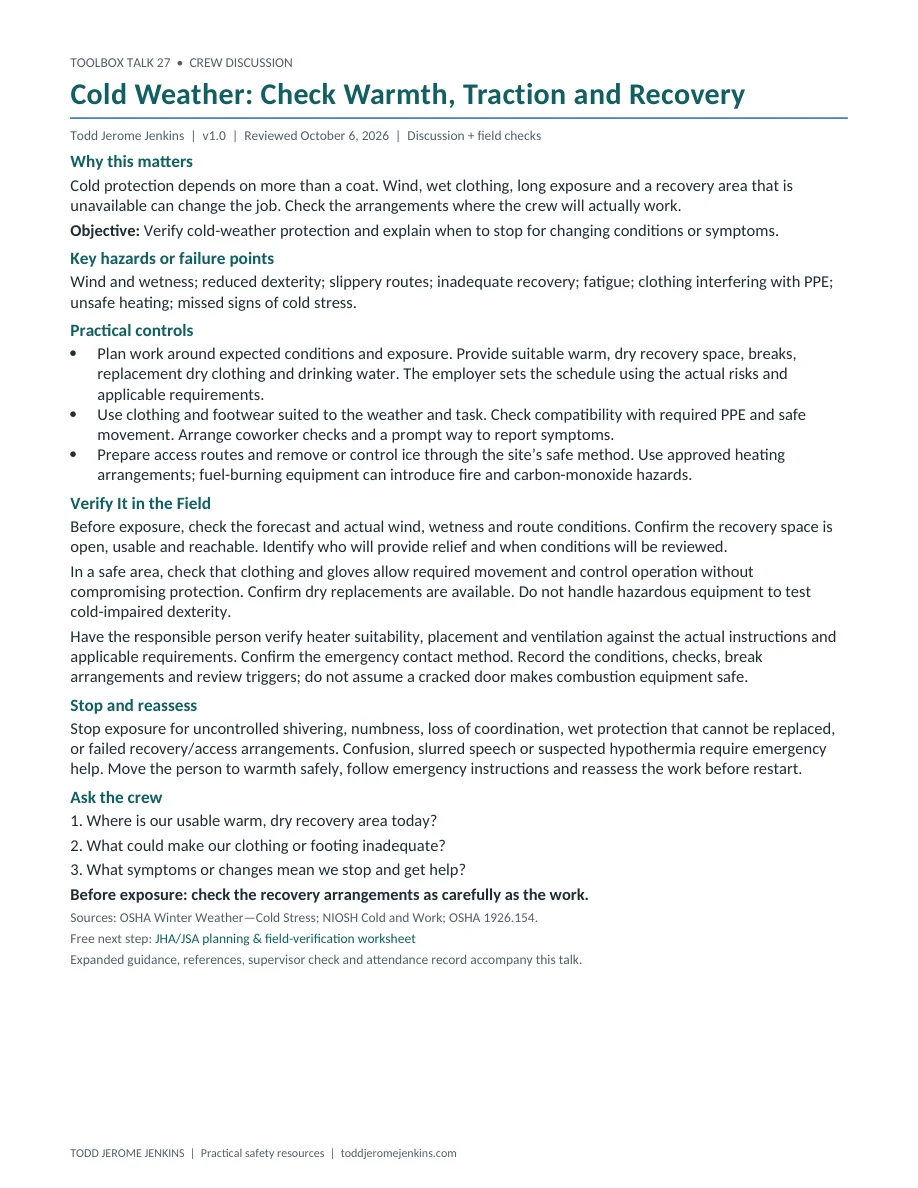
A 5–10 minute crew discussion, plus the time needed for field verification. All six downloads are free without a required signup.
Why this matters
Cold protection depends on more than a coat. Wind, wet clothing, long exposure and a recovery area that is unavailable can change the job. Check the arrangements where the crew will actually work.
Learning objective: Verify cold-weather protection and explain when to stop for changing conditions or symptoms.
Key hazards or failure points
Wind and wetness; reduced dexterity; slippery routes; inadequate recovery; fatigue; clothing interfering with PPE; unsafe heating; missed signs of cold stress.
Practical controls
- Plan work around expected conditions and exposure. Provide suitable warm, dry recovery space, breaks, replacement dry clothing and drinking water. The employer sets the schedule using the actual risks and applicable requirements.
- Use clothing and footwear suited to the weather and task. Check compatibility with required PPE and safe movement. Arrange coworker checks and a prompt way to report symptoms.
- Prepare access routes and remove or control ice through the site’s safe method. Use approved heating arrangements; fuel-burning equipment can introduce fire and carbon-monoxide hazards.
Verify It in the Field
Before exposure, check the forecast and actual wind, wetness and route conditions. Confirm the recovery space is open, usable and reachable. Identify who will provide relief and when conditions will be reviewed.
In a safe area, check that clothing and gloves allow required movement and control operation without compromising protection. Confirm dry replacements are available. Do not handle hazardous equipment to test cold-impaired dexterity.
Have the responsible person verify heater suitability, placement and ventilation against the actual instructions and applicable requirements. Confirm the emergency contact method. Record the conditions, checks, break arrangements and review triggers; do not assume a cracked door makes combustion equipment safe.
Use the separate field check to record the source and criterion, safe method, checker, actual result and time. Mark VERIFIED, HOLD/NOT VERIFIED, or N/A with a reason. Check every required control; the examples below do not clear the whole task.
| Control | Safe verification | Evidence to record |
|---|---|---|
| Recovery available | Inspect the actual warm, dry location and its safe access before exposure. | Location open and usable; relief/break arrangements confirmed. |
| Clothing usable | Check fit, dryness, required PPE compatibility and nonhazardous movement. | Gaps corrected and dry replacement arrangement identified. |
| Safe heating | Responsible person checks the exact device and setup to applicable sources. | Instructions/requirements identified; suitability and installation findings recorded. |
Stop and reassess
Stop exposure for uncontrolled shivering, numbness, loss of coordination, wet protection that cannot be replaced, or failed recovery/access arrangements. Confusion, slurred speech or suspected hypothermia require emergency help. Move the person to warmth safely, follow emergency instructions and reassess the work before restart.
Crew discussion questions
- Where is our usable warm, dry recovery area today?
- What could make our clothing or footing inadequate?
- What symptoms or changes mean we stop and get help?
Before exposure: check the recovery arrangements as carefully as the work.
A situation to discuss
Illustrative situation: the crew’s planned warm-up room is locked and the alternative is a partly enclosed space with an unreviewed heater. The leader holds cold exposure while arranging suitable recovery space and confirming safe heating. The schedule cannot assume a recovery arrangement that is unavailable.
Leader preparation and practical detail
Use conditions, not the calendar
Cold risk changes with wind, wetness, duration and the work being done. OSHA guidance identifies these factors and recommends warm, dry breaks and monitoring. This page provides no universal temperature cutoff or break interval; the employer must establish arrangements suitable for the conditions and workers. [1]
Verify the recovery route
Walk the route without entering an uncontrolled hazard. Check access, availability and room for the people who need recovery at the same time. Ask what happens if clothing becomes soaked or a worker reports numbness. NIOSH recommends warm areas, appropriate clothing, spare clothing and monitoring of coworkers. [2]
Check the heat source
Construction temporary-heating requirements address ventilation, clearances, mounting and other conditions. OSHA also identifies space heaters among possible carbon-monoxide exposure sources. The correct installation depends on the heater and its approval as well as the applicable rule. Have the responsible person resolve unsuitable equipment or uncertainty before using the space. This resource does not certify an indoor heater or set an air-monitoring schedule. [3], [4]
Short supervisor field check
- Forecast and actual wind/wetness/exposure reviewed.
- Warm, dry recovery, relief and drinking water available.
- Clothing, dry replacements, PPE compatibility and access checked.
- Heating suitability/installation verified by responsible person.
- Coworker checks, symptom response and review triggers understood.
Use the separate form to document evidence, restrictions, corrective-action owner, recheck and required restart approval. An unresolved required control means hold the affected work. Missing evidence is not a pass. Complete all task-specific inspections and permits.
Attendance and follow-through
The separate attendance sheet records participants, language support, questions, actions and late-arrival rebriefs. Attendance does not establish competence or prove controls function. Keep completed records private under the employer’s procedures.
Technical scope and references
Cold-stress prevention guidance applies broadly; OSHA 1926.154 is a construction temporary-heating standard. Other jurisdictions, industries and employer requirements may add obligations. The talk is not a medical assessment or complete first-aid course. Use the emergency plan for suspected cold illness. [1], [2], [3]
References checked October 6, 2026. Apply the jurisdiction, task, employer program and equipment instructions that govern the work. No site-specific manual, permit, engineering determination or product SDS has been approved by this general resource.
- OSHA — Winter Weather: Cold Stress — Cold-stress factors, prevention, symptoms and emergency response guidance.
- NIOSH — Cold and Work: Types, Causes, Preparation — Employer arrangements, clothing, recovery and monitoring. Page dated July 14, 2026.
- OSHA 29 CFR 1926.154 — Temporary heating devices — Construction heater ventilation, clearance, mounting and other installation requirements.
- OSHA QuickCard 3282-10N-05 — Carbon Monoxide Poisoning — 2005 guidance, still hosted by OSHA; cited only for identifying combustion-equipment CO hazards, not as a heater installation specification.
Connect this discussion to your JHA/JSA
Use How to Conduct a Job Safety Analysis to connect today’s work steps, hazards and controls. Revisit Pre-Job JHA/JSA: What Changed Today? whenever conditions change.
Related Todd Jerome Jenkins video: What Is PPE and How Do You Choose It? | Workplace Safety.
Related published crew resources: Heat: Conditions Change, Controls Change; Housekeeping Is a Control.
Put one check into practice
Download the free JHA/JSA planning and field-verification worksheet. For today’s task, record an important control, its source and the evidence needed before exposure. Complete the remaining required checks through your task plan.