Download the talk and separate crew records
Free to download without an account. Each PDF is one page. Use the Word version to adapt the record to your task and approved procedures.
Supervisor field check
Download supervisor field check (PDF, 1 page)Editable supervisor field check (Word)Preview the one-page crew talk
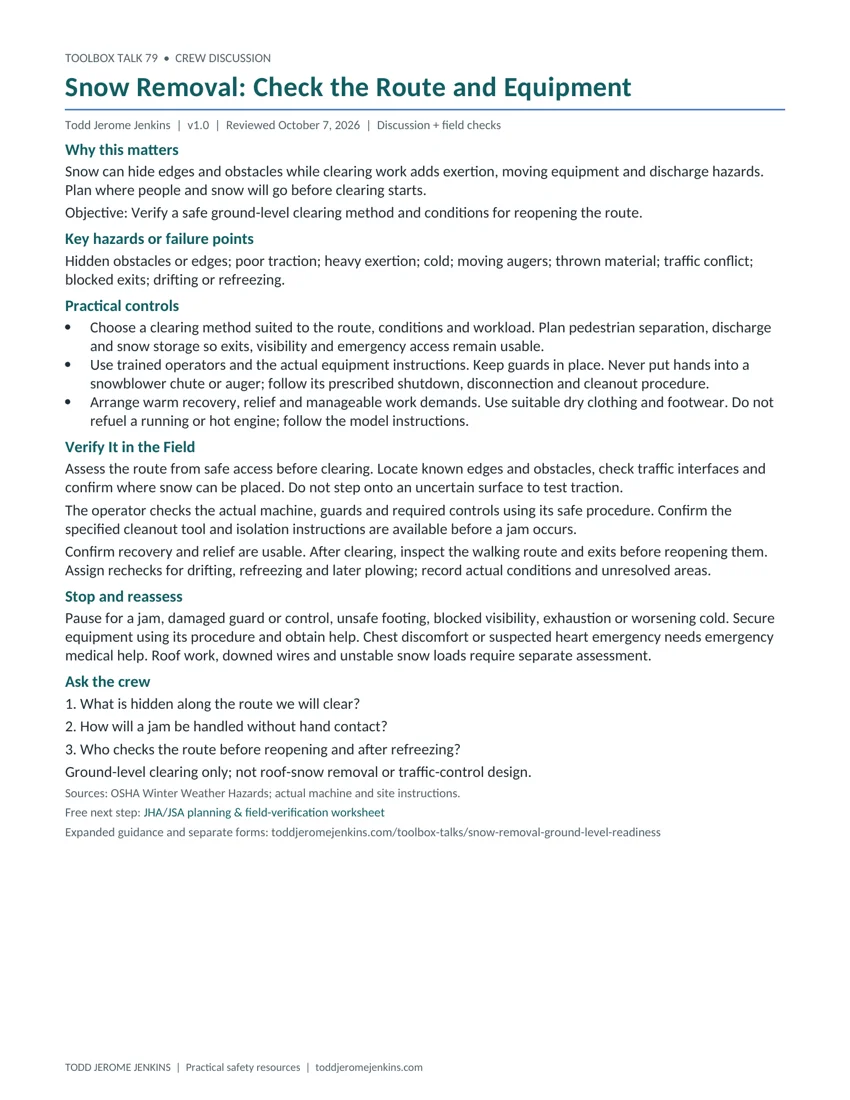
A 5–10 minute crew discussion, plus the time needed for field verification. All six downloads are free without a required signup.
Why this matters
Snow can hide edges and obstacles while clearing work adds exertion, moving equipment and discharge hazards. Plan where people and snow will go before clearing starts.
Learning objective: Verify a safe ground-level clearing method and conditions for reopening the route.
Key hazards or failure points
Hidden obstacles or edges; poor traction; heavy exertion; cold; moving augers; thrown material; traffic conflict; blocked exits; drifting or refreezing.
Practical controls
- Choose a clearing method suited to the route, conditions and workload. Plan pedestrian separation, discharge and snow storage so exits, visibility and emergency access remain usable.
- Use trained operators and the actual equipment instructions. Keep guards in place. Never put hands into a snowblower chute or auger; follow its prescribed shutdown, disconnection and cleanout procedure.
- Arrange warm recovery, relief and manageable work demands. Use suitable dry clothing and footwear. Do not refuel a running or hot engine; follow the model instructions.
Verify It in the Field
Assess the route from safe access before clearing. Locate known edges and obstacles, check traffic interfaces and confirm where snow can be placed. Do not step onto an uncertain surface to test traction.
The operator checks the actual machine, guards and required controls using its safe procedure. Confirm the specified cleanout tool and isolation instructions are available before a jam occurs.
Confirm recovery and relief are usable. After clearing, inspect the walking route and exits before reopening them. Assign rechecks for drifting, refreezing and later plowing; record actual conditions and unresolved areas.
Use the separate field check to record the acceptance source and criterion, safe method, checker, actual result and time. Mark VERIFIED, HOLD/NOT VERIFIED, or N/A with a reason. A checkmark alone is not evidence that protection works. Complete all required task checks; do not enter danger or improvise a test.
| Control | Safe verification | Evidence |
|---|---|---|
| Controlled clearing area | Inspect route and traffic/discharge interfaces from safe access. | Hidden hazards, separation and agreed snow destination. |
| Safe machine readiness | Operator performs model-specific prescribed checks. | Equipment ID, guard/control findings and cleanout method reference. |
| Usable completed route | Inspect actual route and assign condition-based rechecks. | Release/hold, unresolved areas, checker and next trigger. |
Stop and reassess
Pause for a jam, damaged guard or control, unsafe footing, blocked visibility, exhaustion or worsening cold. Secure equipment using its procedure and obtain help. Chest discomfort or suspected heart emergency needs emergency medical help. Roof work, downed wires and unstable snow loads require separate assessment.
Crew discussion questions
- What is hidden along the route we will clear?
- How will a jam be handled without hand contact?
- Who checks the route before reopening and after refreezing?
A situation to discuss
Illustrative situation: a cleared path looks usable, but the snow pile blocks a vehicle’s view of pedestrians. The crew keeps the affected route closed while the layout is corrected, then checks the actual sight line before reopening.
Leader preparation and practical detail
Reduce the clearing demand
OSHA describes shoveling as strenuous work and recommends measures such as manageable amounts, pushing where possible and recovery. Select tools and staffing for the actual snow and route rather than treating effort as a personal toughness test. Heavy wet snow or a longer assignment can require a revised method and additional relief. [1]
Prepare for jams before starting
OSHA warns against clearing snowblower jams by hand. A stopped engine does not by itself resolve every moving-part or stored-energy hazard. Follow the specific machine’s safe shutdown, disconnection and cleanout instructions using the prescribed tool. Do not invent a waiting time or bypass a safeguard to finish the route. [1]
Release a usable route
The crew’s original planning check should examine what clearing leaves behind: traction, exits, crossings, visibility and snow that could drift back. These checks supplement OSHA’s winter-weather guidance; they are not a universal snow-removal acceptance standard. Roofs and elevated work present separate fall and structural risks and are outside this ground-level briefing. [1]
Short supervisor field check
- Route, hidden hazards and separation assessed.
- Discharge and stockpile locations protect access.
- Machine checks and prescribed cleanout arrangements ready.
- Workload, warm recovery and relief suitable.
- Route release and weather-related rechecks assigned.
Record unresolved items, restrictions, correction owner, recheck result and required restart authorization. Reference permits and specialist inspections rather than treating this form as a replacement. Rebrief workers affected by a change.
Attendance and follow-through
Use the separate attendance sheet for participants, discussion concerns, actions and late-arrival rebriefs. Attendance does not establish competence, verify controls or authorize work. Keep completed records private under the employer’s recordkeeping procedures.
Technical scope and references
Ground-level manual and powered snow clearing. OSHA winter-weather material is guidance; actual machine instructions, applicable workplace rules and the site plan govern. No model-specific manual, roof-load assessment, personal exertion limit or universal traction criterion is supplied. [1]
References reviewed October 7, 2026. Apply the industry, activity and jurisdiction that govern the work. No actual site permit, equipment manual, exposure assessment or engineering determination was supplied for this general discussion.
- OSHA — Winter weather hazards and precautions — Shoveling, powered snow equipment, slips and elevated snow-removal hazards.
Connect this discussion to your JHA/JSA
Use How to Conduct a Job Safety Analysis to connect task steps, hazards and controls. Revisit Pre-Job JHA/JSA: What Changed Today? when conditions change.
Related crew discussions
- Mobile Equipment: Separate People from Movement
- Manual Handling: Change the Lift Before You Lift
- Cold Weather: Check Warmth, Traction and Recovery
- Heart Health at Work: Support the Plan and Know the Warning Signs
- Powered Tools: Check the Tool, Guard and Accessory
- Bad-Weather Driving: Decide Before You Go
- Carbon Monoxide: Keep Exhaust Out of the Work
Put one check into practice
Use the free JHA/JSA planning and field-verification worksheet to record today’s changes, important controls and the evidence needed before exposure.