Download the talk and separate crew records
Free to download without an account. Each PDF is one page. Use the Word version to adapt the record to your task and approved procedures.
Supervisor field check
Download supervisor field check (PDF, 1 page)Editable supervisor field check (Word)Preview the one-page crew talk
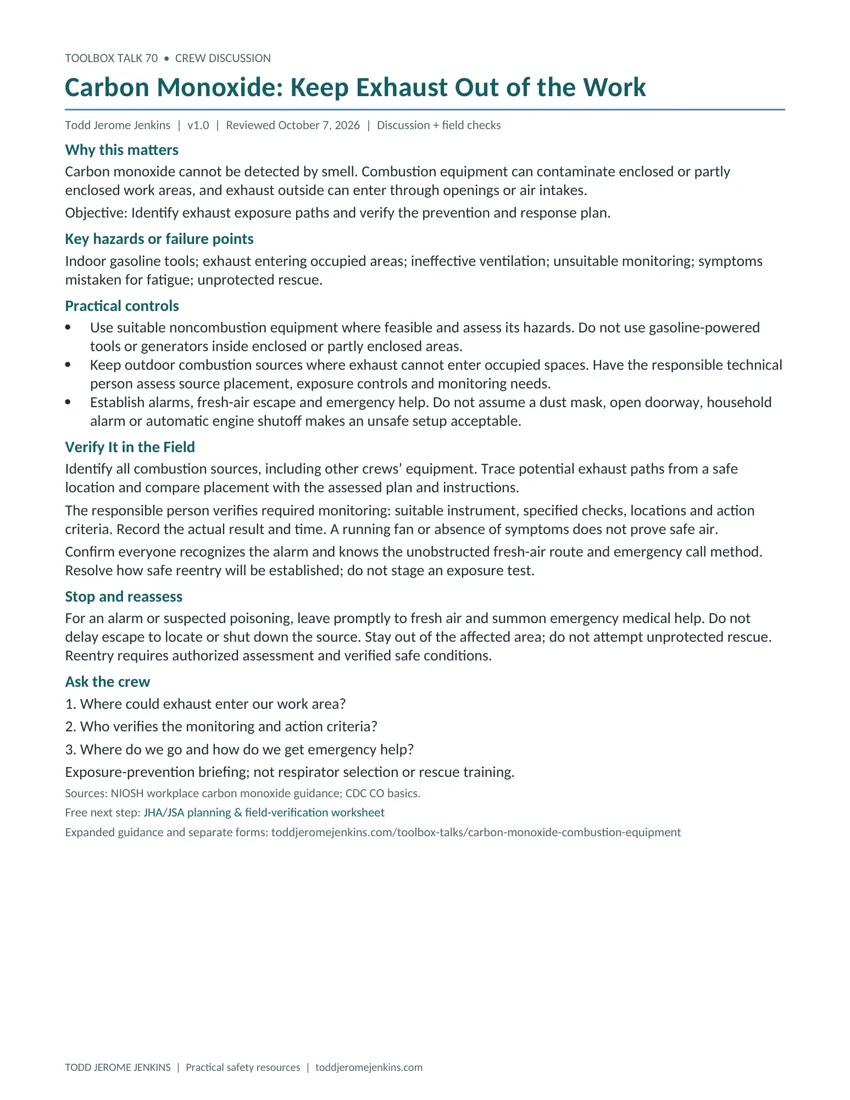
A 5–10 minute crew discussion, plus the time needed for field verification. All six downloads are free without a required signup.
Why this matters
Carbon monoxide cannot be detected by smell. Combustion equipment can contaminate enclosed or partly enclosed work areas, and exhaust outside can enter through openings or air intakes.
Learning objective: Identify exhaust exposure paths and verify the prevention and response plan.
Key hazards or failure points
Indoor gasoline tools; exhaust entering occupied areas; ineffective ventilation; unsuitable monitoring; symptoms mistaken for fatigue; unprotected rescue.
Practical controls
- Use suitable noncombustion equipment where feasible and assess its hazards. Do not use gasoline-powered tools or generators inside enclosed or partly enclosed areas.
- Keep outdoor combustion sources where exhaust cannot enter occupied spaces. Have the responsible technical person assess source placement, exposure controls and monitoring needs.
- Establish alarms, fresh-air escape and emergency help. Do not assume a dust mask, open doorway, household alarm or automatic engine shutoff makes an unsafe setup acceptable.
Verify It in the Field
Identify all combustion sources, including other crews’ equipment. Trace potential exhaust paths from a safe location and compare placement with the assessed plan and instructions.
The responsible person verifies required monitoring: suitable instrument, specified checks, locations and action criteria. Record the actual result and time. A running fan or absence of symptoms does not prove safe air.
Confirm everyone recognizes the alarm and knows the unobstructed fresh-air route and emergency call method. Resolve how safe reentry will be established; do not stage an exposure test.
Use the separate field check to record the acceptance source and criterion, safe method, checker, actual result and time. Mark VERIFIED, HOLD/NOT VERIFIED, or N/A with a reason. A checkmark alone is not evidence that protection works. Complete all required task checks; do not enter danger or improvise a test.
| Control | Safe verification | Evidence |
|---|---|---|
| Controlled exhaust path | Compare source locations and openings with the assessed plan. | Equipment, placement, intake risks and correction. |
| Usable monitoring | Trained person completes prescribed instrument and exposure checks. | Instrument, check result, reading/time and applicable criterion. |
| Prompt escape and help | Confirm alarm recognition, route and emergency communication. | Available route, contact method and unresolved gaps. |
Stop and reassess
For an alarm or suspected poisoning, leave promptly to fresh air and summon emergency medical help. Do not delay escape to locate or shut down the source. Stay out of the affected area; do not attempt unprotected rescue. Reentry requires authorized assessment and verified safe conditions.
Crew discussion questions
- Where could exhaust enter our work area?
- Who verifies the monitoring and action criteria?
- Where do we go and how do we get emergency help?
A situation to discuss
Illustrative situation: another crew starts a gasoline machine near an air intake. The work group stops the affected task and follows its exposure-response plan. The machine being outdoors does not by itself resolve the exhaust-entry hazard.
Leader preparation and practical detail
Prevent the source from reaching people
NIOSH recommends suitable alternatives to gasoline-powered equipment and warns against use in enclosed or partly enclosed spaces. An open door or a fan cannot be treated as permission for a hazardous engine placement. Outdoor equipment also needs assessment of nearby openings and air intakes. [1]
Make monitoring fit the workplace
The exposure assessment and applicable requirements determine monitoring needs and action criteria. Use the actual instrument instructions for readiness checks and operation, through appropriately trained personnel. This talk supplies no invented alarm threshold, calibration interval or reentry reading. Household detector advice does not establish that a workplace monitoring arrangement is adequate. [1, 2]
Do not wait for certainty before leaving
Headache, dizziness, nausea or confusion can occur with CO poisoning, but symptoms are not a reliable exposure detector and may have other causes. An alarm or suspected poisoning calls for prompt fresh air and emergency help. Do not send an unprotected coworker into the affected area or delay escape to find the source. Reentry belongs to the authorized assessment process. [1, 2]
Short supervisor field check
- Combustion sources and exhaust paths identified.
- Suitable alternatives and safe placement assessed.
- Required controls and monitoring verified.
- Alarm, fresh-air route and emergency contact understood.
- Authorized reentry and rescue arrangements established.
Record unresolved items, restrictions, correction owner, recheck result and required restart authorization. Reference permits and specialist inspections rather than treating this form as a replacement. Rebrief workers affected by a change.
Attendance and follow-through
Use the separate attendance sheet for participants, discussion concerns, actions and late-arrival rebriefs. Attendance does not establish competence, verify controls or authorize work. Keep completed records private under the employer’s recordkeeping procedures.
Technical scope and references
Workplace combustion-exhaust awareness. NIOSH and CDC sources are guidance, not a complete regulatory exposure program. Confined-space entry, rescue and respiratory protection require separate specialist programs. [1, 2]
References reviewed October 7, 2026. Apply the industry, activity and jurisdiction that govern the work. No actual site permit, equipment manual, exposure assessment or engineering determination was supplied for this general discussion.
- NIOSH — Carbon monoxide — Workplace sources, prevention, exposure and response guidance.
- CDC — Carbon monoxide poisoning basics — Public-health guidance on symptoms and combustion hazards; not industrial acceptance criteria.
Connect this discussion to your JHA/JSA
Use How to Conduct a Job Safety Analysis to connect task steps, hazards and controls. Revisit Pre-Job JHA/JSA: What Changed Today? when conditions change.
Work through the related Concrete Saw Cutting JHA, then adapt its assumptions to the actual work.
Related crew discussions
- Respiratory Hazards: Know What You’re Breathing
- Emergency Readiness: Can We Reach Supplies and Call for Help?
- Incident Response: Protect People and Call for Help
- Confined Spaces: Verify Entry Readiness
Put one check into practice
Use the free JHA/JSA planning and field-verification worksheet to record today’s changes, important controls and the evidence needed before exposure.