Download the talk and separate crew records
Free to download without an account. Each PDF is one page. Use the Word version to adapt the record to your task and approved procedures.
Supervisor field check
Download supervisor field check (PDF, 1 page)Editable supervisor field check (Word)Preview the one-page crew talk
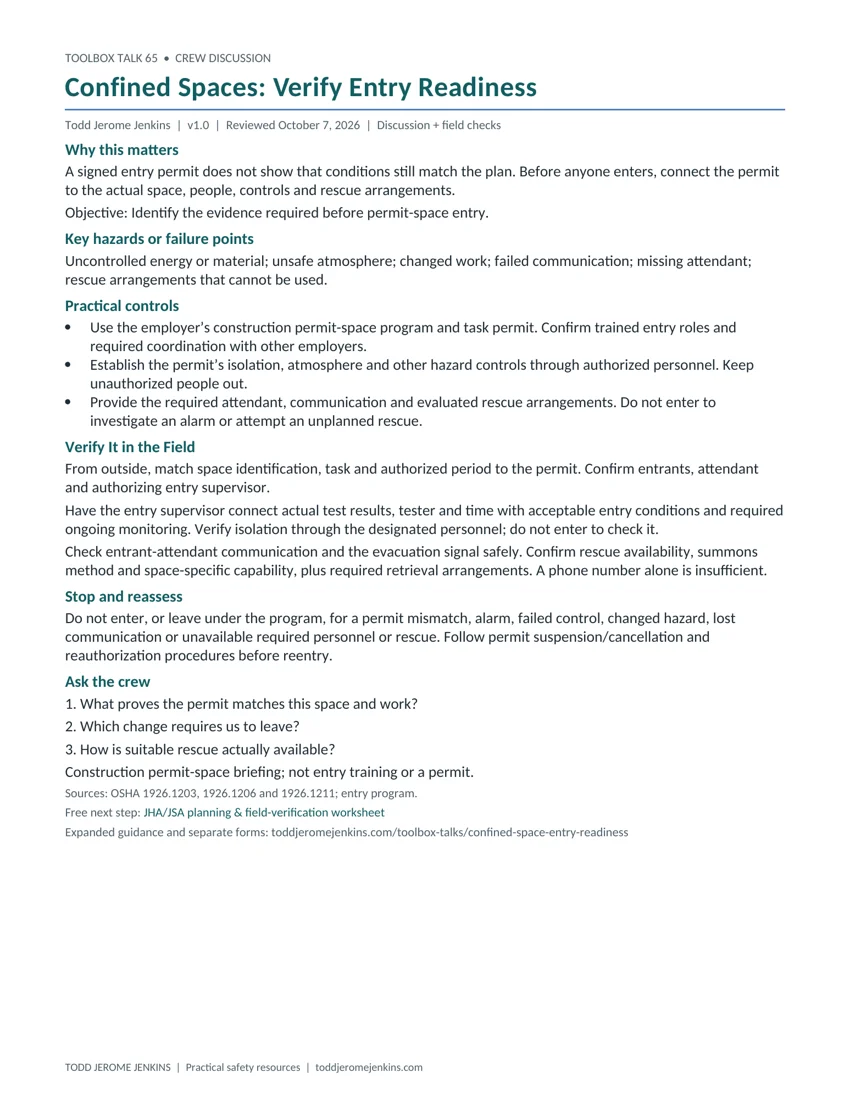
A 5–10 minute crew discussion, plus the time needed for field verification. All six downloads are free without a required signup.
Why this matters
A signed entry permit does not show that conditions still match the plan. Before anyone enters, connect the permit to the actual space, people, controls and rescue arrangements.
Learning objective: Identify the evidence required before permit-space entry.
Key hazards or failure points
Uncontrolled energy or material; unsafe atmosphere; changed work; failed communication; missing attendant; rescue arrangements that cannot be used.
Practical controls
- Use the employer’s construction permit-space program and task permit. Confirm trained entry roles and required coordination with other employers.
- Establish the permit’s isolation, atmosphere and other hazard controls through authorized personnel. Keep unauthorized people out.
- Provide the required attendant, communication and evaluated rescue arrangements. Do not enter to investigate an alarm or attempt an unplanned rescue.
Verify It in the Field
From outside, match space identification, task and authorized period to the permit. Confirm entrants, attendant and authorizing entry supervisor.
Have the entry supervisor connect actual test results, tester and time with acceptable entry conditions and required ongoing monitoring. Verify isolation through the designated personnel; do not enter to check it.
Check entrant-attendant communication and the evacuation signal safely. Confirm rescue availability, summons method and space-specific capability, plus required retrieval arrangements. A phone number alone is insufficient.
Use the separate field check to record the acceptance source and criterion, safe method, checker, actual result and time. Mark VERIFIED, HOLD/NOT VERIFIED, or N/A with a reason. A checkmark alone is not evidence that protection works. Complete all required task checks; do not enter danger or improvise a test.
| Control | Safe verification | Evidence |
|---|---|---|
| Permit match | Compare identification and authorized work from outside. | Permit reference, task, time and entry supervisor. |
| Acceptable conditions | Review actual testing and isolation evidence. | Criteria, readings/results, verifier and monitoring plan. |
| Response readiness | Safely check communications and confirm rescue capability. | Availability, summons method and resolved gaps. |
Stop and reassess
Do not enter, or leave under the program, for a permit mismatch, alarm, failed control, changed hazard, lost communication or unavailable required personnel or rescue. Follow permit suspension/cancellation and reauthorization procedures before reentry.
Crew discussion questions
- What proves the permit matches this space and work?
- Which change requires us to leave?
- How is suitable rescue actually available?
A situation to discuss
Illustrative situation: the crew is ready, but the previously arranged rescue service reports that its required capability is unavailable. Entry is held while the employer resolves rescue readiness and the entry supervisor rechecks authorization.
Leader preparation and practical detail
Classify before choosing the process
Construction Subpart AA requires evaluation of the worksite for confined and permit-required spaces. Not every confined space has the same entry process. A crew must not use this discussion to reclassify a space, select alternate procedures or bypass the employer’s program. [1]
Use the permit as a field comparison
The permit identifies the work and important entry conditions, people, controls, tests, communications and rescue arrangements. Compare those entries with what is actually present now. Record a discrepancy and hold entry rather than treating an earlier signature as permission for changed work. [2]
Verify a workable rescue arrangement
Rescue must be suitable for the space and hazards, with availability and response capability evaluated under the applicable requirements. Retrieval and non-entry rescue provisions also need the program’s assessment. Ordinary crew members must not enter a hazardous space to help a coworker without the required rescue training, equipment and authorization. [3]
Short supervisor field check
- Space, task, period and authorization match.
- Trained entry roles and coordination confirmed.
- Isolation and actual atmospheric results acceptable.
- Communication, attendant and evacuation signal checked.
- Evaluated rescue and retrieval arrangements available.
Record unresolved items, restrictions, correction owner, recheck result and required restart authorization. Reference permits and specialist inspections rather than treating this form as a replacement. Rebrief workers affected by a change.
Attendance and follow-through
Use the separate attendance sheet for participants, discussion concerns, actions and late-arrival rebriefs. Attendance does not establish competence, verify controls or authorize work. Keep completed records private under the employer’s recordkeeping procedures.
Technical scope and references
Construction permit-required confined-space preparation under Subpart AA. General industry has different provisions. This resource is not a permit, classification decision, complete program or entry/rescue training. [1–3]
References reviewed October 7, 2026. Apply the industry, activity and jurisdiction that govern the work. No actual site permit, equipment manual, exposure assessment or engineering determination was supplied for this general discussion.
- OSHA 1926.1203 — General requirements — Construction confined-space identification and entry-program requirements.
- OSHA 1926.1206 — Entry permit — Required permit content and entry conditions.
- OSHA 1926.1211 — Rescue and emergency services — Rescue evaluation, capability and retrieval provisions.
- OSHA 1926.1205 — Permitting process — Permit authorization, suspension and cancellation.
Connect this discussion to your JHA/JSA
Use How to Conduct a Job Safety Analysis to connect task steps, hazards and controls. Revisit Pre-Job JHA/JSA: What Changed Today? when conditions change.
Work through the related Confined Space Entry JSA, then adapt its assumptions to the actual work.
Related crew discussions
- Pre-Job JHA/JSA: What Changed Today?
- Respiratory Hazards: Know What You’re Breathing
- Emergency Readiness: Can We Reach Supplies and Call for Help?
- Incident Response: Protect People and Call for Help
- Energy Isolation: Verify Before Servicing
Put one check into practice
Use the free JHA/JSA planning and field-verification worksheet to record today’s changes, important controls and the evidence needed before exposure.