Download the talk and separate crew records
Free to download without an account. Each PDF is one page. Use the Word version to adapt the record to your task and approved procedures.
Supervisor field check
Download supervisor field check (PDF, 1 page)Editable supervisor field check (Word)Preview the one-page crew talk
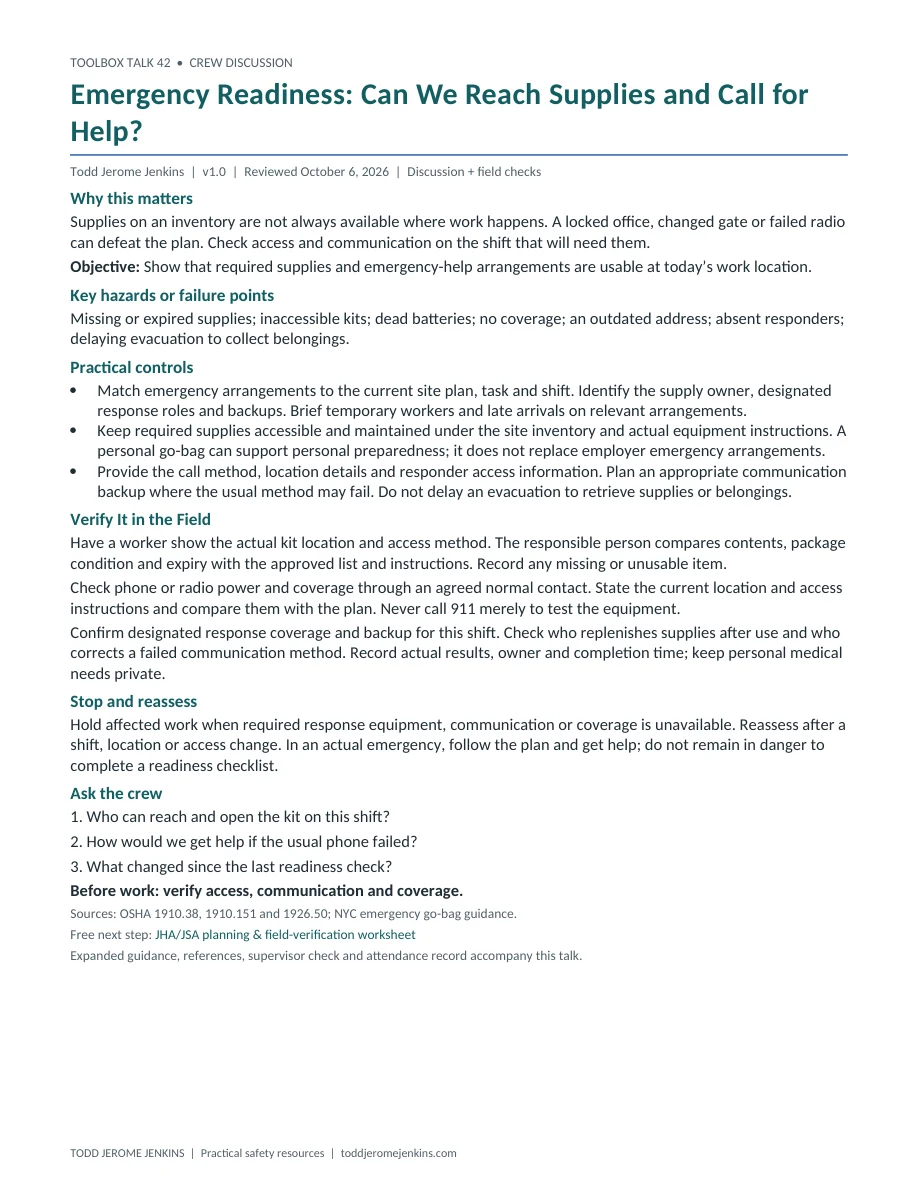
A 5–10 minute crew discussion, plus the time needed for field verification. All six downloads are free without a required signup.
Why this matters
Supplies on an inventory are not always available where work happens. A locked office, changed gate or failed radio can defeat the plan. Check access and communication on the shift that will need them.
Learning objective: Show that required supplies and emergency-help arrangements are usable at today’s work location.
Key hazards or failure points
Missing or expired supplies; inaccessible kits; dead batteries; no coverage; an outdated address; absent responders; delaying evacuation to collect belongings.
Practical controls
- Match emergency arrangements to the current site plan, task and shift. Identify the supply owner, designated response roles and backups. Brief temporary workers and late arrivals on relevant arrangements.
- Keep required supplies accessible and maintained under the site inventory and actual equipment instructions. A personal go-bag can support personal preparedness; it does not replace employer emergency arrangements.
- Provide the call method, location details and responder access information. Plan an appropriate communication backup where the usual method may fail. Do not delay an evacuation to retrieve supplies or belongings.
Verify It in the Field
Have a worker show the actual kit location and access method. The responsible person compares contents, package condition and expiry with the approved list and instructions. Record any missing or unusable item.
Check phone or radio power and coverage through an agreed normal contact. State the current location and access instructions and compare them with the plan. Never call 911 merely to test the equipment.
Confirm designated response coverage and backup for this shift. Check who replenishes supplies after use and who corrects a failed communication method. Record actual results, owner and completion time; keep personal medical needs private.
Use the separate field check to record the source and criterion, safe method, checker, actual result and time. Mark VERIFIED, HOLD/NOT VERIFIED, or N/A with a reason. Check every required control; the examples below do not clear the whole task.
| Control | Safe verification | Evidence to record |
|---|---|---|
| Usable supplies | Compare actual contents/access against approved inventory and instructions. | Missing/expired items, access result and owner. |
| Working call method | Make an agreed normal communication check at the work location. | Method, location, result and backup. |
| Current coverage | Confirm assigned responders and replacements on the shift. | Roles, availability and unresolved gaps. |
Stop and reassess
Hold affected work when required response equipment, communication or coverage is unavailable. Reassess after a shift, location or access change. In an actual emergency, follow the plan and get help; do not remain in danger to complete a readiness checklist.
Crew discussion questions
- Who can reach and open the kit on this shift?
- How would we get help if the usual phone failed?
- What changed since the last readiness check?
Before work: verify access, communication and coverage.
A situation to discuss
Illustrative situation: the first-aid supplies are complete, but the office holding them is locked before the night shift arrives. The readiness check reveals the gap. The employer corrects access and briefs the shift before the affected work begins.
Leader preparation and practical detail
Keep workplace and personal preparedness distinct
An emergency action plan connects reporting, evacuation or other assigned actions, accountability and response roles where the applicable rule requires it. A household go-bag can help someone prepare personal essentials, but it cannot substitute for workplace first-aid supplies, trained coverage or the employer’s response arrangements. Keep personal medication and health needs out of public crew records. [1], [2], [3], [4]
Use the correct inspection requirement
Different supplies and operations have different maintenance requirements. For construction first-aid kits, 1926.50(d) includes checks before being sent to a job and at least weekly on each job to replace expended items. Do not apply that interval automatically to every emergency device. Use each applicable requirement and equipment instruction, and check again after use or a relevant change. [2], [3]
Test communication without misusing emergency services
A normal radio or phone check can reveal power, coverage or access problems. Separately rehearse the information a caller needs: location, entry point and how responders will be met. A successful call from the office does not show coverage at a remote work point. Correct failed checks or establish a suitable alternative before relying on that arrangement.
Short supervisor field check
- Current location, shift and plan agree.
- Required supplies accessible and inspected.
- Normal communications check completed and recorded.
- Response coverage and emergency access confirmed.
- Defects corrected or affected work held with an owner.
Use the separate form to document evidence, restrictions, corrective-action owner, recheck and required restart approval. An unresolved required control means hold the affected work. Missing evidence is not a pass. Complete all task-specific inspections and permits.
Attendance and follow-through
The separate attendance sheet records participants, language support, questions, actions and late-arrival rebriefs. Attendance does not establish competence or prove controls function. Keep completed records private under the employer’s procedures.
Technical scope and references
OSHA 1910.38 applies when a general-industry standard requires an emergency action plan. Medical and first-aid requirements differ between general industry and construction. Personal go-bag guidance is household preparedness advice. Determine the requirements for the actual operation rather than treating this talk as a complete emergency plan. [1], [2], [3], [4]
References checked October 6, 2026. Apply the jurisdiction, task, employer program and equipment instructions that govern the work. No site-specific manual, permit, engineering determination or product SDS has been approved by this general resource.
- OSHA 29 CFR 1910.38 — Emergency action plans — General industry; not a universal claim that this section independently requires a written plan in every workplace.
- OSHA 29 CFR 1926.50 — Medical services and first aid — Construction; exact first-aider coverage depends on reasonably accessible medical care and paragraph (c). No invented response-time limit.
- OSHA 29 CFR 1910.151 — Medical services and first aid — General industry; a toolbox briefing does not certify first-aid or rescue skills.
- NYC Emergency Management — Get Prepared — Household preparedness examples only; do not impose NYC quantities or seasonal/COVID details as national workplace criteria. Ready.gov/kit direct retrieval returned 403, so its full content was not inspected.
Connect this discussion to your JHA/JSA
Use How to Conduct a Job Safety Analysis to connect today’s work steps, hazards and controls. Revisit Pre-Job JHA/JSA: What Changed Today? whenever conditions change.
Related Todd Jerome Jenkins video: Job Safety Analysis: A Basic Overview.
Related published crew resources: Emergency Evacuation: Know the Route and Count the Crew; Working Alone: Check In and Get Help; Severe Weather: Know When and Where to Shelter; CPR and AED Readiness: Can We Act Now?.
Put one check into practice
Download the free JHA/JSA planning and field-verification worksheet. For today’s task, record an important control, its source and the evidence needed before exposure. Complete the remaining required checks through your task plan.