Download the talk and separate crew records
Free to download without an account. Each PDF is one page. Use the Word version to adapt the record to your task and approved procedures.
Supervisor field check
Download supervisor field check (PDF, 1 page)Editable supervisor field check (Word)Preview the one-page crew talk
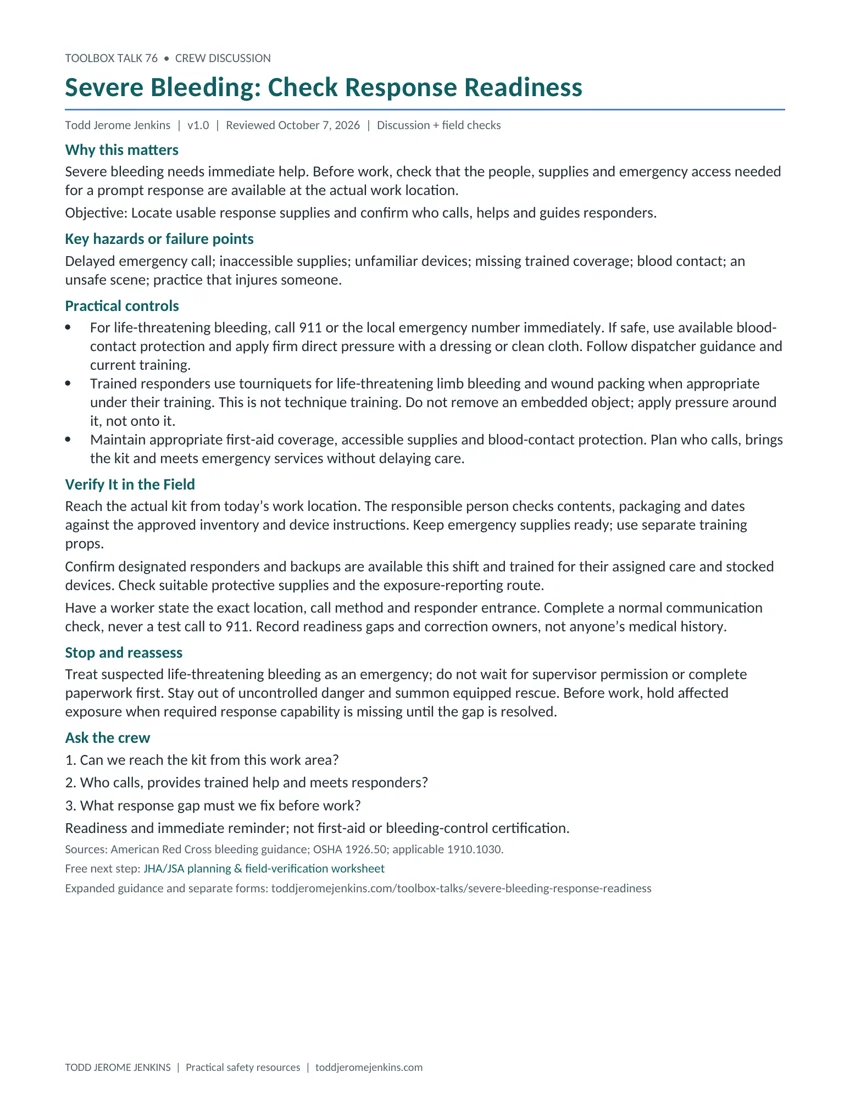
A 5–10 minute crew discussion, plus the time needed for field verification. All six downloads are free without a required signup.
Why this matters
Severe bleeding needs immediate help. Before work, check that the people, supplies and emergency access needed for a prompt response are available at the actual work location.
Learning objective: Locate usable response supplies and confirm who calls, helps and guides responders.
Key hazards or failure points
Delayed emergency call; inaccessible supplies; unfamiliar devices; missing trained coverage; blood contact; an unsafe scene; practice that injures someone.
Practical controls
- For life-threatening bleeding, call 911 or the local emergency number immediately. If safe, use available blood-contact protection and apply firm direct pressure with a dressing or clean cloth. Follow dispatcher guidance and current training.
- Trained responders use tourniquets for life-threatening limb bleeding and wound packing when appropriate under their training. This is not technique training. Do not remove an embedded object; apply pressure around it, not onto it.
- Maintain appropriate first-aid coverage, accessible supplies and blood-contact protection. Plan who calls, brings the kit and meets emergency services without delaying care.
Verify It in the Field
Reach the actual kit from today’s work location. The responsible person checks contents, packaging and dates against the approved inventory and device instructions. Keep emergency supplies ready; use separate training props.
Confirm designated responders and backups are available this shift and trained for their assigned care and stocked devices. Check suitable protective supplies and the exposure-reporting route.
Have a worker state the exact location, call method and responder entrance. Complete a normal communication check, never a test call to 911. Record readiness gaps and correction owners, not anyone’s medical history.
Use the separate field check to record the acceptance source and criterion, safe method, checker, actual result and time. Mark VERIFIED, HOLD/NOT VERIFIED, or N/A with a reason. A checkmark alone is not evidence that protection works. Complete all required task checks; do not enter danger or improvise a test.
| Control | Safe verification | Evidence |
|---|---|---|
| Usable bleeding supplies | Responsible person compares actual kit with inventory and instructions. | Location, package/date findings and replenishment. |
| Available trained response | Confirm shift coverage and familiarity with stocked devices. | Assigned responders, backup and training gap. |
| Prompt emergency help | Rehearse location and access with normal communication check. | Call method result, entrance and responder guide. |
Stop and reassess
Treat suspected life-threatening bleeding as an emergency; do not wait for supervisor permission or complete paperwork first. Stay out of uncontrolled danger and summon equipped rescue. Before work, hold affected exposure when required response capability is missing until the gap is resolved.
Crew discussion questions
- Can we reach the kit from this work area?
- Who calls, provides trained help and meets responders?
- What response gap must we fix before work?
A situation to discuss
Illustrative situation: the crew moves to another floor while the bleeding kit remains behind a locked door. The pre-job check reveals the access gap. The supervisor restores accessible supplies and confirms responder coverage before the affected task begins.
Leader preparation and practical detail
Get help promptly and use current training
The American Red Cross identifies life-threatening bleeding as requiring immediate emergency help and direct-pressure care. Its guidance includes tourniquets for life-threatening limb bleeding and wound packing when trained and appropriate. Do not delay effective care by repeating an archived last-resort rule. Take practical instruction for the actual techniques; this resource is a readiness discussion. [1]
Match supplies to the response plan
Construction 1926.50 requires advance medical arrangements, applicable first-aider coverage, accessible supplies and effective emergency communication. Check the actual kit against the employer’s assessed needs and device instructions. Its first-aid-kit inspection provision includes checks before dispatch to a job and at least weekly there; also address used or damaged supplies promptly. That interval does not replace every device-specific requirement. [2]
Prepare for blood exposure safely
Where occupational blood exposure falls within 1910.1030, the employer’s exposure-control arrangements and appropriate protective equipment apply. Verify suitable, accessible supplies before an emergency and follow the program for reporting exposure and contaminated materials. Practice only with training props and appropriate instruction—never tighten a tourniquet on a coworker or pack a simulated wound on a person during this talk. [3]
Short supervisor field check
- Kit accessible with required usable contents.
- Responder and backup coverage confirmed.
- Training fits assigned care and stocked devices.
- Blood-contact protection and reporting route available.
- Call, location and emergency access verified.
Record unresolved items, restrictions, correction owner, recheck result and required restart authorization. Reference permits and specialist inspections rather than treating this form as a replacement. Rebrief workers affected by a change.
Attendance and follow-through
Use the separate attendance sheet for participants, discussion concerns, actions and late-arrival rebriefs. Attendance does not establish competence, verify controls or authorize work. Keep completed records private under the employer’s recordkeeping procedures.
Technical scope and references
Readiness plus a short emergency reminder from current Red Cross guidance. Construction first-aid requirements and the applicable occupational blood-exposure program have separate scopes. This is not a wound-treatment course, device certification or medical assessment. [1–3]
References reviewed October 7, 2026. Apply the industry, activity and jurisdiction that govern the work. No actual site permit, equipment manual, exposure assessment or engineering determination was supplied for this general discussion.
- American Red Cross — Life-threatening external bleeding — Current recognition, emergency activation, pressure and trained responder guidance.
- OSHA 1926.50 — Medical services and first aid — Construction response arrangements, supplies and communication.
- OSHA 1910.1030 — Bloodborne pathogens — Exposure-control and protective-equipment provisions where occupational exposure applies.
Connect this discussion to your JHA/JSA
Use How to Conduct a Job Safety Analysis to connect task steps, hazards and controls. Revisit Pre-Job JHA/JSA: What Changed Today? when conditions change.
Related crew discussions
- Hand Tools: Condition, Selection & Line of Fire
- Hand Protection: Match the Glove to the Task
- CPR and AED Readiness: Can We Act Now?
- Emergency Readiness: Can We Reach Supplies and Call for Help?
- Incident Response: Protect People and Call for Help
Put one check into practice
Use the free JHA/JSA planning and field-verification worksheet to record today’s changes, important controls and the evidence needed before exposure.