Download the talk and separate crew records
Free to download without an account. Each PDF is one page. Use the Word version to adapt the record to your task and approved procedures.
Supervisor field check
Download supervisor field check (PDF, 1 page)Editable supervisor field check (Word)Preview the one-page crew talk
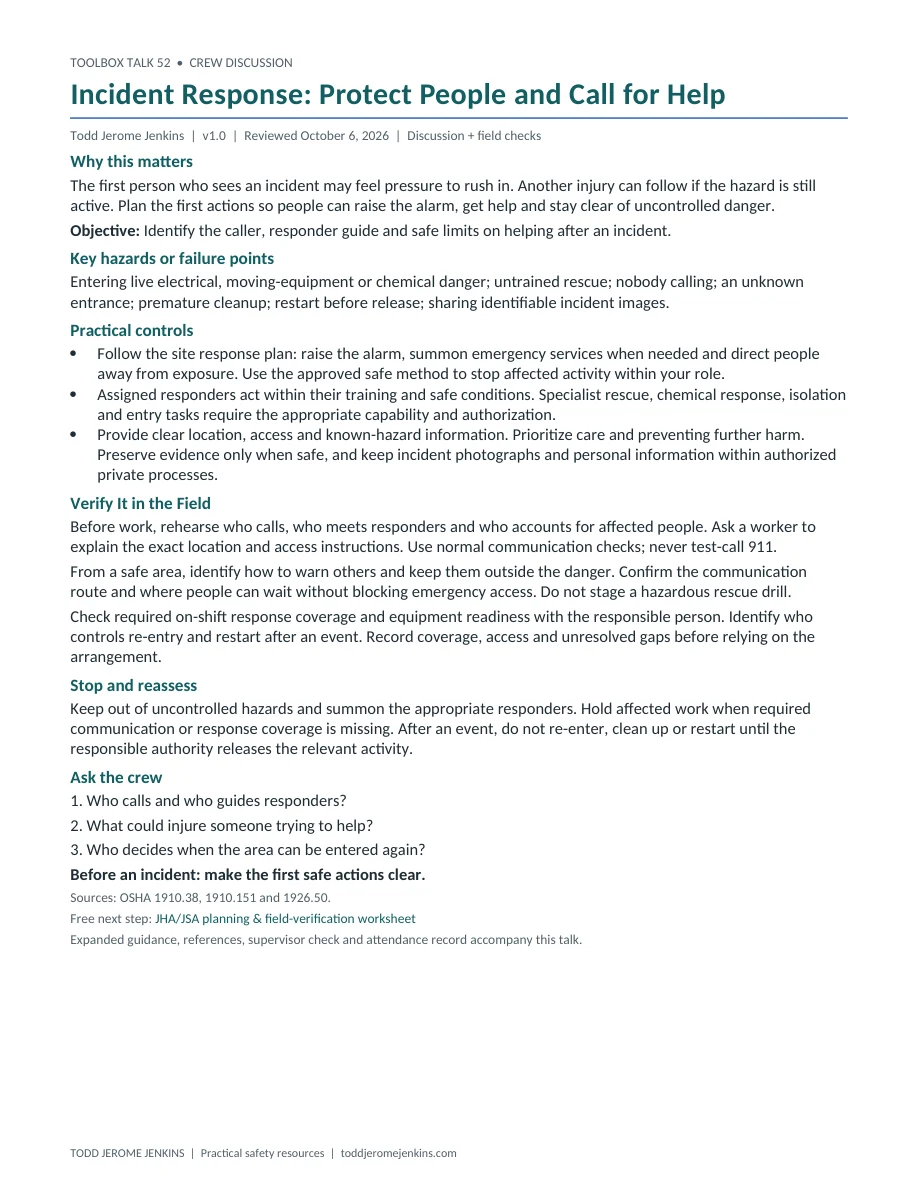
A 5–10 minute crew discussion, plus the time needed for field verification. All six downloads are free without a required signup.
Why this matters
The first person who sees an incident may feel pressure to rush in. Another injury can follow if the hazard is still active. Plan the first actions so people can raise the alarm, get help and stay clear of uncontrolled danger.
Learning objective: Identify the caller, responder guide and safe limits on helping after an incident.
Key hazards or failure points
Entering live electrical, moving-equipment or chemical danger; untrained rescue; nobody calling; an unknown entrance; premature cleanup; restart before release; sharing identifiable incident images.
Practical controls
- Follow the site response plan: raise the alarm, summon emergency services when needed and direct people away from exposure. Use the approved safe method to stop affected activity within your role.
- Assigned responders act within their training and safe conditions. Specialist rescue, chemical response, isolation and entry tasks require the appropriate capability and authorization.
- Provide clear location, access and known-hazard information. Prioritize care and preventing further harm. Preserve evidence only when safe, and keep incident photographs and personal information within authorized private processes.
Verify It in the Field
Before work, rehearse who calls, who meets responders and who accounts for affected people. Ask a worker to explain the exact location and access instructions. Use normal communication checks; never test-call 911.
From a safe area, identify how to warn others and keep them outside the danger. Confirm the communication route and where people can wait without blocking emergency access. Do not stage a hazardous rescue drill.
Check required on-shift response coverage and equipment readiness with the responsible person. Identify who controls re-entry and restart after an event. Record coverage, access and unresolved gaps before relying on the arrangement.
Use the separate field check to record the source and criterion, safe method, checker, actual result and time. Mark VERIFIED, HOLD/NOT VERIFIED, or N/A with a reason. Check every required control; the examples below do not clear the whole task.
| Control | Safe verification | Evidence to record |
|---|---|---|
| Clear first roles | Rehearse caller, guide and accountability assignments verbally. | Roles, exact location and handoff. |
| Safe boundaries | Identify warning and access-control arrangements from outside danger. | Boundary, safe waiting area and communication. |
| Controlled restart | Identify responsible re-entry/release authority. | Required review, restrictions and release evidence. |
Stop and reassess
Keep out of uncontrolled hazards and summon the appropriate responders. Hold affected work when required communication or response coverage is missing. After an event, do not re-enter, clean up or restart until the responsible authority releases the relevant activity.
Crew discussion questions
- Who calls and who guides responders?
- What could injure someone trying to help?
- Who decides when the area can be entered again?
Before an incident: make the first safe actions clear.
A situation to discuss
Illustrative situation: an injured person is near damaged energized equipment. The crew raises the alarm and keeps others clear while calling emergency help and the appropriate authorized electrical response. Nobody touches the equipment or enters the electrical exposure to begin an improvised rescue.
Leader preparation and practical detail
Plan before the event
The appropriate emergency and first-aid arrangements should identify reporting, assigned response and access needs before work starts. Recheck when work moves or shift coverage changes. A posted number does not resolve poor communication coverage or a locked entry point. [1], [2], [3]
Respect the limits of the role
This talk provides coordination reminders rather than rescue or medical techniques. Confined-space rescue, hazardous-material response and electrical isolation have their own requirements. Workers should know when to stay out and how to summon the right capability. A desire to help does not make an uncontrolled scene safe.
Separate care, release and learning
Life safety and hazard control come before preserving a scene. Once the response authority permits, preserve useful information through the employer’s process and protect privacy. Regulatory reporting and later investigation are separate duties. Use the incident-learning resource after the immediate response to evaluate the work conditions and verify corrective actions before future exposure.
Short supervisor field check
- Caller, guide and accountability roles rehearsed.
- Emergency contact and access arrangements effective.
- Required responders and equipment available.
- Crew understands safe boundaries and role limits.
- Re-entry, restart and information handoffs clear.
Use the separate form to document evidence, restrictions, corrective-action owner, recheck and required restart approval. An unresolved required control means hold the affected work. Missing evidence is not a pass. Complete all task-specific inspections and permits.
Attendance and follow-through
The separate attendance sheet records participants, language support, questions, actions and late-arrival rebriefs. Attendance does not establish competence or prove controls function. Keep completed records private under the employer’s procedures.
Technical scope and references
This is pre-job response coordination, not emergency medical, rescue, spill-response or energy-isolation training. OSHA emergency-plan and first-aid requirements have industry-specific applicability. Use the task’s actual emergency plan and authorized response capability. [1], [2], [3]
References checked October 6, 2026. Apply the jurisdiction, task, employer program and equipment instructions that govern the work. No site-specific manual, permit, engineering determination or product SDS has been approved by this general resource.
- OSHA 29 CFR 1910.38 — Emergency action plans — General industry; not a universal claim that this section independently requires a written plan in every workplace.
- OSHA 29 CFR 1926.50 — Medical services and first aid — Construction; exact first-aider coverage depends on reasonably accessible medical care and paragraph (c). No invented response-time limit.
- OSHA 29 CFR 1910.151 — Medical services and first aid — General industry; a toolbox briefing does not certify first-aid or rescue skills.
Connect this discussion to your JHA/JSA
Use How to Conduct a Job Safety Analysis to connect today’s work steps, hazards and controls. Revisit Pre-Job JHA/JSA: What Changed Today? whenever conditions change.
Related Todd Jerome Jenkins article: How to Conduct a Workplace Incident Investigation.
Related published crew resources: Emergency Evacuation: Know the Route and Count the Crew; Working Alone: Check In and Get Help; Barricades: What Does This Boundary Keep Out?; Learning from Incidents: Verify the Fix; CPR and AED Readiness: Can We Act Now?; Emergency Readiness: Can We Reach Supplies and Call for Help?.
Put one check into practice
Download the free JHA/JSA planning and field-verification worksheet. For today’s task, record an important control, its source and the evidence needed before exposure. Complete the remaining required checks through your task plan.