Download the talk and separate crew records
Free to download without an account. Each PDF is one page. Use the Word version to adapt the record to your task and approved procedures.
Supervisor field check
Download supervisor field check (PDF, 1 page)Editable supervisor field check (Word)Preview the one-page crew talk
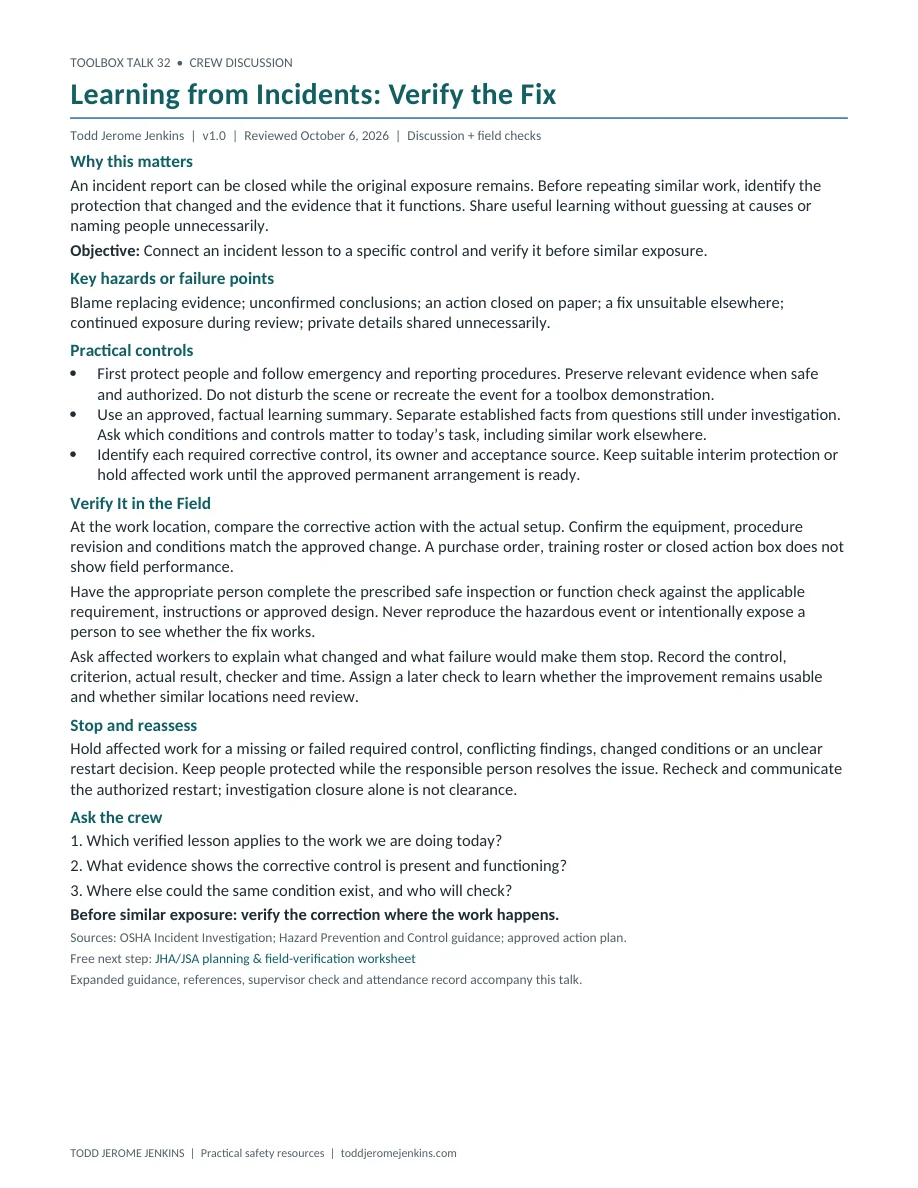
A 5–10 minute crew discussion, plus the time needed for field verification. All six downloads are free without a required signup.
Why this matters
An incident report can be closed while the original exposure remains. Before repeating similar work, identify the protection that changed and the evidence that it functions. Share useful learning without guessing at causes or naming people unnecessarily.
Learning objective: Connect an incident lesson to a specific control and verify it before similar exposure.
Key hazards or failure points
Blame replacing evidence; unconfirmed conclusions; an action closed on paper; a fix unsuitable elsewhere; continued exposure during review; private details shared unnecessarily.
Practical controls
- First protect people and follow emergency and reporting procedures. Preserve relevant evidence when safe and authorized. Do not disturb the scene or recreate the event for a toolbox demonstration.
- Use an approved, factual learning summary. Separate established facts from questions still under investigation. Ask which conditions and controls matter to today’s task, including similar work elsewhere.
- Identify each required corrective control, its owner and acceptance source. Keep suitable interim protection or hold affected work until the approved permanent arrangement is ready.
Verify It in the Field
At the work location, compare the corrective action with the actual setup. Confirm the equipment, procedure revision and conditions match the approved change. A purchase order, training roster or closed action box does not show field performance.
Have the appropriate person complete the prescribed safe inspection or function check against the applicable requirement, instructions or approved design. Never reproduce the hazardous event or intentionally expose a person to see whether the fix works.
Ask affected workers to explain what changed and what failure would make them stop. Record the control, criterion, actual result, checker and time. Assign a later check to learn whether the improvement remains usable and whether similar locations need review.
Use the separate field check to record the source and criterion, safe method, checker, actual result and time. Mark VERIFIED, HOLD/NOT VERIFIED, or N/A with a reason. Check every required control; the examples below do not clear the whole task.
| Control | Safe verification | Evidence to record |
|---|---|---|
| Applicable lesson | Compare the approved event learning with today’s task and conditions. | Facts and unresolved questions distinguished; applicable exposure identified. |
| Effective correction | Use the prescribed inspection or safe function check against source criteria. | Actual field result recorded; action status alone not accepted as evidence. |
| Sustained improvement | Ask affected workers about usability and schedule the next review. | Owner/date set; similar work locations and remaining restrictions identified. |
Stop and reassess
Hold affected work for a missing or failed required control, conflicting findings, changed conditions or an unclear restart decision. Keep people protected while the responsible person resolves the issue. Recheck and communicate the authorized restart; investigation closure alone is not clearance.
Crew discussion questions
- Which verified lesson applies to the work we are doing today?
- What evidence shows the corrective control is present and functioning?
- Where else could the same condition exist, and who will check?
Before similar exposure: verify the correction where the work happens.
A situation to discuss
Illustrative situation: after a pedestrian/equipment close call, a new walkway is marked and the action is closed. The field review finds deliveries still block the route. The leader holds the affected movement and gets the layout corrected before treating the action as effective.
Leader preparation and practical detail
Bring an evidence-based lesson
Use the organization’s approved summary and remove unnecessary personal or client details. State what is established and what remains uncertain. OSHA encourages investigation of injuries and close calls to identify contributing conditions and corrective actions, rather than stopping at a fault label. A crew briefing should not settle an unfinished investigation by consensus. [1]
Define completion in operational terms
Specify what must be different at the work location and how that difference will be checked. For a physical safeguard, use its actual installation and performance criteria. For a work arrangement, verify that the necessary staffing, sequence and resources exist. Required technical tests still need their designated people and methods.
Check again after the change meets real work
An initial check establishes readiness at that time. A later review can reveal whether the control remains effective through normal variations, maintenance or another shift. OSHA’s hazard-control guidance recommends follow-up evaluation and maintenance. Record what the later check found, including new difficulties and whether another corrective decision is needed. [2]
Short supervisor field check
- Approved factual learning summary protects private information.
- Relevant task, exposure and contributing conditions identified.
- Corrective/interim controls and acceptance sources specified.
- Appropriate person records actual inspection/function-check results.
- Restart authority, follow-up review and similar-work checks assigned.
Use the separate form to document evidence, restrictions, corrective-action owner, recheck and required restart approval. An unresolved required control means hold the affected work. Missing evidence is not a pass. Complete all task-specific inspections and permits.
Attendance and follow-through
The separate attendance sheet records participants, language support, questions, actions and late-arrival rebriefs. Attendance does not establish competence or prove controls function. Keep completed records private under the employer’s procedures.
Technical scope and references
This briefing supports applying lessons and verifying controls. It does not replace emergency response, evidence preservation, a formal investigation or required external reporting. The employer must separately determine applicable reporting duties and deadlines. No actual employer/client event is described; the scenario is illustrative. [1], [2]
References checked October 6, 2026. Apply the jurisdiction, task, employer program and equipment instructions that govern the work. No site-specific manual, permit, engineering determination or product SDS has been approved by this general resource.
- OSHA — Incident Investigation — Overview of learning from injuries/close calls and addressing contributing conditions.
- OSHA — Hazard Prevention and Control — Recommended practices: control selection, implementation, follow-up and maintenance.
Connect this discussion to your JHA/JSA
Use How to Conduct a Job Safety Analysis to connect today’s work steps, hazards and controls. Revisit Pre-Job JHA/JSA: What Changed Today? whenever conditions change.
Related Todd Jerome Jenkins article: How to Conduct a Workplace Incident Investigation.
Related Todd Jerome Jenkins video: Job Safety Analysis: A Basic Overview.
Put one check into practice
Download the free JHA/JSA planning and field-verification worksheet. For today’s task, record an important control, its source and the evidence needed before exposure. Complete the remaining required checks through your task plan.
Continue the crew discussion
- Pre-Job JHA/JSA: What Changed Today?
- Hierarchy of Controls: Verify the Protection
- Human Performance: Make the Next Step Clearer
- Learning Teams: Ask What Makes Work Difficult