Download the talk and separate crew records
Free to download without an account. Each PDF is one page. Use the Word version to adapt the record to your task and approved procedures.
Supervisor field check
Download supervisor field check (PDF, 1 page)Editable supervisor field check (Word)Preview the one-page crew talk
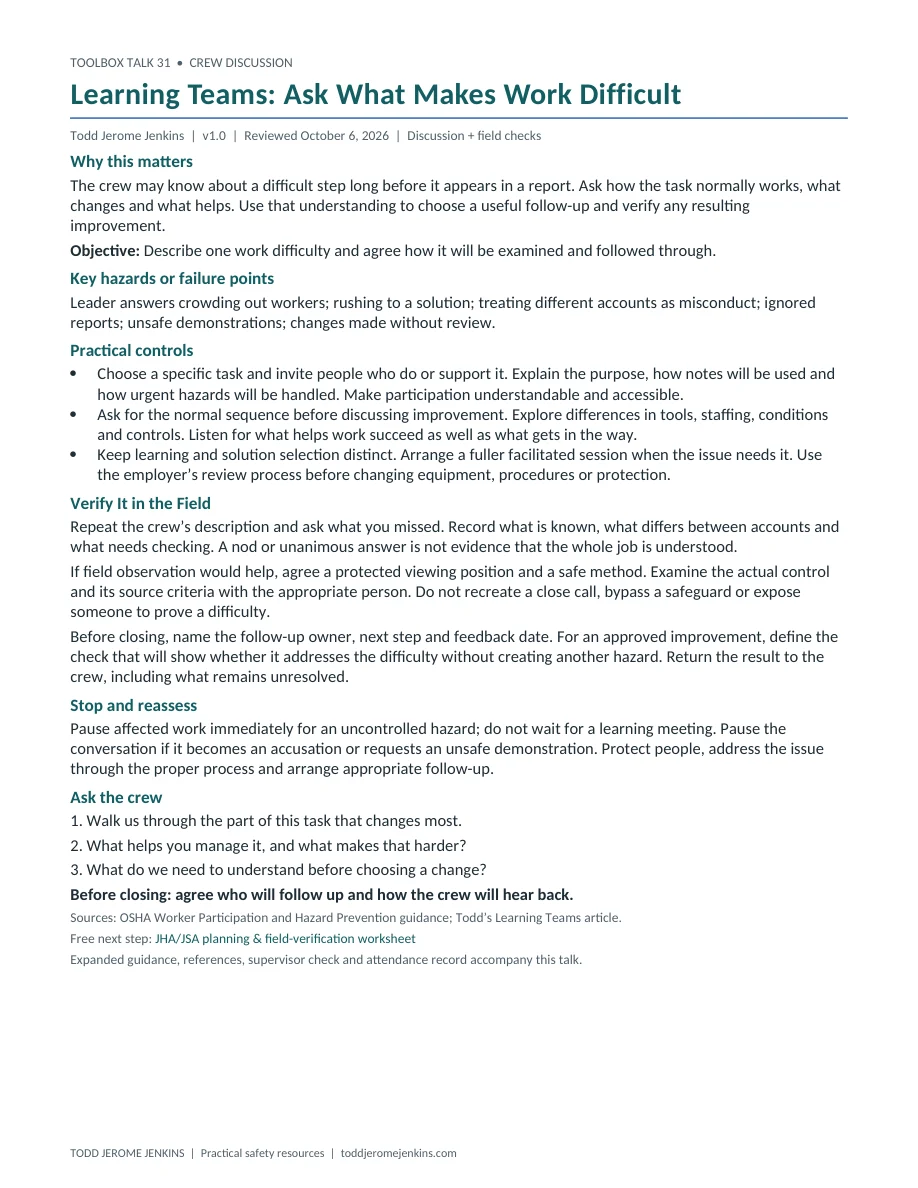
A 5–10 minute crew discussion, plus the time needed for field verification. All six downloads are free without a required signup.
Why this matters
The crew may know about a difficult step long before it appears in a report. Ask how the task normally works, what changes and what helps. Use that understanding to choose a useful follow-up and verify any resulting improvement.
Learning objective: Describe one work difficulty and agree how it will be examined and followed through.
Key hazards or failure points
Leader answers crowding out workers; rushing to a solution; treating different accounts as misconduct; ignored reports; unsafe demonstrations; changes made without review.
Practical controls
- Choose a specific task and invite people who do or support it. Explain the purpose, how notes will be used and how urgent hazards will be handled. Make participation understandable and accessible.
- Ask for the normal sequence before discussing improvement. Explore differences in tools, staffing, conditions and controls. Listen for what helps work succeed as well as what gets in the way.
- Keep learning and solution selection distinct. Arrange a fuller facilitated session when the issue needs it. Use the employer’s review process before changing equipment, procedures or protection.
Verify It in the Field
Repeat the crew’s description and ask what you missed. Record what is known, what differs between accounts and what needs checking. A nod or unanimous answer is not evidence that the whole job is understood.
If field observation would help, agree a protected viewing position and a safe method. Examine the actual control and its source criteria with the appropriate person. Do not recreate a close call, bypass a safeguard or expose someone to prove a difficulty.
Before closing, name the follow-up owner, next step and feedback date. For an approved improvement, define the check that will show whether it addresses the difficulty without creating another hazard. Return the result to the crew, including what remains unresolved.
Use the separate field check to record the source and criterion, safe method, checker, actual result and time. Mark VERIFIED, HOLD/NOT VERIFIED, or N/A with a reason. Check every required control; the examples below do not clear the whole task.
| Control | Safe verification | Evidence to record |
|---|---|---|
| Shared understanding | Repeat the task description and invite corrections or different conditions. | Agreed facts, differing accounts and unanswered questions kept distinct. |
| Safe observation | Agree the appropriate observer, protected position and permitted checks. | Observation resolves a question without recreating exposure. |
| Visible follow-through | Confirm owner, next step and date before the briefing ends. | Crew receives the outcome; approved change has a defined verification method. |
Stop and reassess
Pause affected work immediately for an uncontrolled hazard; do not wait for a learning meeting. Pause the conversation if it becomes an accusation or requests an unsafe demonstration. Protect people, address the issue through the proper process and arrange appropriate follow-up.
Crew discussion questions
- Walk us through the part of this task that changes most.
- What helps you manage it, and what makes that harder?
- What do we need to understand before choosing a change?
Before closing: agree who will follow up and how the crew will hear back.
A situation to discuss
Illustrative situation: workers describe a control that is easy to use on the day shift but difficult when material is staged differently at night. The leader records both accounts and arranges a safe observation with the affected shifts before selecting a change.
Leader preparation and practical detail
Use the talk to open learning
This short briefing introduces a way to ask about work and identify a subject for deeper learning. It is not a complete Learning Team process. A fuller session needs an appropriate facilitator, enough time and the relevant perspectives. Todd’s existing Learning Teams article explains that broader method; this resource adds a compact crew starting point.
Make room for an incomplete picture
Ask people to describe concrete examples before proposing solutions. Keep differences visible: one crew may have different equipment or access from another. A field visit, maintenance record or another participant may be needed to clarify the account. Explain the handling of notes honestly and avoid promises of absolute confidentiality or immunity that the organization cannot keep.
Follow through without rushing
OSHA’s recommended practices support worker involvement, accessible reporting and feedback. They do not, in the references used here, specifically prescribe a named Learning Teams method. When an improvement is approved, define how its effect will be checked and tell workers the result. Immediate hazards require action while broader learning continues. [1], [2]
Short supervisor field check
- Specific task and relevant worker perspectives included.
- Purpose, note use, participation support and urgent-hazard response clear.
- Facts, differing accounts and questions recorded without premature conclusions.
- Observation or improvement uses an approved safe process.
- Named owner, feedback date and effectiveness check agreed.
Use the separate form to document evidence, restrictions, corrective-action owner, recheck and required restart approval. An unresolved required control means hold the affected work. Missing evidence is not a pass. Complete all task-specific inspections and permits.
Attendance and follow-through
The separate attendance sheet records participants, language support, questions, actions and late-arrival rebriefs. Attendance does not establish competence or prove controls function. Keep completed records private under the employer’s procedures.
Technical scope and references
This is a short introductory crew conversation and follow-up aid. A Learning Team does not replace an incident investigation, required training or task-specific hazard controls. OSHA references support participation and control follow-through, not a claim that OSHA or NIOSH endorses the named Learning Teams method. [1], [2]
References checked October 6, 2026. Apply the jurisdiction, task, employer program and equipment instructions that govern the work. No site-specific manual, permit, engineering determination or product SDS has been approved by this general resource.
- OSHA — Worker Participation — Recommended practices: meaningful worker input, reporting, feedback and removing participation barriers.
- OSHA — Hazard Prevention and Control — Recommended practices: control selection, implementation, follow-up and maintenance.
Connect this discussion to your JHA/JSA
Use How to Conduct a Job Safety Analysis to connect today’s work steps, hazards and controls. Revisit Pre-Job JHA/JSA: What Changed Today? whenever conditions change.
Related Todd Jerome Jenkins article: How Learning Teams Improve Workplace Safety.
Related Todd Jerome Jenkins video: Job Safety Analysis: A Basic Overview.
Put one check into practice
Download the free JHA/JSA planning and field-verification worksheet. For today’s task, record an important control, its source and the evidence needed before exposure. Complete the remaining required checks through your task plan.
Continue the crew discussion
- Pre-Job JHA/JSA: What Changed Today?
- Hierarchy of Controls: Verify the Protection
- Human Performance: Make the Next Step Clearer
- Learning from Incidents: Verify the Fix