Download the talk and separate crew records
Free to download without an account. Each PDF is one page. Use the Word version to adapt the record to your task and approved procedures.
Supervisor field check
Download supervisor field check (PDF, 1 page)Editable supervisor field check (Word)Preview the one-page crew talk
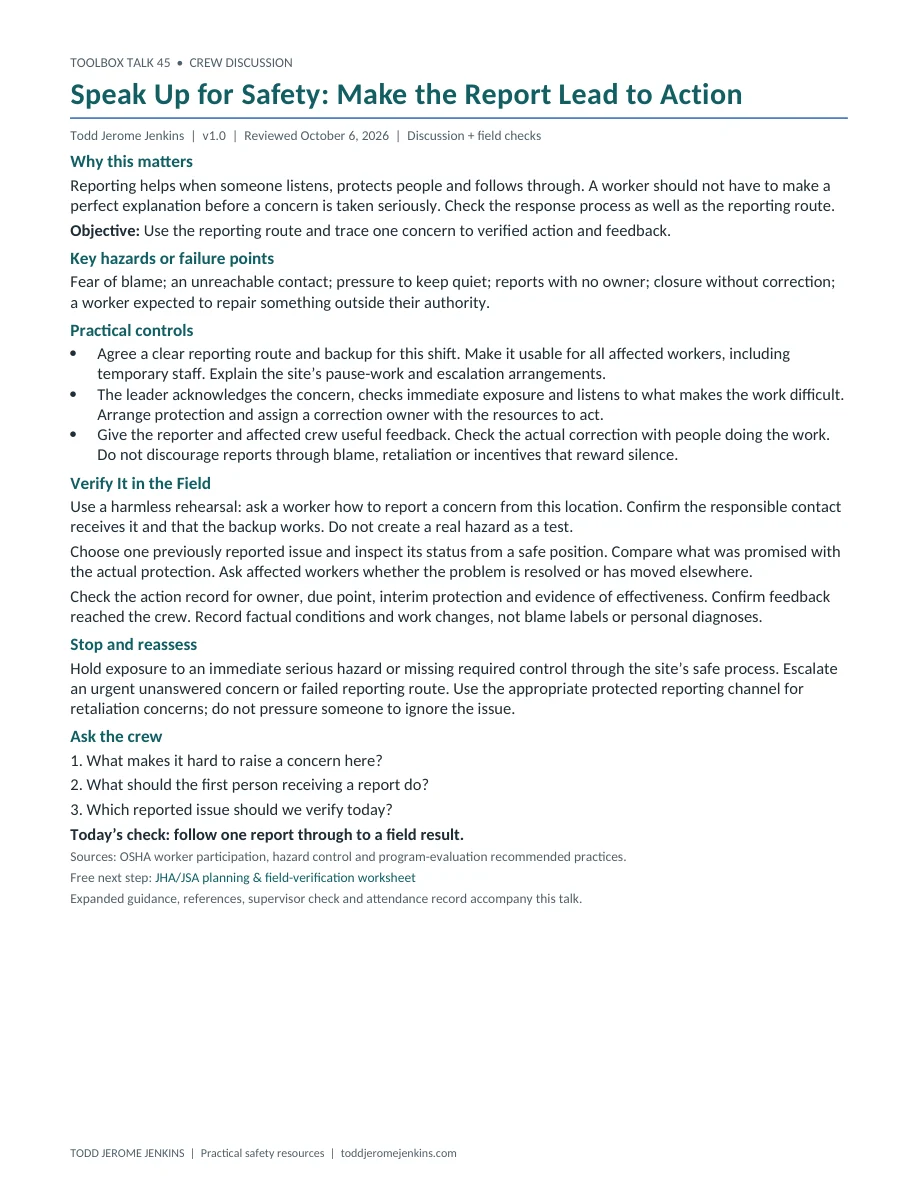
A 5–10 minute crew discussion, plus the time needed for field verification. All six downloads are free without a required signup.
Why this matters
Reporting helps when someone listens, protects people and follows through. A worker should not have to make a perfect explanation before a concern is taken seriously. Check the response process as well as the reporting route.
Learning objective: Use the reporting route and trace one concern to verified action and feedback.
Key hazards or failure points
Fear of blame; an unreachable contact; pressure to keep quiet; reports with no owner; closure without correction; a worker expected to repair something outside their authority.
Practical controls
- Agree a clear reporting route and backup for this shift. Make it usable for all affected workers, including temporary staff. Explain the site’s pause-work and escalation arrangements.
- The leader acknowledges the concern, checks immediate exposure and listens to what makes the work difficult. Arrange protection and assign a correction owner with the resources to act.
- Give the reporter and affected crew useful feedback. Check the actual correction with people doing the work. Do not discourage reports through blame, retaliation or incentives that reward silence.
Verify It in the Field
Use a harmless rehearsal: ask a worker how to report a concern from this location. Confirm the responsible contact receives it and that the backup works. Do not create a real hazard as a test.
Choose one previously reported issue and inspect its status from a safe position. Compare what was promised with the actual protection. Ask affected workers whether the problem is resolved or has moved elsewhere.
Check the action record for owner, due point, interim protection and evidence of effectiveness. Confirm feedback reached the crew. Record factual conditions and work changes, not blame labels or personal diagnoses.
Use the separate field check to record the source and criterion, safe method, checker, actual result and time. Mark VERIFIED, HOLD/NOT VERIFIED, or N/A with a reason. Check every required control; the examples below do not clear the whole task.
| Control | Safe verification | Evidence to record |
|---|---|---|
| Accessible reporting | Rehearse contact from the actual location without creating exposure. | Recipient, response and backup. |
| Effective correction | Compare one closed action with current field conditions. | Observed result and worker feedback. |
| Follow-through | Check owner, protection, due point and feedback record. | Open restriction, next action and who will verify. |
Stop and reassess
Hold exposure to an immediate serious hazard or missing required control through the site’s safe process. Escalate an urgent unanswered concern or failed reporting route. Use the appropriate protected reporting channel for retaliation concerns; do not pressure someone to ignore the issue.
Crew discussion questions
- What makes it hard to raise a concern here?
- What should the first person receiving a report do?
- Which reported issue should we verify today?
Today’s check: follow one report through to a field result.
A situation to discuss
Illustrative situation: a missing barrier is reported, and the action is marked complete after replacement material is ordered. A field check shows the barrier is still absent. The leader restores protection, corrects the action status and confirms installation before releasing the affected work.
Leader preparation and practical detail
Make the first response useful
Thank the worker for the information, determine whether anyone remains exposed and ask factual questions about the work. Avoid starting with who is at fault. A report can be incomplete and still identify a serious problem. OSHA’s recommended practices call for accessible reporting, timely response and feedback without retaliation. [1]
Measure response, not silence
Fewer reports alone do not prove stronger controls. A change in access, trust or work activity can affect reporting. Look at whether urgent concerns receive protection, actions have owners and completed changes work in the field. Involve affected workers in checking whether the response solved the problem. [1], [2], [3]
Keep the action within the worker’s role
Asking someone to report a damaged control does not authorize that person to repair, test or engineer it. The employer supplies the necessary decision maker and resources. Explain how to escalate if the first contact cannot resolve the concern, and distinguish the company’s pause-work process from legal work-refusal rules that depend on the situation.
Short supervisor field check
- Reporting route and backup demonstrated.
- Leader response includes protection and listening.
- Owner and interim controls assigned.
- One completed action checked with affected workers.
- Feedback provided without discouraging reports.
Use the separate form to document evidence, restrictions, corrective-action owner, recheck and required restart approval. An unresolved required control means hold the affected work. Missing evidence is not a pass. Complete all task-specific inspections and permits.
Attendance and follow-through
The separate attendance sheet records participants, language support, questions, actions and late-arrival rebriefs. Attendance does not establish competence or prove controls function. Keep completed records private under the employer’s procedures.
Technical scope and references
This is a practical reporting and leader-response resource based on OSHA recommended practices. It does not transfer employer duties to workers or claim an unlimited statutory right to refuse any assignment. Use appropriate reporting protections and the site’s safe escalation process. [1], [2], [3]
References checked October 6, 2026. Apply the jurisdiction, task, employer program and equipment instructions that govern the work. No site-specific manual, permit, engineering determination or product SDS has been approved by this general resource.
- OSHA Recommended Practices — Worker Participation — Recommended program practice; legal anti-retaliation protections separately discussed on page. Do not claim unlimited statutory refusal rights.
- OSHA Recommended Practices — Hazard Prevention and Control — Recommended practices, not a standalone technical acceptance standard. Site-specific criteria must come from applicable authoritative sources.
- OSHA Recommended Practices — Program Evaluation and Improvement — Recommended practices; no universal staffing ratio, workload maximum, or redundancy specification.
Connect this discussion to your JHA/JSA
Use How to Conduct a Job Safety Analysis to connect today’s work steps, hazards and controls. Revisit Pre-Job JHA/JSA: What Changed Today? whenever conditions change.
Related Todd Jerome Jenkins article: What Is Human and Organizational Performance?.
Related Todd Jerome Jenkins video: What Is the Difference Between a Hazard and a Risk?.
Related published crew resources: Human Performance: Make the Next Step Clearer; Learning Teams: Ask What Makes Work Difficult; Learning from Incidents: Verify the Fix.
Put one check into practice
Download the free JHA/JSA planning and field-verification worksheet. For today’s task, record an important control, its source and the evidence needed before exposure. Complete the remaining required checks through your task plan.