Download the talk and separate crew records
Free to download without an account. Each PDF is one page. Use the Word version to adapt the record to your task and approved procedures.
Supervisor field check
Download supervisor field check (PDF, 1 page)Editable supervisor field check (Word)Preview the one-page crew talk
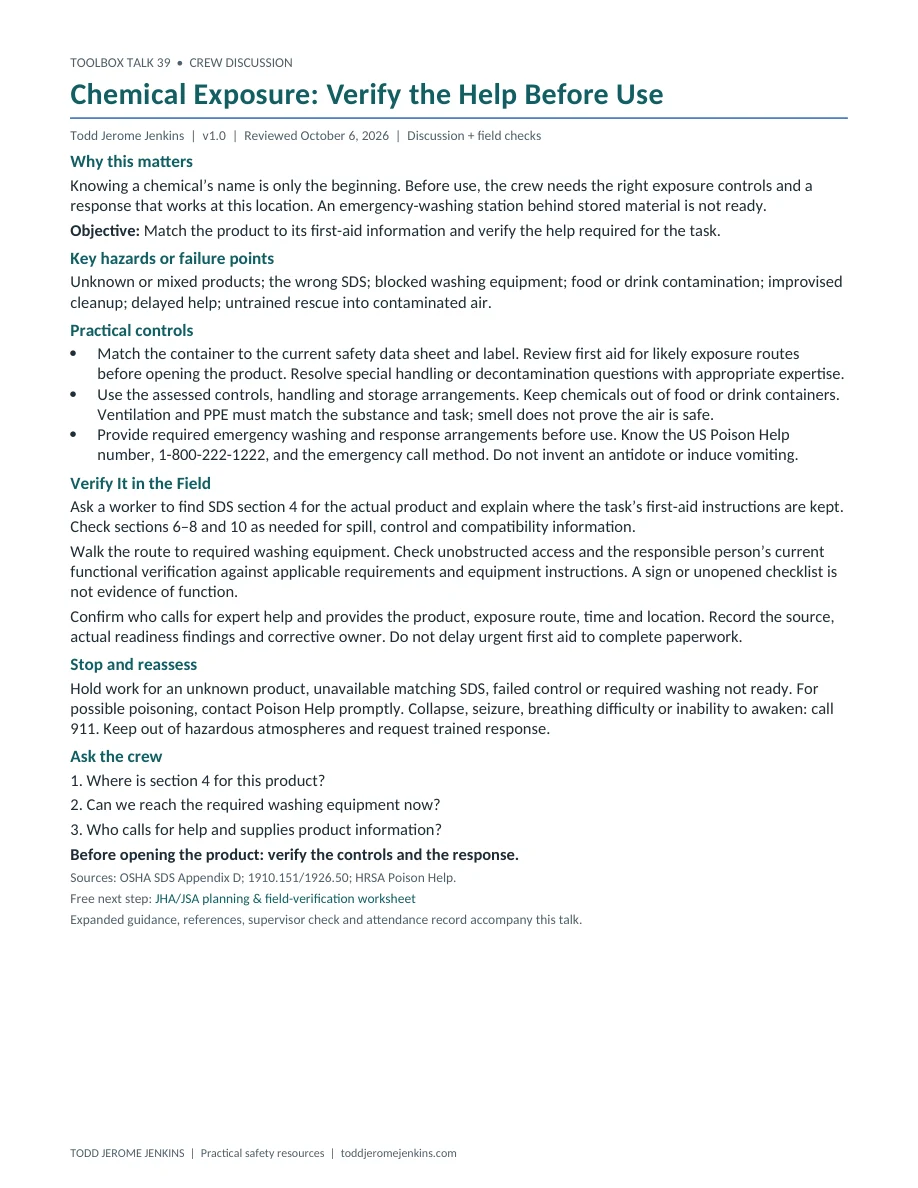
A 5–10 minute crew discussion, plus the time needed for field verification. All six downloads are free without a required signup.
Why this matters
Knowing a chemical’s name is only the beginning. Before use, the crew needs the right exposure controls and a response that works at this location. An emergency-washing station behind stored material is not ready.
Learning objective: Match the product to its first-aid information and verify the help required for the task.
Key hazards or failure points
Unknown or mixed products; the wrong SDS; blocked washing equipment; food or drink contamination; improvised cleanup; delayed help; untrained rescue into contaminated air.
Practical controls
- Match the container to the current safety data sheet and label. Review first aid for likely exposure routes before opening the product. Resolve special handling or decontamination questions with appropriate expertise.
- Use the assessed controls, handling and storage arrangements. Keep chemicals out of food or drink containers. Ventilation and PPE must match the substance and task; smell does not prove the air is safe.
- Provide required emergency washing and response arrangements before use. Know the US Poison Help number, 1-800-222-1222, and the emergency call method. Do not invent an antidote or induce vomiting.
Verify It in the Field
Ask a worker to find SDS section 4 for the actual product and explain where the task’s first-aid instructions are kept. Check sections 6–8 and 10 as needed for spill, control and compatibility information.
Walk the route to required washing equipment. Check unobstructed access and the responsible person’s current functional verification against applicable requirements and equipment instructions. A sign or unopened checklist is not evidence of function.
Confirm who calls for expert help and provides the product, exposure route, time and location. Record the source, actual readiness findings and corrective owner. Do not delay urgent first aid to complete paperwork.
Use the separate field check to record the source and criterion, safe method, checker, actual result and time. Mark VERIFIED, HOLD/NOT VERIFIED, or N/A with a reason. Check every required control; the examples below do not clear the whole task.
| Control | Safe verification | Evidence to record |
|---|---|---|
| Correct first-aid information | Match label/product to SDS and locate exposure-specific instructions. | Product, SDS version and unresolved questions. |
| Usable washing facilities | Check route and responsible person’s functional verification. | Applicable criterion, actual result and time. |
| Expert help | Identify call method, product-information source and caller. | Help contacts, location details and assigned roles. |
Stop and reassess
Hold work for an unknown product, unavailable matching SDS, failed control or required washing not ready. For possible poisoning, contact Poison Help promptly. Collapse, seizure, breathing difficulty or inability to awaken: call 911. Keep out of hazardous atmospheres and request trained response.
Crew discussion questions
- Where is section 4 for this product?
- Can we reach the required washing equipment now?
- Who calls for help and supplies product information?
Before opening the product: verify the controls and the response.
A situation to discuss
Illustrative situation: the correct SDS is available, but pallets block the route to the required eyewash. The crew holds the chemical task while access and equipment readiness are corrected and checked. Having discussed first aid does not compensate for an unusable facility.
Leader preparation and practical detail
Plan for the actual exposure
SDS section 4 addresses first aid by exposure route, while other sections provide spill precautions, handling, controls and stability information. Check the exact product and current information before work. Where a substance has unusual reactivity or decontamination needs, establish the procedure with the appropriate specialist beforehand. [1]
Verify washing facilities against the governing criteria
OSHA’s general-industry and construction provisions address suitable quick drenching or flushing facilities where injurious corrosive exposure may occur. Determine which provision applies. The task assessment and equipment instructions must resolve suitability, access, checks and maintenance; this talk does not invent a universal flow rate, duration, distance or inspection interval. Record the actual criterion used and result. [2], [3]
Get poison advice without delay
US Poison Help connects callers to poison expertise at 1-800-222-1222. Seek advice about possible poisoning without waiting for symptoms. For a life-threatening emergency, call 911. Follow the indicated first aid promptly, and obtain substance-specific guidance; do not induce vomiting, improvise neutralizers or enter a hazardous atmosphere to rescue someone without the required response capability. [4], [5], [6]
Short supervisor field check
- Actual product and matching SDS identified.
- Exposure controls and first-aid instructions reviewed.
- Required washing access and function verified.
- Emergency and Poison Help call routes known.
- Gaps corrected before exposure; results and owner recorded.
Use the separate form to document evidence, restrictions, corrective-action owner, recheck and required restart approval. An unresolved required control means hold the affected work. Missing evidence is not a pass. Complete all task-specific inspections and permits.
Attendance and follow-through
The separate attendance sheet records participants, language support, questions, actions and late-arrival rebriefs. Attendance does not establish competence or prove controls function. Keep completed records private under the employer’s procedures.
Technical scope and references
This is readiness guidance, not a chemical-specific treatment or spill-response procedure. The actual SDS, label, task assessment and applicable standard govern. US poison and emergency numbers are shown; adapt contact details for other countries. Do not delay urgent first aid while finding documents. [1], [2], [3], [4], [5], [6]
References checked October 6, 2026. Apply the jurisdiction, task, employer program and equipment instructions that govern the work. No site-specific manual, permit, engineering determination or product SDS has been approved by this general resource.
- 29 CFR 1910.1200 Appendix D — Safety Data Sheets — Section4 organizes first aid by exposure route and indicates urgent treatment; sections6–8/10 support spill precautions, handling/storage, exposure controls and incompatible materials. Actual product SDS still must be checked at job.
- 29 CFR 1910.151 Medical services and first aid — General-industry medical advice, first-aid readiness and suitable quick drenching/flushing facilities where injurious corrosive exposure may occur. Scope actual operation before applying.
- 29 CFR 1926.50 Medical services and first aid — Construction-specific readiness requirements. No universal emergency response time or AED mandate derived here.
- What You Can Do — US Poison Help 1-800-222-1222; do not wait for symptoms to ask about possible poisoning; have product and route/time/location information ready. Do not delay urgent decontamination or 911 call for paperwork.
- First Steps in a Poisoning Emergency — Exposure-specific first-aid routes and poison-expert advice. No routine activated charcoal. Product/site procedure must address special hazards before use.
- First aid guidelines — Poison-center primary clinical guidance: collapse, seizure, breathing difficulty or inability to awaken calls for immediate911. Do not induce vomiting. Avoid entering hazardous atmosphere to rescue; call trained emergency responders.
Connect this discussion to your JHA/JSA
Use How to Conduct a Job Safety Analysis to connect today’s work steps, hazards and controls. Revisit Pre-Job JHA/JSA: What Changed Today? whenever conditions change.
Related Todd Jerome Jenkins video: What Is a Safety Data Sheet and How Do You Read It?.
Related published crew resources: Respiratory Hazards: Know What You’re Breathing; Hazard Communication: Labels, SDS & the Task; Wet Concrete: Prevent Skin and Eye Contact; Hand Protection: Match the Glove to the Task.
Put one check into practice
Download the free JHA/JSA planning and field-verification worksheet. For today’s task, record an important control, its source and the evidence needed before exposure. Complete the remaining required checks through your task plan.