Download the talk and separate crew records
Free to download without an account. Each PDF is one page. Use the Word version to adapt the record to your task and approved procedures.
Supervisor field check
Download supervisor field check (PDF, 1 page)Editable supervisor field check (Word)Preview the one-page crew talk
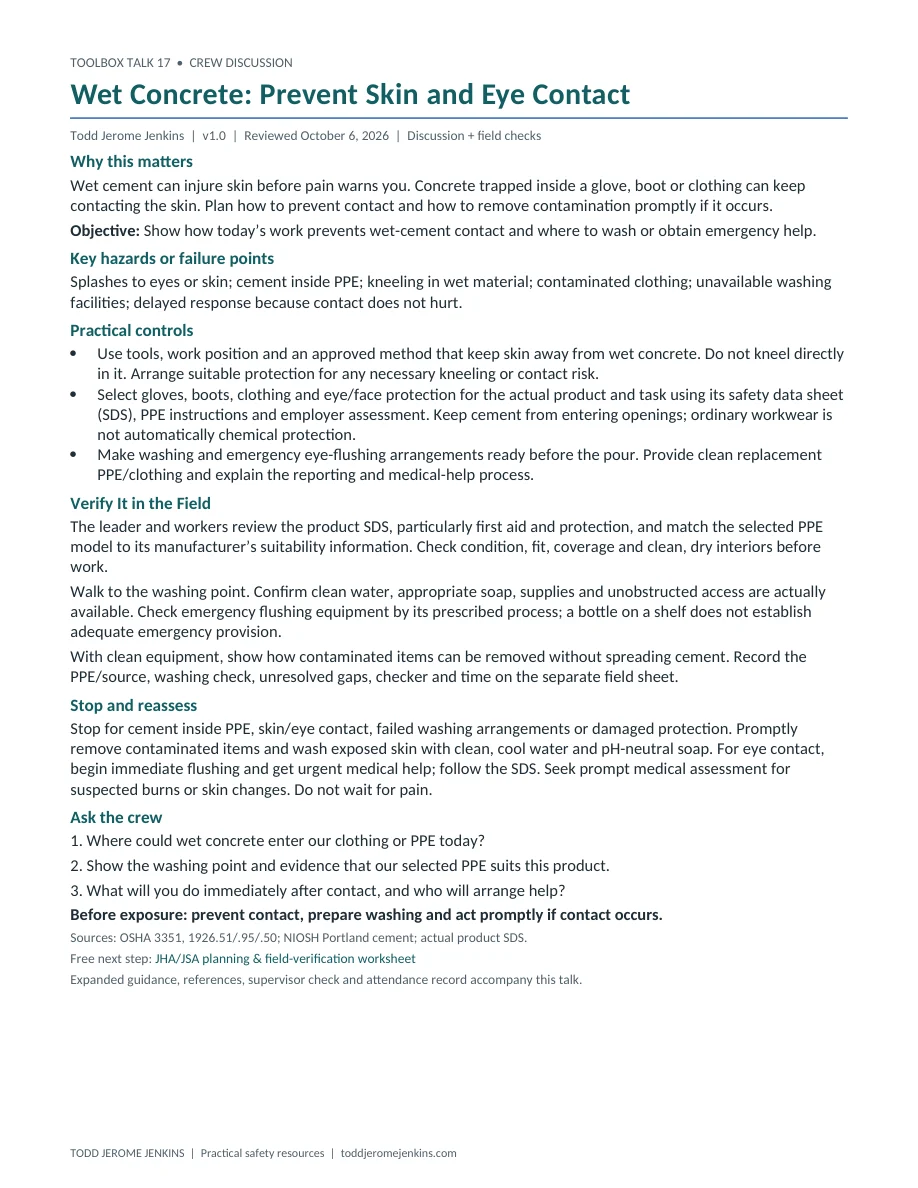
A 5–10 minute crew discussion, plus the time needed for field verification. All six downloads are free without a required signup.
Why this matters
Wet cement can injure skin before pain warns you. Concrete trapped inside a glove, boot or clothing can keep contacting the skin. Plan how to prevent contact and how to remove contamination promptly if it occurs.
Learning objective: Show how today’s work prevents wet-cement contact and where to wash or obtain emergency help.
Key hazards or failure points
Splashes to eyes or skin; cement inside PPE; kneeling in wet material; contaminated clothing; unavailable washing facilities; delayed response because contact does not hurt.
Practical controls
- Use tools, work position and an approved method that keep skin away from wet concrete. Do not kneel directly in it. Arrange suitable protection for any necessary kneeling or contact risk.
- Select gloves, boots, clothing and eye/face protection for the actual product and task using its safety data sheet (SDS), PPE instructions and employer assessment. Keep cement from entering openings; ordinary workwear is not automatically chemical protection.
- Make washing and emergency eye-flushing arrangements ready before the pour. Provide clean replacement PPE/clothing and explain the reporting and medical-help process.
Verify It in the Field
The leader and workers review the product SDS, particularly first aid and protection, and match the selected PPE model to its manufacturer’s suitability information. Check condition, fit, coverage and clean, dry interiors before work.
Walk to the washing point. Confirm clean water, appropriate soap, supplies and unobstructed access are actually available. Check emergency flushing equipment by its prescribed process; a bottle on a shelf does not establish adequate emergency provision.
With clean equipment, show how contaminated items can be removed without spreading cement. Record the PPE/source, washing check, unresolved gaps, checker and time on the separate field sheet.
Use the separate field check to record the source and criterion, safe method, checker, actual result and time. Mark VERIFIED, HOLD/NOT VERIFIED, or N/A with a reason. Check every required control; the examples below do not clear the whole task.
| Control | Safe verification | Evidence to record |
|---|---|---|
| Skin protection | Compare product hazards with PPE model instructions and the task assessment. | Suitable model, fit and coverage confirmed; no wet cement inside. |
| Washing access | Walk the route and confirm functioning water, suitable soap and supplies. | Location and actual availability recorded; missing provision resolved before work. |
| Emergency response | Review SDS first aid and prescribed flushing-equipment checks. | Immediate response, helper and medical contact identified; equipment readiness confirmed. |
Stop and reassess
Stop for cement inside PPE, skin/eye contact, failed washing arrangements or damaged protection. Promptly remove contaminated items and wash exposed skin with clean, cool water and pH-neutral soap. For eye contact, begin immediate flushing and get urgent medical help; follow the SDS. Seek prompt medical assessment for suspected burns or skin changes. Do not wait for pain.
Crew discussion questions
- Where could wet concrete enter our clothing or PPE today?
- Show the washing point and evidence that our selected PPE suits this product.
- What will you do immediately after contact, and who will arrange help?
Before exposure: prevent contact, prepare washing and act promptly if contact occurs.
A situation to discuss
Illustrative situation: a worker’s boot stays dry outside but contains a small amount of wet concrete inside. They feel no pain. The crew stops the exposure, removes the contaminated item and follows the washing and medical-response arrangements instead of waiting for discomfort.
Leader preparation and practical detail
Check the inside as well as the outside
A glove can be intact and still expose skin if cement entered through the cuff. The same applies to boots and clothing. Agree how workers will get replacements and remove contaminated items promptly. The task should not depend on someone continuing through the pour in contaminated protection. [1]
Use the actual product information
Different mixes and additives can change the information needed. Have the current SDS available and identify its first-aid instructions before exposure. Match protective equipment using its actual model and supplier information; a material name alone does not establish suitability for every product or duration. No particular manufacturer’s glove, boot or cement SDS was selected for this general resource.
Make the response physically possible
Walk the route to washing and emergency equipment before starting. Check access during the pour, not only when the area is empty. Assign someone to keep supplies available. Do not improvise a neutralizing chemical or use a general skin cream to treat a burn. Follow the product first-aid instructions and medical direction. A toolbox talk is not treatment training.
Other hazards during the pour
The one-page crew talk focuses on wet-cement skin and eye exposure. The pour plan must also address movement, impalement, lifting and electrical hazards.
- Reinforcing steel: 1926.701(b) requires protection against impalement where a worker could fall onto or into protruding steel. From a protected position, the responsible person checks the installed system against its approved use, instructions and actual exposure. A colored cap alone is not evidence of impalement protection; do not improvise an impact test.
- Concrete buckets: 1926.701(d)–(e) prohibits riding buckets and working beneath them during elevation or lowering, and addresses routing. Confirm the planned load path and separation before lifting. Under 1926.702(f), check the required gate safety devices and equipment condition using the specified safe method. Required lifting capacity must be established through the applicable lift plan and equipment information; a trial lift does not establish capacity.
- Bull floats: Where handles might contact energized conductors, apply 1926.702(h)’s handle-protection requirements and the task’s electrical controls. Have the responsible person verify the actual equipment and arrangement before use. Do not attempt contact as a test.
Record these checks in the relevant task plans. Use the related line-of-fire, rigging, electrical and manual-handling discussions when preparing the pour.
Short supervisor field check
- Current product SDS and exposure assessment available.
- Work method limits skin contact and addresses necessary kneeling.
- PPE model suitability, fit, condition and clean interiors confirmed.
- Washing and required emergency flushing arrangements checked in place.
- Replacement items, contamination response and medical-help route ready.
Use the separate form to document evidence, restrictions, corrective-action owner, recheck and required restart approval. An unresolved required control means hold the affected work. Missing evidence is not a pass. Complete all task-specific inspections and permits.
Attendance and follow-through
The separate attendance sheet records participants, language support, questions, actions and late-arrival rebriefs. Attendance does not establish competence or prove controls function. Keep completed records private under the employer’s procedures.
Technical scope and references
OSHA Publication 3351 is historical guidance (2008), still hosted by OSHA; its skin-contact advice is used here, not its old statistics, exposure limits or terminology. Current construction requirements reviewed include 1926.51(f), 1926.95 and 1926.50(g) for suitable immediate flushing where injurious corrosive exposure is possible. The actual product SDS and site provisions determine the detailed response. [1], [2], [3], [4] NIOSH’s Portland-cement first-aid entry supports immediate eye irrigation and prompt skin washing. [5]
References checked October 6, 2026. Apply the jurisdiction, task, employer program and equipment instructions that govern the work. No site-specific manual, permit, engineering determination or product SDS has been approved by this general resource.
- OSHA Publication 3351 — Preventing Skin Problems from Working with Portland Cement — 2008 historical guidance still hosted by OSHA; used for skin prevention/response, not old limits or statistics.
- OSHA 29 CFR 1926.51 — Sanitation — Construction washing facilities.
- OSHA 29 CFR 1926.95 — Criteria for personal protective equipment — Construction; selection must ensure proper fit for each affected employee.
- OSHA 29 CFR 1926.50 — Medical services and first aid — Construction emergency arrangements; suitable immediate flushing for corrosives.
- NIOSH Pocket Guide — Portland cement — Chemical-hazard guidance; page reviewed October 2019. Used only for contact prevention and first aid.
Connect this discussion to your JHA/JSA
Use How to Conduct a Job Safety Analysis to connect today’s work steps, hazards and controls. Revisit Pre-Job JHA/JSA: What Changed Today? whenever conditions change.
Related Todd Jerome Jenkins video: What Is a Safety Data Sheet and How Do You Read It?.
Related published crew resources: Hazard Communication: Labels, SDS & the Task; Eye & Face Protection.
Put one check into practice
Download the free JHA/JSA planning and field-verification worksheet. For today’s task, record an important control, its source and the evidence needed before exposure. Complete the remaining required checks through your task plan.
Continue the crew discussion
- Hazard Communication: Labels, SDS & the Task
- Eye & Face Protection
- Hand Protection: Match the Glove to the Task