Download the talk and separate crew records
Free to download without an account. Each PDF is one page. Use the Word version to adapt the record to your task and approved procedures.
Supervisor field check
Download supervisor field check (PDF, 1 page)Editable supervisor field check (Word)Preview the one-page crew talk
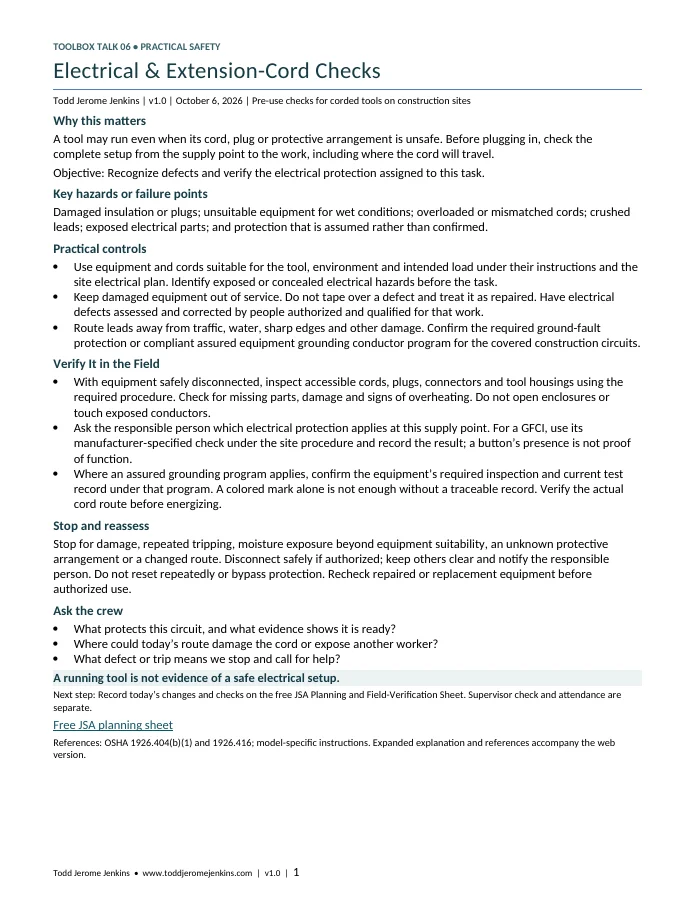
One-page crew talk, with separate supervisor and attendance sheets. Plan a 5–10 minute discussion and allow the time needed for field verification. All downloads are free; no account is required.
Learning objective
Recognize defects and verify the electrical protection assigned to this task.
Start with today’s work
Illustrative scenario: A grinder runs from a temporary supply, but the crew cannot say whether the circuit has GFCI protection or is managed under the site’s assured grounding program. Stop before use. Ask the responsible electrical person to establish the protective arrangement and the evidence required. A functioning motor and a colored cord label do not settle that question.
Key hazards or failure points
Damaged insulation or plugs; unsuitable equipment for wet conditions; overloaded or mismatched cords; crushed leads; exposed electrical parts; and protection that is assumed rather than confirmed.
Practical controls
- Use equipment and cords suitable for the tool, environment and intended load under their instructions and the site electrical plan. Identify exposed or concealed electrical hazards before the task.
- Keep damaged equipment out of service. Do not tape over a defect and treat it as repaired. Have electrical defects assessed and corrected by people authorized and qualified for that work.
- Route leads away from traffic, water, sharp edges and other damage. Confirm the required ground-fault protection or compliant assured equipment grounding conductor program for the covered construction circuits.
Verify It in the Field
- With equipment safely disconnected, inspect accessible cords, plugs, connectors and tool housings using the required procedure. Check for missing parts, damage and signs of overheating. Do not open enclosures or touch exposed conductors.
- Ask the responsible person which electrical protection applies at this supply point. For a GFCI, use its manufacturer-specified check under the site procedure and record the result; a button’s presence is not proof of function.
- Where an assured grounding program applies, confirm the equipment’s required inspection and current test record under that program. A colored mark alone is not enough without a traceable record. Verify the actual cord route before energizing.
For each required control, identify the acceptance source and safe check method, assign a person with the required competence and authority, and record the actual result and time. Use VERIFIED, HOLD/NOT VERIFIED, or N/A with a reason. A checkmark alone does not demonstrate that protection works.
| Control | Safe verification | Criterion, evidence and response |
|---|---|---|
| Cord and plug condition | Disconnect safely and inspect accessible surfaces and connectors without opening equipment. | 1926.416(e), applicable inspection procedure and equipment instructions. Record item ID and defect; remove defective items from use. |
| Protective arrangement | Responsible person confirms the supply’s required protection and the specified check or test evidence. | 1926.404(b)(1); site program; manufacturer instructions. Record the circuit/device, result or test reference and date. |
| Route protection | Walk the route from a safe position and compare it with today’s traffic, edges, water and access. | Site electrical/JHA plan and equipment suitability requirements. Record crossings and protection; hold if damage or exposure remains. |
These are examples, not a complete task inspection. Check all required controls. Do not enter danger, defeat a safeguard or improvise a test. If the criterion, method or result is uncertain, hold affected work and get the appropriate technical help. No actual equipment model, product SDS or site permit was supplied for these examples; use the documents for your task.
Leader preparation and explanation
Know which protection applies
OSHA 1926.404(b)(1) provides GFCI and assured equipment grounding conductor program provisions for covered construction equipment and circuits. Their scopes and conditions matter. A worker should not choose between them informally at the receptacle. Follow the employer’s compliant arrangement, including any applicable exceptions and more protective site requirements.
Check function and records safely
Use the GFCI manufacturer’s instructions for its test and the site’s safe procedure. For an assured grounding program, the written program, designated competent person, inspections, required testing and records must support the arrangement. This page does not supply a substitute electrical test method or tell unqualified workers to probe circuits.
Manage the physical route
A cord can be sound at issue and damaged during use. Protect it using a suitable planned route and approved protection. OSHA 1926.416 prohibits using worn or frayed cords and specified damaging attachment methods. Do not nail, staple or hang cords from wire. Reassess when doors, vehicles, water or nearby work change the exposure.
Stop and reassess
Stop for damage, repeated tripping, moisture exposure beyond equipment suitability, an unknown protective arrangement or a changed route. Disconnect safely if authorized; keep others clear and notify the responsible person. Do not reset repeatedly or bypass protection. Recheck repaired or replacement equipment before authorized use.
When conditions change, return to Pre-Job JHA/JSA: What Changed Today? and revise the affected task plan with the crew.
Three crew discussion questions
- What protects this circuit, and what evidence shows it is ready?
- Where could today’s route damage the cord or expose another worker?
- What defect or trip means we stop and call for help?
Short supervisor field check
- Equipment, cord selection and supply arrangement suit the task and environment.
- Required visual checks found no unresolved defects; damaged items are isolated from use.
- Applicable GFCI protection or assured grounding program is identified for the covered circuits.
- Specified function check or traceable grounding test records are complete and acceptable.
- Cord routing, traffic, water and nearby electrical exposures are controlled.
Use the separate supervisor sheet to record the task and change, JHA/JSA revision, acceptance source, safe method, verifier, actual result, unresolved items, corrective action, recheck and required restart authorization. Link specialist inspection records rather than copying private or unnecessary details.
Attendance and follow-through
Use the separate attendance sheet for participant names, roles and acknowledgment, meeting details, concerns, actions and rebriefs. Attendance is not proof of competence, functioning controls or permission to work. Keep completed records under the employer’s privacy and recordkeeping procedures; never post completed sign-in sheets publicly.
Related JHA/JSA resource and existing video
How to Conduct a Job Safety Analysis connects the task steps, hazards and controls. For related background, see What Is the Hierarchy of Controls?.
Related crew discussions
One next step
Use the free JSA Planning and Field-Verification Sheet to record today’s changes and checks with the crew.
Sources and references
Sources reviewed October 6, 2026. Apply each regulation’s industry and activity scope, and current state or local requirements where applicable. Guidance is identified separately. This discussion resource supports preparation; it does not replace task procedures, required training, permits or specialist decisions.
- OSHA 29 CFR 1926.404 — Subpart (b)(1): ground-fault protection and assured equipment grounding conductor program requirements within their respective scope.
- OSHA 29 CFR 1926.416 — Protection from electrical circuits, keeping work spaces clear and restrictions on damaged cords and their attachment.