Download the talk and separate crew records
Free to download without an account. Each PDF is one page. Use the Word version to adapt the record to your task and approved procedures.
Supervisor field check
Download supervisor field check (PDF, 1 page)Editable supervisor field check (Word)Preview the one-page crew talk
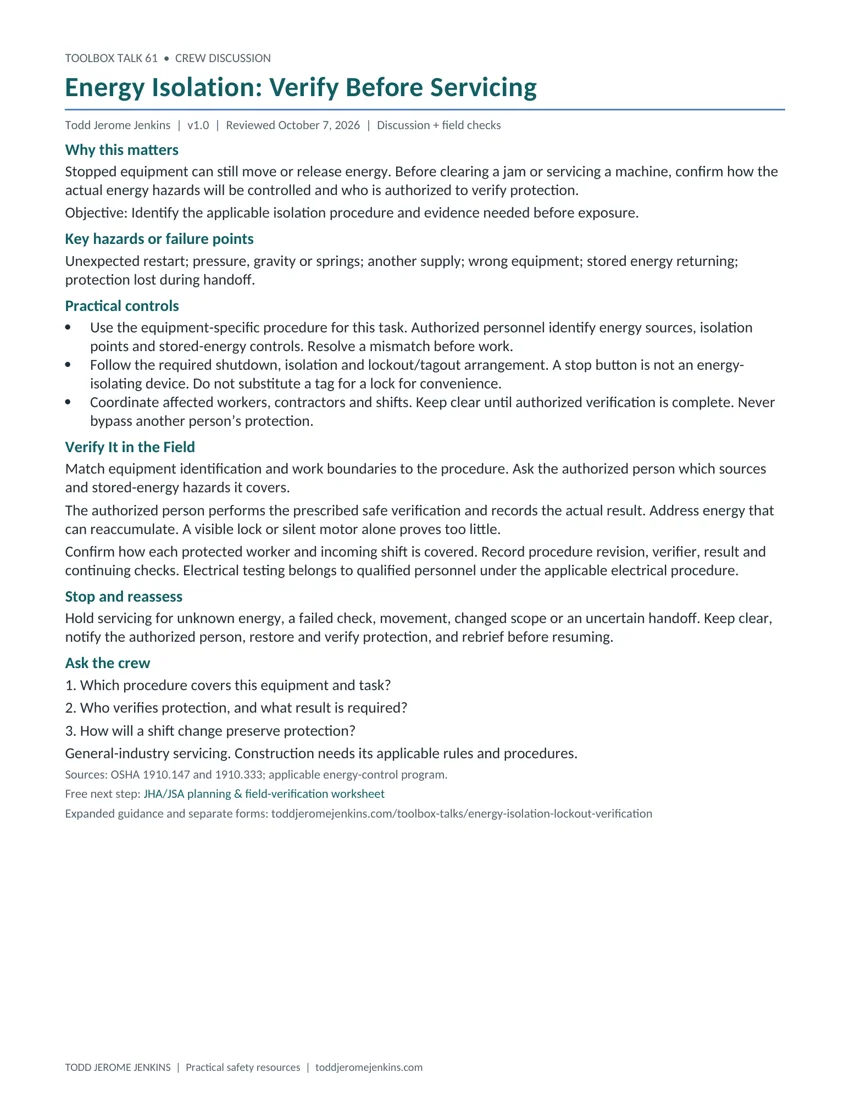
A 5–10 minute crew discussion, plus the time needed for field verification. All six downloads are free without a required signup.
Why this matters
Stopped equipment can still move or release energy. Before clearing a jam or servicing a machine, confirm how the actual energy hazards will be controlled and who is authorized to verify protection.
Learning objective: Identify the applicable isolation procedure and evidence needed before exposure.
Key hazards or failure points
Unexpected restart; pressure, gravity or springs; another supply; wrong equipment; stored energy returning; protection lost during handoff.
Practical controls
- Use the equipment-specific procedure for this task. Authorized personnel identify energy sources, isolation points and stored-energy controls. Resolve a mismatch before work.
- Follow the required shutdown, isolation and lockout/tagout arrangement. A stop button is not an energy-isolating device. Do not substitute a tag for a lock for convenience.
- Coordinate affected workers, contractors and shifts. Keep clear until authorized verification is complete. Never bypass another person’s protection.
Verify It in the Field
Match equipment identification and work boundaries to the procedure. Ask the authorized person which sources and stored-energy hazards it covers.
The authorized person performs the prescribed safe verification and records the actual result. Address energy that can reaccumulate. A visible lock or silent motor alone proves too little.
Confirm how each protected worker and incoming shift is covered. Record procedure revision, verifier, result and continuing checks. Electrical testing belongs to qualified personnel under the applicable electrical procedure.
Use the separate field check to record the acceptance source and criterion, safe method, checker, actual result and time. Mark VERIFIED, HOLD/NOT VERIFIED, or N/A with a reason. A checkmark alone is not evidence that protection works. Complete all required task checks; do not enter danger or improvise a test.
| Control | Safe verification | Evidence |
|---|---|---|
| Correct boundary | Compare actual equipment and task with the procedure. | Equipment ID, procedure revision and resolved mismatch. |
| Effective isolation | Authorized person uses the prescribed safe method. | Actual result, verifier and continuing-check requirement. |
| Protected handoff | Review the actual group and shift-transfer arrangement. | Protected work group, coordinator and resolved gaps. |
Stop and reassess
Hold servicing for unknown energy, a failed check, movement, changed scope or an uncertain handoff. Keep clear, notify the authorized person, restore and verify protection, and rebrief before resuming.
Crew discussion questions
- Which procedure covers this equipment and task?
- Who verifies protection, and what result is required?
- How will a shift change preserve protection?
A situation to discuss
Illustrative situation: a jammed machine is stopped at its control panel, but the repair extends beyond the equipment named in the isolation procedure. The crew holds the task while the authorized person resolves the boundary. Work starts only after the correct procedure and verification are completed.
Leader preparation and practical detail
Use the standard for the industry
OSHA 1910.147 covers specified general-industry servicing and expressly excludes construction employment. Construction requires its applicable activity-specific rules and employer procedures. This briefing does not choose an exception, design an isolation sequence or authorize energized work. [1]
Match evidence to the energy
The check must address the actual energy hazard. A failed start attempt may leave pressure, gravity or an independent electrical supply unresolved. Use the equipment procedure’s prescribed verification and continuing controls. Exposed electrical parts require the separately applicable electrical work practices; under 1910.333, deenergization testing is qualified-person work. [1, 2]
Plan continuity and restart
Agree on the group, contractor and shift arrangements before work. Return to service is a separate controlled process involving people, equipment, devices and notification. Finishing the repair is not automatic permission to remove protection or restart. [1]
Short supervisor field check
- Equipment and task match the applicable procedure.
- Authorized roles and electrical qualifications confirmed.
- Energy sources and stored-energy controls addressed.
- Required verification has acceptable actual results.
- Group, contractor and shift handoffs preserve protection.
Record unresolved items, restrictions, correction owner, recheck result and required restart authorization. Reference permits and specialist inspections rather than treating this form as a replacement. Rebrief workers affected by a change.
Attendance and follow-through
Use the separate attendance sheet for participants, discussion concerns, actions and late-arrival rebriefs. Attendance does not establish competence, verify controls or authorize work. Keep completed records private under the employer’s recordkeeping procedures.
Technical scope and references
General-industry hazardous-energy preparation. OSHA 1910.147 does not cover construction employment; determine the applicable standard and procedure for the actual work. Electrical verification has separate qualification and work-practice requirements. [1, 2]
References reviewed October 7, 2026. Apply the industry, activity and jurisdiction that govern the work. No actual site permit, equipment manual, exposure assessment or engineering determination was supplied for this general discussion.
- OSHA 1910.147 — Control of hazardous energy — Scope, procedures, stored energy, verification and personnel changes.
- OSHA 1910.333 — Electrical work practices — General-industry deenergization and qualified-person verification.
Connect this discussion to your JHA/JSA
Use How to Conduct a Job Safety Analysis to connect task steps, hazards and controls. Revisit Pre-Job JHA/JSA: What Changed Today? when conditions change.
Related Todd Jerome Jenkins video: What Is Lockout Tagout?.
Related crew discussions
- Pre-Job JHA/JSA: What Changed Today?
- Electrical & Extension-Cord Checks
- Powered Tools: Check the Tool, Guard and Accessory
- Site-Specific Safety Plan: Check the Interfaces Today
Put one check into practice
Use the free JHA/JSA planning and field-verification worksheet to record today’s changes, important controls and the evidence needed before exposure.