Download the free toolbox talk
The one-page talk, editable Word version, and guidance below are open to everyone. No account required.
One-page toolbox talk
Download one-page toolbox talk (PDF, 1 page)Editable one-page toolbox talk (Word)Preview the one-page toolbox talk
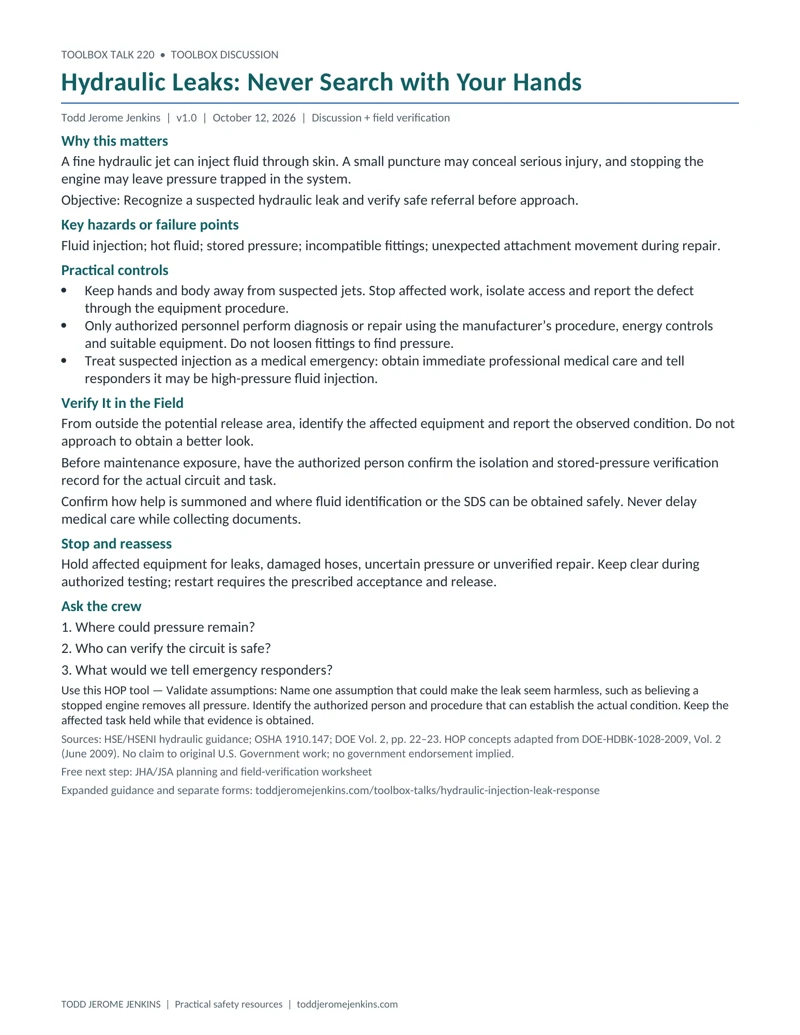
Supporting documents
Included with free Safety & Systems membership.
Supervisor field check
A separate check to verify conditions and controls before work. Includes a one-page PDF and editable Word file.
Attendance sheet
A separate sign-in sheet to record the crew discussion. Includes a one-page PDF and editable Word file.
Need the crew records? Join free to use these supporting documents and the Safety & Systems Academy. No payment details. Email updates are optional.
Get supporting documents — free membershipAlready a member? Use the same link to sign in.
Hazard-based toolbox talk 45 of 52, with a practical HOP exercise.
Plan a 5–10 minute toolbox discussion, plus time to verify the actual controls. The one-page toolbox talk and editable Word version are public. Separate supervisor and attendance records are included with free Safety & Systems membership.
Why this matters
A fine hydraulic jet can inject fluid through skin. A small puncture may conceal serious injury, and stopping the engine may leave pressure trapped in the system.
Learning objective
Recognize a suspected hydraulic leak and verify safe referral before approach.
Key hazards or failure points
Fluid injection; hot fluid; stored pressure; incompatible fittings; unexpected attachment movement during repair.
Practical controls
- Keep hands and body away from suspected jets. Stop affected work, isolate access and report the defect through the equipment procedure.
- Only authorized personnel perform diagnosis or repair using the manufacturer’s procedure, energy controls and suitable equipment. Do not loosen fittings to find pressure.
- Treat suspected injection as a medical emergency: obtain immediate professional medical care and tell responders it may be high-pressure fluid injection.
Verify It in the Field
- From outside the potential release area, identify the affected equipment and report the observed condition. Do not approach to obtain a better look.
- Before maintenance exposure, have the authorized person confirm the isolation and stored-pressure verification record for the actual circuit and task.
- Confirm how help is summoned and where fluid identification or the SDS can be obtained safely. Never delay medical care while collecting documents.
Stop and reassess
Hold affected equipment for leaks, damaged hoses, uncertain pressure or unverified repair. Keep clear during authorized testing; restart requires the prescribed acceptance and release.
Crew discussion questions
- Where could pressure remain?
- Who can verify the circuit is safe?
- What would we tell emergency responders?
For each required control, record its acceptance source and criterion, safe verification method, responsible verifier, actual result and time. Mark VERIFIED, HOLD/NOT VERIFIED, or N/A with a reason. Complete all required inspections; never enter danger or improvise a test to fill out a form.
Use this HOP tool
Validate assumptions
Name one assumption that could make the leak seem harmless, such as believing a stopped engine removes all pressure. Identify the authorized person and procedure that can establish the actual condition. Keep the affected task held while that evidence is obtained.
This exercise supports hazard identification or control verification. It does not replace safeguards, required training, specialist decisions or work authorization.
Leader preparation and practical detail
A small mark is not reassurance
HSE’s hydraulic-injection alert calls for immediate professional treatment. Tell the receiving medical service what happened and identify the fluid if readily available. This toolbox talk offers no waiting period, home treatment or injury-severity test. A person who suspects injection should not be sent back to finish the shift because the wound appears minor.
Separate reporting from diagnosis
Illustrative situation: an operator notices an oily patch and reaches toward a hose to locate the source. The useful report is the equipment identifier, observed location and operating condition, obtained without entering the potential release path. A closer photograph is not worth creating exposure. The supervisor’s next task is to establish controlled access and competent maintenance, not ask a coworker to feel for a leak.
Use the actual hydraulic procedure
HSENI guidance addresses stored pressure and manufacturer instructions; HSE also emphasizes replacement-fitting compatibility and controlled verification after repair. These are UK guidance sources, not U.S. legal substitutes. General-industry servicing may fall under 1910.147, which excludes construction employment. Apply the actual construction activity rules and employer procedure where relevant. No circuit diagram, pressure-release sequence or permissible test pressure is supplied here.
Short supervisor field check
- Leak area access controlled
- Equipment and circuit identified
- Authorized maintenance assigned
- Energy verification recorded
- Injection response understood
Use the separate sheet to document evidence, unresolved restrictions, correction owner, recheck and required release authority. Rebrief affected workers. This record does not replace specialist inspections, permits or engineering determinations.
Attendance and follow-through
Use the separate attendance record for participants, roles, questions, actions and late-arrival rebriefs. Attendance does not prove competence, functioning controls or authorization. Keep completed records private under employer procedures.
Source acknowledgment
HOP concepts are adapted from DOE-HDBK-1028-2009, Human Performance Improvement Handbook, Volume 2 (June 2009). Todd Jerome Jenkins makes no claim to authorship or copyright ownership of original U.S. Government work. The explanations and exercises are original adaptations; no endorsement by DOE or the U.S. Government is implied. Third-party material credited in the handbook retains its separate ownership.
HOP source: Volume 2/VOLUME 2 VALIDATE ASSUMPTIONS.pdf; PDF pp. 1–2; printed pp. 22–23. The handbook supplies concepts; task-specific technical references are listed below.
Technical scope and references
Technical sources inspected October 12, 2026; resource edition October 12, 2026. Apply current jurisdictional requirements, the actual task procedure, manufacturer instructions, permits and required competent or qualified decisions. This resource supplies no equipment-specific acceptance criteria.
- HSE — Hydraulic Injection Injury — Injection hazard, compatible fittings, controlled post-repair verification and immediate medical treatment; UK guidance.
- HSENI — Safe Working on Vehicle Hydraulic Systems — Manufacturer-based maintenance, stored pressure and no hand leak searches; Northern Ireland guidance.
- OSHA 29 CFR 1910.147 — General-industry servicing scope and energy verification; construction expressly excluded.
- DOE-HDBK-1028-2009 Volume 2 (June 2009) — Printed pp. 22–23; historical HOP concept, original adapted exercise.
Connect this discussion to your JHA/JSA
Use the JHA/JSA planning and field-verification worksheet to connect this discussion to the actual task, controls and responsible people.
Related Todd Jerome Jenkins articles: How to Conduct a Job Safety Analysis and What Is Human and Organizational Performance?.
Related toolbox talks
- Energy Isolation: Verify Before Servicing
- Assumptions: Show What Is Known and What Is Not
- Raised Equipment: What Holds It Up?
Continue the hazard series
Put one verification into practice
Record today’s change and evidence using the free JHA/JSA planning and field-verification worksheet.