Download the talk and separate crew records
Free to download without an account. Each PDF is one page. Use the Word version to adapt the record to your task and approved procedures.
Supervisor field check
Download supervisor field check (PDF, 1 page)Editable supervisor field check (Word)Preview the one-page crew talk
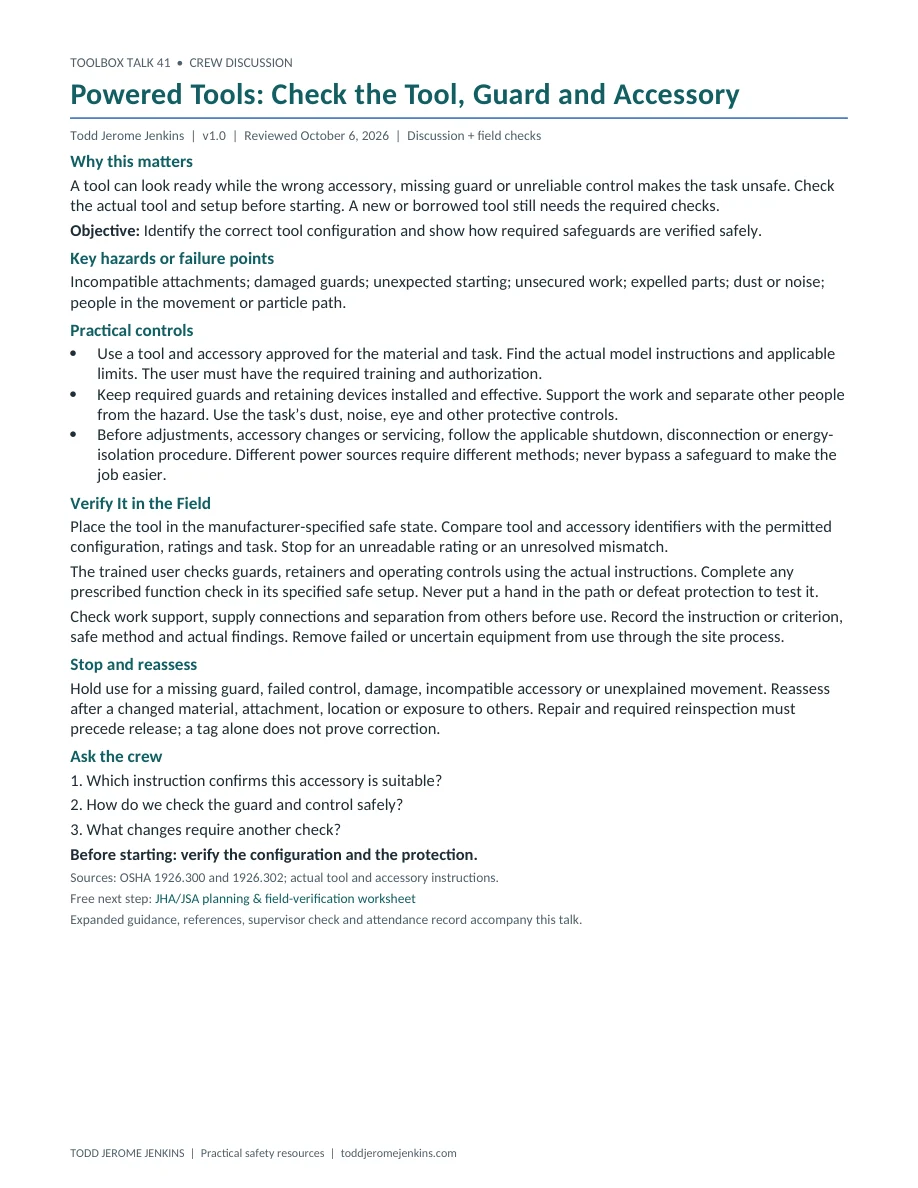
A 5–10 minute crew discussion, plus the time needed for field verification. All six downloads are free without a required signup.
Why this matters
A tool can look ready while the wrong accessory, missing guard or unreliable control makes the task unsafe. Check the actual tool and setup before starting. A new or borrowed tool still needs the required checks.
Learning objective: Identify the correct tool configuration and show how required safeguards are verified safely.
Key hazards or failure points
Incompatible attachments; damaged guards; unexpected starting; unsecured work; expelled parts; dust or noise; people in the movement or particle path.
Practical controls
- Use a tool and accessory approved for the material and task. Find the actual model instructions and applicable limits. The user must have the required training and authorization.
- Keep required guards and retaining devices installed and effective. Support the work and separate other people from the hazard. Use the task’s dust, noise, eye and other protective controls.
- Before adjustments, accessory changes or servicing, follow the applicable shutdown, disconnection or energy-isolation procedure. Different power sources require different methods; never bypass a safeguard to make the job easier.
Verify It in the Field
Place the tool in the manufacturer-specified safe state. Compare tool and accessory identifiers with the permitted configuration, ratings and task. Stop for an unreadable rating or an unresolved mismatch.
The trained user checks guards, retainers and operating controls using the actual instructions. Complete any prescribed function check in its specified safe setup. Never put a hand in the path or defeat protection to test it.
Check work support, supply connections and separation from others before use. Record the instruction or criterion, safe method and actual findings. Remove failed or uncertain equipment from use through the site process.
Use the separate field check to record the source and criterion, safe method, checker, actual result and time. Mark VERIFIED, HOLD/NOT VERIFIED, or N/A with a reason. Check every required control; the examples below do not clear the whole task.
| Control | Safe verification | Evidence to record |
|---|---|---|
| Compatible configuration | Compare model/accessory identification to actual permitted use and ratings. | Identifiers, source criterion and finding. |
| Effective safeguards | Trained user follows the specified safe inspection/function check. | Guard/control, method, checker and result. |
| Safe task setup | Check work support, energy procedure and separation before use. | Actual setup, restrictions and correction owner. |
Stop and reassess
Hold use for a missing guard, failed control, damage, incompatible accessory or unexplained movement. Reassess after a changed material, attachment, location or exposure to others. Repair and required reinspection must precede release; a tag alone does not prove correction.
Crew discussion questions
- Which instruction confirms this accessory is suitable?
- How do we check the guard and control safely?
- What changes require another check?
Before starting: verify the configuration and the protection.
A situation to discuss
Illustrative situation: an accessory fits the tool but its rating cannot be read. The crew holds the task and obtains a clearly compatible replacement. Physical fit is not accepted as proof that the attachment is suitable for the tool and material.
Leader preparation and practical detail
Match more than the connector
Identify the model, accessory and intended use. Check the manufacturer’s permitted combination and applicable ratings rather than assuming that a part which attaches must be safe. Record the source and result for the actual configuration. This talk supplies no universal speed, wheel size, pressure or fastener rule. [1], [2]
A guard check must not create exposure
Inspection and function checks need a defined safe method. The trained user follows the relevant instructions, keeps people out of the hazard path and holds the tool out of use when the result is unclear. Do not defeat interlocks, touch moving parts or expose a coworker to demonstrate the device. Required engineering protection remains necessary even when PPE is worn. [1]
Tool types have different requirements
Construction provisions distinguish electric, pneumatic, fuel, hydraulic and powder-actuated tools. For example, powder-actuated tools require training on the particular tool and prescribed safety-device checks before loading. This general briefing cannot qualify an operator or replace the model-specific procedure. Link the tool check with cord/supply checks and the task’s airborne-hazard assessment. [2]
Short supervisor field check
- Tool, material and accessory compatibility verified.
- Required training and authorization confirmed.
- Guards, retainers and controls checked safely.
- Energy procedure, support and bystander separation established.
- Defects isolated; repair and reinspection owner identified.
Use the separate form to document evidence, restrictions, corrective-action owner, recheck and required restart approval. An unresolved required control means hold the affected work. Missing evidence is not a pass. Complete all task-specific inspections and permits.
Attendance and follow-through
The separate attendance sheet records participants, language support, questions, actions and late-arrival rebriefs. Attendance does not establish competence or prove controls function. Keep completed records private under the employer’s procedures.
Technical scope and references
The cited OSHA provisions apply to construction. Other industries and particular equipment have their own requirements. This talk is not an isolation procedure, operator qualification or complete tool inspection. Use the actual manufacturer instructions, applicable standards and employer procedures. [1], [2]
References checked October 6, 2026. Apply the jurisdiction, task, employer program and equipment instructions that govern the work. No site-specific manual, permit, engineering determination or product SDS has been approved by this general resource.
- OSHA 1926.300 — General requirements for hand and power tools — Construction requirements; apply the provisions for the particular tool and task.
- OSHA 1926.302 — Power-operated hand tools — Construction requirements; apply the provisions for the particular tool and task.
Connect this discussion to your JHA/JSA
Use How to Conduct a Job Safety Analysis to connect today’s work steps, hazards and controls. Revisit Pre-Job JHA/JSA: What Changed Today? whenever conditions change.
Related Todd Jerome Jenkins video: What Is PPE and How Do You Choose It? | Workplace Safety.
Related published crew resources: Electrical & Extension-Cord Checks; Respiratory Hazards: Know What You’re Breathing; Eye & Face Protection; Hand Tools: Condition, Selection & Line of Fire; Hearing Protection: Control Noise, Check the Fit; Hand Protection: Match the Glove to the Task.
Put one check into practice
Download the free JHA/JSA planning and field-verification worksheet. For today’s task, record an important control, its source and the evidence needed before exposure. Complete the remaining required checks through your task plan.