Download the free crew talk
The one-page talk, editable Word version, and guidance below are open to everyone. No account required.
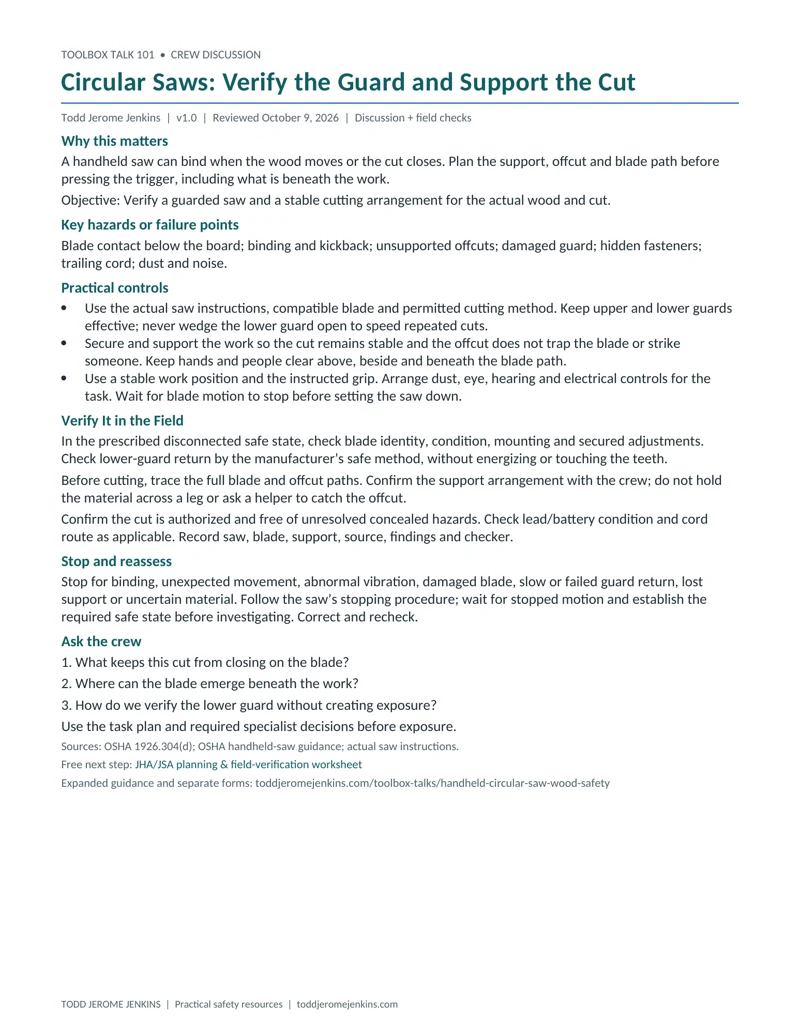
Preview the one-page crew talk
Supporting documents
Included with free Safety & Systems membership.
Supervisor field check
A separate check to verify conditions and controls before work. Includes a one-page PDF and editable Word file.
Attendance sheet
A separate sign-in sheet to record the crew discussion. Includes a one-page PDF and editable Word file.
Need the crew records? Join free to use these supporting documents and the Safety & Systems Academy. No payment details. Email updates are optional.
Get supporting documents — free membershipAlready a member? Use the same link to sign in.
A 5–10 minute crew discussion, plus time to verify the actual controls. The crew talk and Word version are public. Separate supervisor and attendance records are included with free Safety & Systems membership.
Why this matters
A handheld saw can bind when the wood moves or the cut closes. Plan the support, offcut and blade path before pressing the trigger, including what is beneath the work.
Learning objective
Verify a guarded saw and a stable cutting arrangement for the actual wood and cut.
Key hazards or failure points
Blade contact below the board; binding and kickback; unsupported offcuts; damaged guard; hidden fasteners; trailing cord; dust and noise.
Practical controls
- Use the actual saw instructions, compatible blade and permitted cutting method. Keep upper and lower guards effective; never wedge the lower guard open to speed repeated cuts.
- Secure and support the work so the cut remains stable and the offcut does not trap the blade or strike someone. Keep hands and people clear above, beside and beneath the blade path.
- Use a stable work position and the instructed grip. Arrange dust, eye, hearing and electrical controls for the task. Wait for blade motion to stop before setting the saw down.
Verify It in the Field
- In the prescribed disconnected safe state, check blade identity, condition, mounting and secured adjustments. Check lower-guard return by the manufacturer’s safe method, without energizing or touching the teeth.
- Before cutting, trace the full blade and offcut paths. Confirm the support arrangement with the crew; do not hold the material across a leg or ask a helper to catch the offcut.
- Confirm the cut is authorized and free of unresolved concealed hazards. Check lead/battery condition and cord route as applicable. Record saw, blade, support, source, findings and checker.
Stop and reassess
Stop for binding, unexpected movement, abnormal vibration, damaged blade, slow or failed guard return, lost support or uncertain material. Follow the saw’s stopping procedure; wait for stopped motion and establish the required safe state before investigating. Correct and recheck.
Crew discussion questions
- What keeps this cut from closing on the blade?
- Where can the blade emerge beneath the work?
- How do we verify the lower guard without creating exposure?
For each required control, record its acceptance source and criterion, safe verification method, responsible checker, actual result and time. Use VERIFIED, HOLD/NOT VERIFIED, or N/A with a reason. A tick alone is not evidence. Complete all applicable task inspections; do not enter danger or improvise a test to fill out a form.
Leader preparation and practical detail
Focus on wood cutting
This is a portable woodworking-saw briefing. The existing concrete-saw talk covers different blades, embedded-hazard releases and silica controls. It does not replace this saw’s guard and stock-support checks. Treated wood or engineered products require their own material information and exposure assessment.
Verify automatic protection
Section 1926.304(d) requires upper and lower guards on covered portable circular saws and automatic lower-guard return when withdrawn from the work. A guard that sticks needs correction before use. Do not use a powered demonstration or a hand near the blade to prove it works. The actual model determines the safe inspection method.
Support the changed shape
Illustrative situation: a long offcut begins to sag and changes the load at the kerf. Stop and revise support before another cut. Do not supply a universal support spacing or blade projection; the saw instructions, material and cut determine the arrangement. This briefing does not authorize plunge cuts or alterations to structural framing.
Use the related JHA as context only
The subfloor-panel JHA places panel cutting at a separate protected station. It is not a complete circular-saw JHA and does not provide a cutting sequence. Add the actual saw task, support, material hazards and manufacturer criteria before work. General powered-tool, dust and hearing talks remain useful supporting links.
Apply this briefing to roofing and siding work
Wood siding: support the finished strip and the offcut
This application is for wood siding and wood trim cut with a suitable handheld circular saw. It does not authorize using the woodworking setup for fiber cement, metal or another product. Before each changed cut, the operator should identify where the finished strip and the waste piece will move. A narrow last piece can change the support arrangement that worked for the first cuts.
For covered portable woodworking saws, 1926.304(d) requires upper and lower guarding and automatic lower-guard return. Use the actual model’s safe inspection method with power disconnected as instructed. Check that the siding profile, support and clamps do not obstruct the guard or put a hand beneath the blade. Do not wedge the guard back to clear an irregular edge.
Before energizing, trace the entire cut and offcut path while the stock is secured. Establish support that prevents shifting or closing the cut onto the blade; a helper’s hand is not an offcut catcher. Check the operator’s footing and the cord route through the planned movement.
Record: wood product, saw/blade, guard-check method and result, support findings and checker/time. Stop for binding, a sticking guard, unstable stock or an obstructed path. Follow the stopping and safe-state procedure before investigating; resolve and recheck before the next cut.
Record the acceptance source, safe check method, assigned verifier, actual result and time. Hold affected work for an unresolved required control; correct, recheck and rebrief before authorized restart.
Short supervisor field check
- Saw, blade and cutting method match.
- Guards and controls checked safely.
- Stock and offcut support established.
- Blade path and bystanders clear.
- Exposure controls and stop process ready.
Confirm the relevant trained/authorized people, unresolved items, interim protection, correction owner and recheck. Record required release authority and rebrief anyone affected. The separate sheet supports these records; it does not replace a specialist inspection, permit or engineering determination.
Attendance and follow-through
Use the separate attendance sheet for participants, roles, discussion concerns, actions and late-arrival rebriefs. Attendance is not proof of competence, functioning controls or authorization to work. Keep completed records private under employer procedures.
Technical scope and references
Reviewed October 9, 2026 for construction crew preparation. Apply the actual task, jurisdiction and relevant standard provisions. Manufacturer sources below are reference examples, not approval of your equipment. No site-specific design, permit, exposure assessment, product SDS or current model manual was supplied; obtain the applicable documents before work. This discussion does not replace required training.
- OSHA 1926.304(d) — Construction portable circular-saw guarding.
- OSHA handheld-saw eTool — Blade-contact prevention and tool/material selection guidance; apply construction requirements.
- OSHA 1926.300 — Tool condition, guarding and task-specific protection.
Connect this discussion to your JHA/JSA
Use the related worked JHA/JSA/AHA example to prepare task steps, hazards and controls. Return to What Changed Today? when the plan or conditions change.
Related Todd Jerome Jenkins article: How to Conduct a Job Safety Analysis.
Related crew discussions
Put one check into practice
Use the free JHA/JSA planning and field-verification worksheet to record today’s change, the required protection and the evidence needed before exposure.