Download the talk and separate crew records
Free to download without an account. Each PDF is one page. Use the Word version to adapt the record to your task and approved procedures.
Supervisor field check
Download supervisor field check (PDF, 1 page)Editable supervisor field check (Word)Preview the one-page crew talk
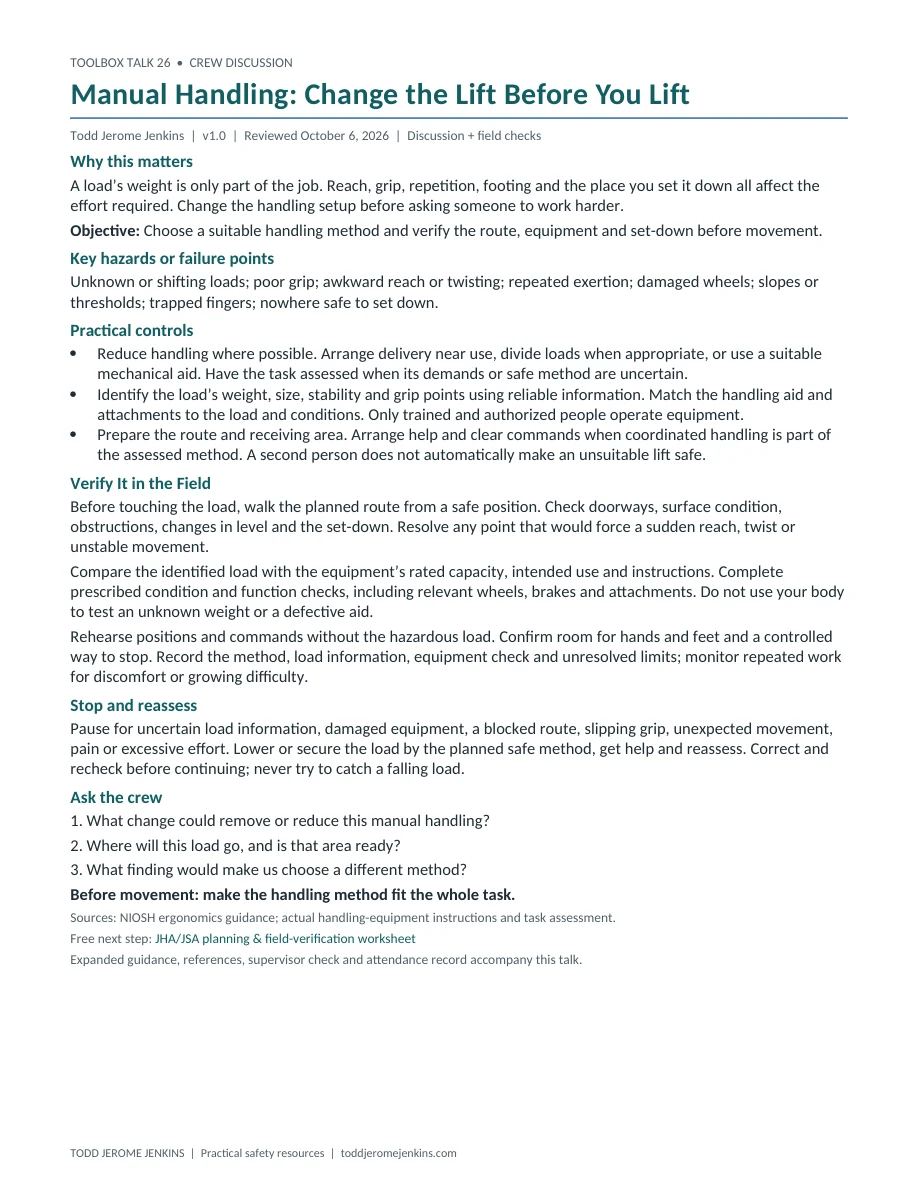
A 5–10 minute crew discussion, plus the time needed for field verification. All six downloads are free without a required signup.
Why this matters
A load’s weight is only part of the job. Reach, grip, repetition, footing and the place you set it down all affect the effort required. Change the handling setup before asking someone to work harder.
Learning objective: Choose a suitable handling method and verify the route, equipment and set-down before movement.
Key hazards or failure points
Unknown or shifting loads; poor grip; awkward reach or twisting; repeated exertion; damaged wheels; slopes or thresholds; trapped fingers; nowhere safe to set down.
Practical controls
- Reduce handling where possible. Arrange delivery near use, divide loads when appropriate, or use a suitable mechanical aid. Have the task assessed when its demands or safe method are uncertain.
- Identify the load’s weight, size, stability and grip points using reliable information. Match the handling aid and attachments to the load and conditions. Only trained and authorized people operate equipment.
- Prepare the route and receiving area. Arrange help and clear commands when coordinated handling is part of the assessed method. A second person does not automatically make an unsuitable lift safe.
Verify It in the Field
Before touching the load, walk the planned route from a safe position. Check doorways, surface condition, obstructions, changes in level and the set-down. Resolve any point that would force a sudden reach, twist or unstable movement.
Compare the identified load with the equipment’s rated capacity, intended use and instructions. Complete prescribed condition and function checks, including relevant wheels, brakes and attachments. Do not use your body to test an unknown weight or a defective aid.
Rehearse positions and commands without the hazardous load. Confirm room for hands and feet and a controlled way to stop. Record the method, load information, equipment check and unresolved limits; monitor repeated work for discomfort or growing difficulty.
Use the separate field check to record the source and criterion, safe method, checker, actual result and time. Mark VERIFIED, HOLD/NOT VERIFIED, or N/A with a reason. Check every required control; the examples below do not clear the whole task.
| Control | Safe verification | Evidence to record |
|---|---|---|
| Known load | Confirm weight and stability from reliable records, markings or an approved assessment. | Source recorded; unknown characteristics resolved before movement. |
| Suitable aid | Match device capacity/intended use to the load and complete prescribed checks. | Equipment ID, instructions and actual condition/function results. |
| Prepared route | Review the complete path and receiving area without moving the hazardous load. | Obstructions and level changes resolved; safe set-down and stop method agreed. |
Stop and reassess
Pause for uncertain load information, damaged equipment, a blocked route, slipping grip, unexpected movement, pain or excessive effort. Lower or secure the load by the planned safe method, get help and reassess. Correct and recheck before continuing; never try to catch a falling load.
Crew discussion questions
- What change could remove or reduce this manual handling?
- Where will this load go, and is that area ready?
- What finding would make us choose a different method?
Before movement: make the handling method fit the whole task.
A situation to discuss
Illustrative situation: a cart is suitable for the load, but a raised threshold blocks the route. Forcing the cart over it would add effort and instability. The crew holds the move until the route or handling method is changed through the approved process.
Leader preparation and practical detail
Assess more than weight
The same load can present different demands when lifted from the floor, reached for across an obstacle or handled repeatedly. The task assessment needs the actual starting and ending positions, frequency, duration and conditions. This talk does not set a universal lifting limit or declare any weight safe for every worker.
Put the improvement into the setup
NIOSH identifies mechanical assistance and changes to tools, materials and tasks as ways to reduce musculoskeletal hazards. Redesign the move where feasible and involve the people doing it in evaluating the change. Training alone cannot make a poor route or unsuitable aid work. [1]
Check the aid as a system
A capacity label answers only part of the question. Check that the device is intended for the load shape, surface and slope, with any required attachment. Arrange a receiving position that keeps people out of pinch points. Crane lifts and powered industrial trucks have additional requirements; use their dedicated plans and trained personnel rather than treating this sheet as an equipment procedure.
Repeated effort and early reporting
Look beyond a single lift. Repeated exertion, sustained postures and awkward reach can remain after the load weight is reduced. Ask workers where the task is difficult, then evaluate a suitable mechanical aid, layout change or different work method. Use the NIOSH ergonomics guidance to prioritize higher-level controls and evaluate whether the change actually reduces the identified demand.
Record the task condition, improvement, safe evaluation method and worker feedback. A completed warmup does not verify that the work is adequately controlled. New or worsening pain should prompt reporting and appropriate medical help; urgent care must not wait for employer paperwork. MedlinePlus guidance on sprains calls for immediate help for serious injury, severe pain, a suspected fracture or an out-of-position joint. Do not assume that swelling must disappear before assessment or that waiting two days is always safe.
Short supervisor field check
- Handling reduction or mechanical aid considered.
- Load information and task demands established.
- Equipment suitability, capacity and condition/function checked.
- Route, receiving area, positions and communication ready.
- Stop response, discomfort reporting and reassessment agreed.
Use the separate form to document evidence, restrictions, corrective-action owner, recheck and required restart approval. An unresolved required control means hold the affected work. Missing evidence is not a pass. Complete all task-specific inspections and permits.
Attendance and follow-through
The separate attendance sheet records participants, language support, questions, actions and late-arrival rebriefs. Attendance does not establish competence or prove controls function. Keep completed records private under the employer’s procedures.
Technical scope and references
General material-handling discussion. NIOSH ergonomics information is guidance, not a universal OSHA lifting threshold. An appropriate task assessment and the actual equipment instructions govern the method. Patient handling, rigging and powered equipment require additional task-specific arrangements. [1]
References checked October 6, 2026. Apply the jurisdiction, task, employer program and equipment instructions that govern the work. No site-specific manual, permit, engineering determination or product SDS has been approved by this general resource.
- NIOSH — Step 4: Implement Your Ergonomic Program — Engineering and administrative approaches to reducing musculoskeletal hazards; evaluating improvements. Guidance.
Connect this discussion to your JHA/JSA
Use How to Conduct a Job Safety Analysis to connect today’s work steps, hazards and controls. Revisit Pre-Job JHA/JSA: What Changed Today? whenever conditions change.
Related Todd Jerome Jenkins video: What Is the Hierarchy of Controls? | Workplace Safety Explained.
Related published crew resources: Rigging: Before the Load Moves; Hand Tools: Condition, Selection & Line of Fire; Housekeeping Is a Control.
Put one check into practice
Download the free JHA/JSA planning and field-verification worksheet. For today’s task, record an important control, its source and the evidence needed before exposure. Complete the remaining required checks through your task plan.