Download the free toolbox talk
The one-page talk, editable Word version, and guidance below are open to everyone. No account required.
One-page toolbox talk
Download one-page toolbox talk (PDF, 1 page)Editable one-page toolbox talk (Word)Preview the one-page toolbox talk
Supporting documents
Included with free Safety & Systems membership.
Supervisor field check
A separate check to verify conditions and controls before work. Includes a one-page PDF and editable Word file.
Attendance sheet
A separate sign-in sheet to record the crew discussion. Includes a one-page PDF and editable Word file.
Need the crew records? Join free to use these supporting documents and the Safety & Systems Academy. No payment details. Email updates are optional.
Get supporting documents — free membershipAlready a member? Use the same link to sign in.
Hazard-based toolbox talk 6 of 52, with a practical HOP exercise.
Plan a 5–10 minute toolbox discussion, plus time to verify the actual controls. The one-page toolbox talk and editable Word version are public. Separate supervisor and attendance records are included with free Safety & Systems membership.
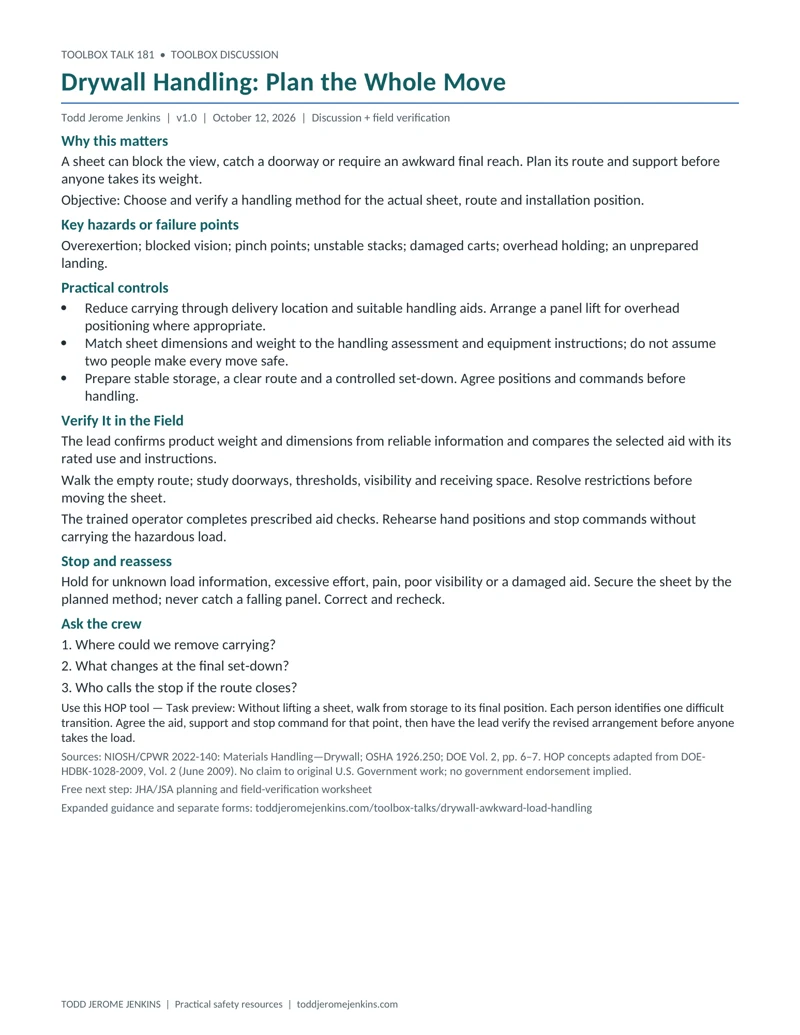
Why this matters
A sheet can block the view, catch a doorway or require an awkward final reach. Plan its route and support before anyone takes its weight.
Learning objective
Choose and verify a handling method for the actual sheet, route and installation position.
Key hazards or failure points
Overexertion; blocked vision; pinch points; unstable stacks; damaged carts; overhead holding; an unprepared landing.
Practical controls
- Reduce carrying through delivery location and suitable handling aids. Arrange a panel lift for overhead positioning where appropriate.
- Match sheet dimensions and weight to the handling assessment and equipment instructions; do not assume two people make every move safe.
- Prepare stable storage, a clear route and a controlled set-down. Agree positions and commands before handling.
Verify It in the Field
- The lead confirms product weight and dimensions from reliable information and compares the selected aid with its rated use and instructions.
- Walk the empty route; study doorways, thresholds, visibility and receiving space. Resolve restrictions before moving the sheet.
- The trained operator completes prescribed aid checks. Rehearse hand positions and stop commands without carrying the hazardous load.
Stop and reassess
Hold for unknown load information, excessive effort, pain, poor visibility or a damaged aid. Secure the sheet by the planned method; never catch a falling panel. Correct and recheck.
Crew discussion questions
- Where could we remove carrying?
- What changes at the final set-down?
- Who calls the stop if the route closes?
For each required control, record its acceptance source and criterion, safe verification method, responsible verifier, actual result and time. Mark VERIFIED, HOLD/NOT VERIFIED, or N/A with a reason. Complete all required inspections; never enter danger or improvise a test to fill out a form.
Use this HOP tool
Task preview
Without lifting a sheet, walk from storage to its final position. Each person identifies one difficult transition. Agree the aid, support and stop command for that point, then have the lead verify the revised arrangement before anyone takes the load.
This exercise supports hazard identification or control verification. It does not replace safeguards, required training, specialist decisions or work authorization.
Leader preparation and practical detail
Study the final movement
The cart may reach the room while leaving a difficult transfer to the wall or ceiling. Include loading, travel, unloading and positioning in the assessment. Arrange support that reduces sustained overhead holding and keeps hands clear. This talk sets no universal safe lifting weight.
Use the product and equipment information
NIOSH/CPWR recommends staging close to use and mechanical assistance for drywall. Its guidance is not an equipment operating manual or proof a particular lift is safe. The employer must assess the actual sheet, people and conditions. OSHA 1926.250 addresses stable storage, floor loading and clear passageways.
Make the preview change the setup
Ask the crew to identify the tightest turn and hardest transfer before handling. Record the changed route or aid, its acceptance source and who verified readiness. Worker reports of difficulty are useful evidence; a successful first carry does not establish that repeated work is adequately controlled.
Short supervisor field check
- Load information known
- Suitable aid verified
- Route and landing ready
- Positions and commands agreed
- Unresolved restrictions recorded
Use the separate sheet to document evidence, unresolved restrictions, correction owner, recheck and required release authority. Rebrief affected workers. This record does not replace specialist inspections, permits or engineering determinations.
Attendance and follow-through
Use the separate attendance record for participants, roles, questions, actions and late-arrival rebriefs. Attendance does not prove competence, functioning controls or authorization. Keep completed records private under employer procedures.
Source acknowledgment
HOP concepts are adapted from DOE-HDBK-1028-2009, Human Performance Improvement Handbook, Volume 2 (June 2009). Todd Jerome Jenkins makes no claim to authorship or copyright ownership of original U.S. Government work. The explanations and exercises are original adaptations; no endorsement by DOE or the U.S. Government is implied. Third-party material credited in the handbook retains its separate ownership.
HOP source: Volume 2/VOLUME 2 TASK PREVIEW.pdf; Printed pp. 6–7. The handbook supplies concepts; task-specific technical references are listed below.
Technical scope and references
Technical sources inspected October 9, 2026; resource edition October 12, 2026. Apply current jurisdictional requirements, the actual task procedure, manufacturer instructions, permits and required competent or qualified decisions. This resource supplies no equipment-specific acceptance criteria.
- NIOSH/CPWR 2022-140: Materials Handling—Drywall — Guidance, both PDF pages inspected October 9; staging and mechanical assistance. No story, graphics or fixed lifting threshold reproduced.
- OSHA 1926.250 — Construction storage, safe floor loads and passageways, especially (a)(1)–(4).
- DOE-HDBK-1028-2009, Volume 2 — Task preview — Historical June 2009 guidance, printed pages 6–7. Original task exercise; not a regulatory requirement.
Connect this discussion to your JHA/JSA
Related worked JHA/JSA/AHA example. Use the example to study task steps, hazards and controls; adapt it to the actual work.
Related Todd Jerome Jenkins articles: How to Conduct a Job Safety Analysis and What Is Human and Organizational Performance?.
Related toolbox talks
- Manual Handling: Change the Lift Before You Lift
- Pre-Job JHA/JSA: What Changed Today?
- Task Preview: Prepare Before the Crew Briefing
Continue the hazard series
- Temporary Power: Verify Before Changing Outlets
- Silica Cleanup: Keep Settled Dust from Becoming Exposure
Put one verification into practice
Record today’s change and evidence using the free JHA/JSA planning and field-verification worksheet.