Download the free crew talk
The one-page talk, editable Word version, and guidance below are open to everyone. No account required.
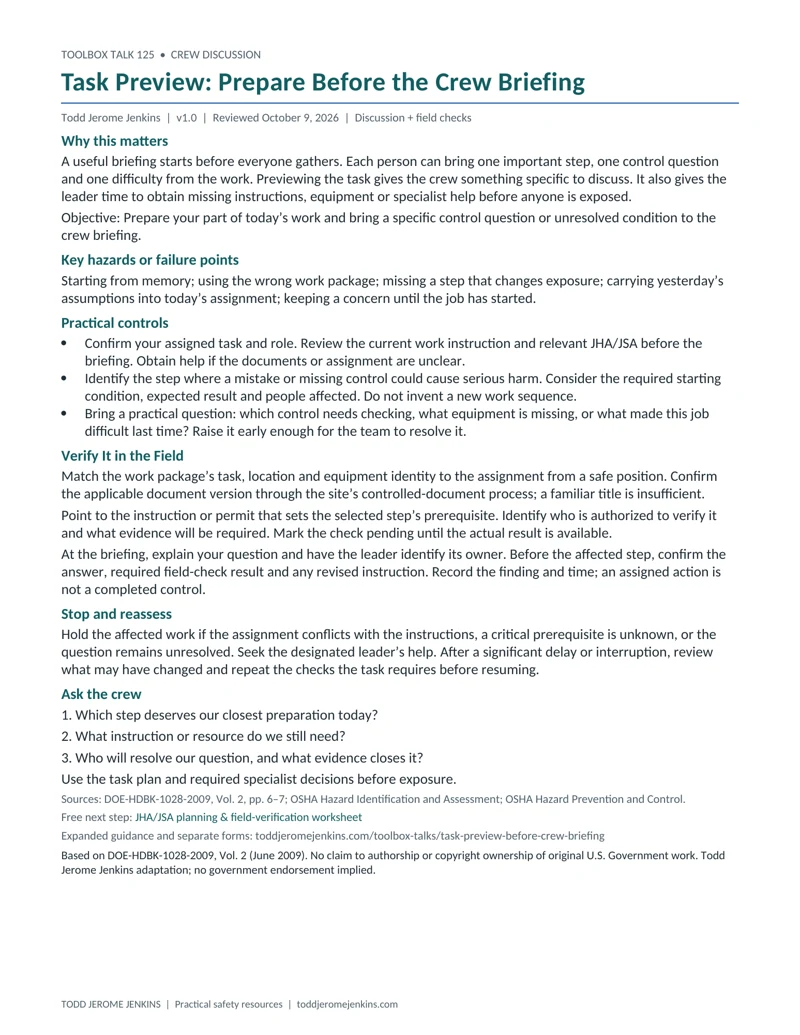
Preview the one-page crew talk
Supporting documents
Included with free Safety & Systems membership.
Supervisor field check
A separate check to verify conditions and controls before work. Includes a one-page PDF and editable Word file.
Attendance sheet
A separate sign-in sheet to record the crew discussion. Includes a one-page PDF and editable Word file.
Need the crew records? Join free to use these supporting documents and the Safety & Systems Academy. No payment details. Email updates are optional.
Get supporting documents — free membershipAlready a member? Use the same link to sign in.
Human Performance weekly series: lesson 2 of 52.
A 5–10 minute crew discussion, plus time to verify the actual controls. The crew talk and Word version are public. Separate supervisor and attendance records are included with free Safety & Systems membership.
Why this matters
A useful briefing starts before everyone gathers. Each person can bring one important step, one control question and one difficulty from the work. Previewing the task gives the crew something specific to discuss. It also gives the leader time to obtain missing instructions, equipment or specialist help before anyone is exposed.
Learning objective
Prepare your part of today’s work and bring a specific control question or unresolved condition to the crew briefing.
Key hazards or failure points
Starting from memory; using the wrong work package; missing a step that changes exposure; carrying yesterday’s assumptions into today’s assignment; keeping a concern until the job has started.
Practical controls
- Confirm your assigned task and role. Review the current work instruction and relevant JHA/JSA before the briefing. Obtain help if the documents or assignment are unclear.
- Identify the step where a mistake or missing control could cause serious harm. Consider the required starting condition, expected result and people affected. Do not invent a new work sequence.
- Bring a practical question: which control needs checking, what equipment is missing, or what made this job difficult last time? Raise it early enough for the team to resolve it.
Verify It in the Field
- Match the work package’s task, location and equipment identity to the assignment from a safe position. Confirm the applicable document version through the site’s controlled-document process; a familiar title is insufficient.
- Point to the instruction or permit that sets the selected step’s prerequisite. Identify who is authorized to verify it and what evidence will be required. Mark the check pending until the actual result is available.
- At the briefing, explain your question and have the leader identify its owner. Before the affected step, confirm the answer, required field-check result and any revised instruction. Record the finding and time; an assigned action is not a completed control.
Stop and reassess
Hold the affected work if the assignment conflicts with the instructions, a critical prerequisite is unknown, or the question remains unresolved. Seek the designated leader’s help. After a significant delay or interruption, review what may have changed and repeat the checks the task requires before resuming.
Crew discussion questions
- Which step deserves our closest preparation today?
- What instruction or resource do we still need?
- Who will resolve our question, and what evidence closes it?
For each required control, record its acceptance source and criterion, safe verification method, responsible checker, actual result and time. Use VERIFIED, HOLD/NOT VERIFIED, or N/A with a reason. A tick alone is not evidence. Complete all applicable task inspections; do not enter danger or improvise a test to fill out a form.
Leader preparation and practical detail
A replacement tool changes the preparation
Illustrative situation: a worker preparing for an installation notices that the delivered tool differs from the one listed in the work package. The preview should surface the mismatch before the crew gathers at the work face. Assign the suitability and instruction review to the appropriate person; do not treat the worker’s familiarity with the brand as approval. The question is closed only when the authorized decision, applicable instructions and required checks support the planned use.
Separate preparation from permission
A preview can identify what needs verification without performing it. Someone can locate an isolation prerequisite in a work instruction but cannot mark isolation verified on that basis. Required energy-control verification remains with the authorized people using the task-specific procedure. The preview record should distinguish information reviewed, questions raised and checks still pending. This prevents a well-prepared discussion from being mistaken for work authorization.
Give the crew a reason to prepare
Ask each role for one useful contribution rather than a long recitation of the entire procedure. A person who performed the task previously may identify a difficult handoff; a new participant may notice an unclear identifier. Make time to resolve both. If questions recur across jobs, improve the instructions or resource planning through the site’s approval process. Do not close repeated difficulty with a request for more attention.
Short supervisor field check
- Each assigned role can identify its task and controlling work document.
- Important step, prerequisite and expected result are understood.
- Prior experience informs a specific task question without replacing requirements.
- Open questions have an owner, hold point and verified closure evidence.
- Field checks, briefing and required authorization remain necessary before exposure.
Confirm the relevant trained/authorized people, unresolved items, interim protection, correction owner and recheck. Record required release authority and rebrief anyone affected. The separate sheet supports these records; it does not replace a specialist inspection, permit or engineering determination.
Attendance and follow-through
Use the separate attendance sheet for participants, roles, discussion concerns, actions and late-arrival rebriefs. Attendance is not proof of competence, functioning controls or authorization to work. Keep completed records private under employer procedures.
Source acknowledgment
This resource draws on the U.S. Department of Energy’s DOE-HDBK-1028-2009, Human Performance Improvement Handbook, Volume 2 (June 2009). Todd Jerome Jenkins makes no claim of authorship or copyright ownership in the original U.S. Government work. New explanations, examples, exercises and layouts are Todd Jerome Jenkins adaptations. No endorsement by DOE or the U.S. Government is implied. Third-party material credited in the handbook remains attributed to its source; this notice does not claim rights in that material.
Source excerpt: Volume 2/VOLUME 2 TASK PREVIEW.pdf; Printed pp. 6, 7. The June 2009 handbook supplies concepts; this lesson uses original explanations and exercises.
Technical scope and references
References reviewed October 9, 2026. DOE human-performance tools and OSHA recommended practices support preparation and discussion; they do not establish universal technical acceptance criteria. Apply the current task procedure, manufacturer instructions, permit and required competent or qualified decisions. A successful exercise does not replace required training, technical verification or work authorization.
- DOE-HDBK-1028-2009, Volume 2 — Task Preview — June 2009 guidance, printed pages 6–7: individual preparation, important steps, controls, relevant experience and reconsideration after interruptions. No universal mandatory preview format or frequency is asserted.
- OSHA — Hazard Identification and Assessment — Recommended practices, action items 1 and 5: use relevant hazard information and anticipate nonroutine work.
- OSHA — Hazard Prevention and Control — Recommended practices, action items 3 and 6: assign control responsibility and evaluate implementation.
Connect this discussion to your JHA/JSA
Use the JHA/JSA planning and field-verification worksheet to record the actual task steps, hazards, responsible roles and controls. No task-specific worked example is linked for this topic yet. Return to What Changed Today? when the plan or conditions change.
Related Todd Jerome Jenkins articles: How to Conduct a Job Safety Analysis and What Is Human and Organizational Performance?.
Related crew discussions
Continue the weekly series
- Lesson 1: Hazard, Error and Control: Agree What We Mean
- Lesson 3: Job-Site Review: Does the Place Match the Plan?
Put one check into practice
Use the free JHA/JSA planning and field-verification worksheet to record today’s change, the required protection and the evidence needed before exposure.