Download the free crew talk
The one-page talk, editable Word version, and guidance below are open to everyone. No account required.
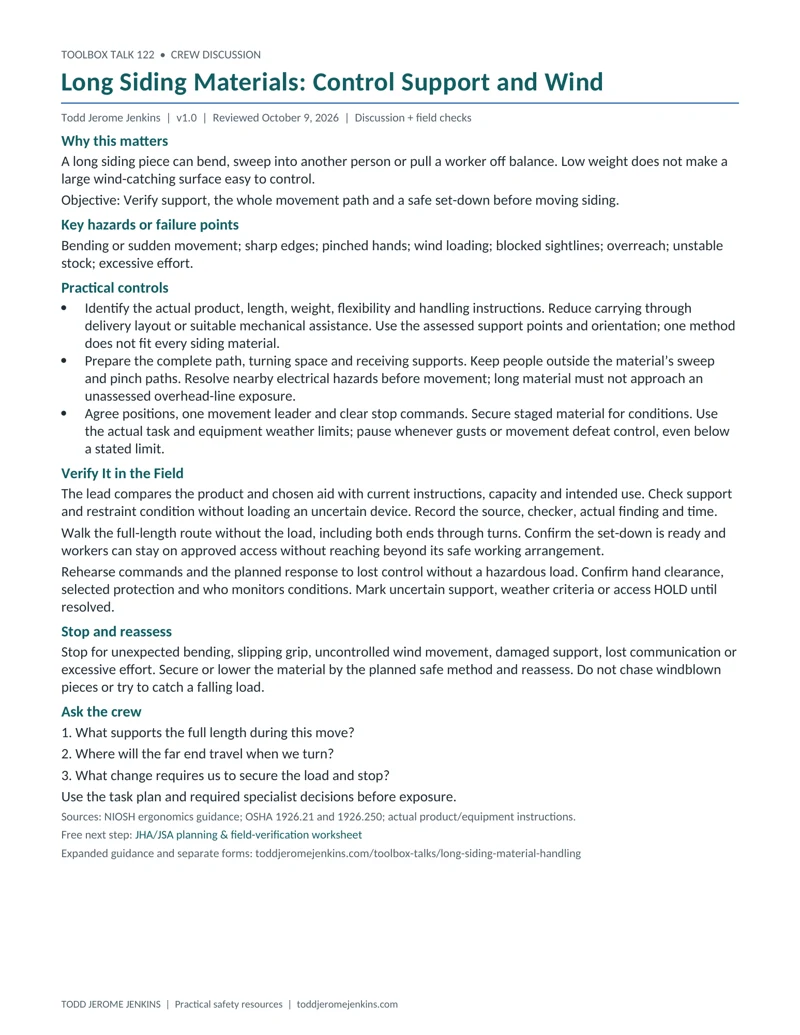
Preview the one-page crew talk
Supporting documents
Included with free Safety & Systems membership.
Supervisor field check
A separate check to verify conditions and controls before work. Includes a one-page PDF and editable Word file.
Attendance sheet
A separate sign-in sheet to record the crew discussion. Includes a one-page PDF and editable Word file.
Need the crew records? Join free to use these supporting documents and the Safety & Systems Academy. No payment details. Email updates are optional.
Get supporting documents — free membershipAlready a member? Use the same link to sign in.
A 5–10 minute crew discussion, plus time to verify the actual controls. The crew talk and Word version are public. Separate supervisor and attendance records are included with free Safety & Systems membership.
Why this matters
A long siding piece can bend, sweep into another person or pull a worker off balance. Low weight does not make a large wind-catching surface easy to control.
Learning objective
Verify support, the whole movement path and a safe set-down before moving siding.
Key hazards or failure points
Bending or sudden movement; sharp edges; pinched hands; wind loading; blocked sightlines; overreach; unstable stock; excessive effort.
Practical controls
- Identify the actual product, length, weight, flexibility and handling instructions. Reduce carrying through delivery layout or suitable mechanical assistance. Use the assessed support points and orientation; one method does not fit every siding material.
- Prepare the complete path, turning space and receiving supports. Keep people outside the material’s sweep and pinch paths. Resolve nearby electrical hazards before movement; long material must not approach an unassessed overhead-line exposure.
- Agree positions, one movement leader and clear stop commands. Secure staged material for conditions. Use the actual task and equipment weather limits; pause whenever gusts or movement defeat control, even below a stated limit.
Verify It in the Field
- The lead compares the product and chosen aid with current instructions, capacity and intended use. Check support and restraint condition without loading an uncertain device. Record the source, checker, actual finding and time.
- Walk the full-length route without the load, including both ends through turns. Confirm the set-down is ready and workers can stay on approved access without reaching beyond its safe working arrangement.
- Rehearse commands and the planned response to lost control without a hazardous load. Confirm hand clearance, selected protection and who monitors conditions. Mark uncertain support, weather criteria or access HOLD until resolved.
Stop and reassess
Stop for unexpected bending, slipping grip, uncontrolled wind movement, damaged support, lost communication or excessive effort. Secure or lower the material by the planned safe method and reassess. Do not chase windblown pieces or try to catch a falling load.
Crew discussion questions
- What supports the full length during this move?
- Where will the far end travel when we turn?
- What change requires us to secure the load and stop?
For each required control, record its acceptance source and criterion, safe verification method, responsible checker, actual result and time. Use VERIFIED, HOLD/NOT VERIFIED, or N/A with a reason. A tick alone is not evidence. Complete all applicable task inspections; do not enter danger or improvise a test to fill out a form.
Leader preparation and practical detail
A siding-specific check, not a glass-handling method
This combines the workbook’s siding material-handling and long/flexible-material topics. The general manual-handling talk addresses exertion and route planning; this briefing adds flexing, the path of both ends, continuous support and weather response. Glass-device or stone-cladding instructions must not be transferred to siding simply because the pieces have similar dimensions.
Obtain product-specific support information
Metal, vinyl, wood and fiber-cement products can need different support and carrying arrangements. Obtain the current instructions for the actual product and equipment before choosing grip points, orientation or an aid. This resource prescribes no universal support spacing, crew size or manual lifting limit. NIOSH guidance supports engineering improvements and checking whether a proposed change reduces the real task demand.
Control wind before it becomes a recovery task
Review the full route and receiving position, including exposed corners and changes in orientation. Assign a person to monitor conditions against the actual task, access-system and equipment limits. A limit is not a promise of control below that value; gusts, flexing, poor footing or a blocked view may require an earlier stop. Plan where and how the load can be secured before starting. Do not improvise ballast or rely on a worker’s strength to restrain unstable stock.
Keep the access arrangement intact
Movement must fit the approved scaffold, platform or other access method, including its loading and fall-protection requirements. This talk does not authorize carrying siding up a ladder, adding an improvised platform or removing guardrails. If the material cannot reach its destination without unsafe reach or loss of support, change the delivery or handling arrangement through the responsible person.
Capture the actual check
Use the general JHA/JSA planning and field-verification worksheet because no directly matching siding JHA is present in the inspected library. Record the product and location, governing instructions, safe verification method, responsible checker, actual result and time. HOLD an unresolved required control; obtain correction, recheck and rebrief before the next movement.
Stage siding around buildings without closing the route
The nearest place to unload is not automatically a suitable storage area. Before delivery, the siding lead and site coordinator identify the full bundle footprint, handling space, supporting surface and the route from storage to installation. Include doors, emergency access, occupied paths and the positions needed by other trades.
Use actual product instructions to establish support, orientation and restraint. Check the proposed supports and surface from a safe position; do not use a loaded bundle to test an uncertain cover or weak surface. Resolve load-bearing concerns with the responsible technical person. Keep stacked material stable and passageways usable. Do not borrow a support spacing or stack height from a different siding product.
Plan how the bundle remains stable when packaging is opened and individual pieces are removed. Shipping bands alone do not establish a safe unpacking sequence. Agree who controls vehicle movement during delivery and who releases the area for manual pickup afterward. Keep incompatible materials separated and account for weather that could move exposed stock or packaging.
Verify the layout again after the first delivery and whenever the working elevation changes. Record storage location, product and instruction references, support and restraint findings, route availability, checker and time. Hold unloading or pickup for an unstable stack, blocked door, unknown support or uncontrolled traffic interface. Change the arrangement and recheck before workers enter; do not ask them to squeeze through the remaining gap.
Sources reviewed: OSHA 1926.250(a), (b)(3), (c): storage stability, passageways and segregation. Apply the actual task and jurisdiction; site and product documents establish the applicable detailed criteria.
Related discussion: Housekeeping Is a Control. Return to What Changed Today? when the arrangement changes.
Short supervisor field check
- Product and handling method identified.
- Support and aid verified.
- Whole-length route and set-down checked.
- Positions and stop response agreed.
- Weather and changes monitored.
Confirm the relevant trained/authorized people, unresolved items, interim protection, correction owner and recheck. Record required release authority and rebrief anyone affected. The separate sheet supports these records; it does not replace a specialist inspection, permit or engineering determination.
Attendance and follow-through
Use the separate attendance sheet for participants, roles, discussion concerns, actions and late-arrival rebriefs. Attendance is not proof of competence, functioning controls or authorization to work. Keep completed records private under employer procedures.
Technical scope and references
Reviewed October 9, 2026 for construction crew preparation. Apply the actual task, jurisdiction and relevant standard provisions. Any manufacturer guidance is reference material, not approval of your equipment or installation. No site-specific design, permit, exposure assessment, product SDS or current model manual was supplied; obtain the applicable documents before work. This discussion does not replace required training.
- NIOSH — Step 4: Implement Your Ergonomic Program — Guidance supporting mechanical assistance, task redesign and evaluation; no universal lifting weight.
- OSHA 1926.21(b)(2) — Instruction in recognizing and avoiding unsafe conditions.
- OSHA 1926.250(a), (c) — Storage stability, load limits, clear routes and housekeeping; no universal siding support spacing.
Connect this discussion to your JHA/JSA
Use the JHA/JSA planning and field-verification worksheet to record the actual task steps, hazards, responsible roles and controls. No task-specific worked example is linked for this topic yet. Return to What Changed Today? when the plan or conditions change.
Related Todd Jerome Jenkins article: How to Conduct a Job Safety Analysis.
Related crew discussions
Put one check into practice
Use the free JHA/JSA planning and field-verification worksheet to record today’s change, the required protection and the evidence needed before exposure.