Download the talk and separate crew records
Free to download without an account. Each PDF is one page. Use the Word version to adapt the record to your task and approved procedures.
Supervisor field check
Download supervisor field check (PDF, 1 page)Editable supervisor field check (Word)Preview the one-page crew talk
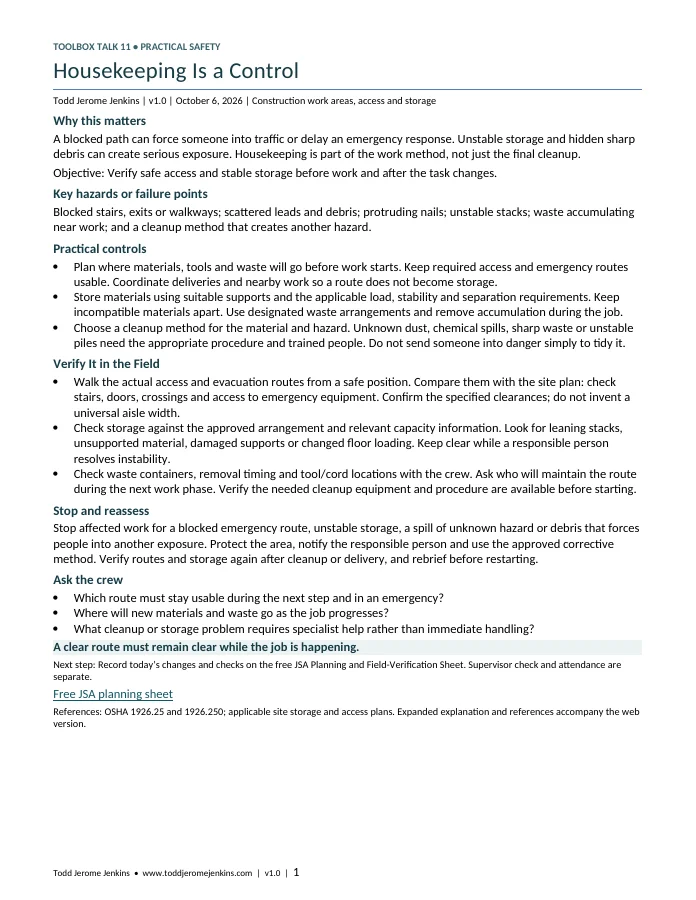
One-page crew talk, with separate supervisor and attendance sheets. Plan a 5–10 minute discussion and allow the time needed for field verification. All downloads are free; no account is required.
Learning objective
Verify safe access and stable storage before work and after the task changes.
Start with today’s work
Illustrative scenario: A pallet arrives in the only planned pedestrian path. People begin walking beside moving equipment to get around it. The problem is not just untidy storage: the delivery has defeated the separation plan. Hold affected movement or work through the site process, restore the route or establish an approved alternative, and confirm everyone knows the arrangement.
Key hazards or failure points
Blocked stairs, exits or walkways; scattered leads and debris; protruding nails; unstable stacks; waste accumulating near work; and a cleanup method that creates another hazard.
Practical controls
- Plan where materials, tools and waste will go before work starts. Keep required access and emergency routes usable. Coordinate deliveries and nearby work so a route does not become storage.
- Store materials using suitable supports and the applicable load, stability and separation requirements. Keep incompatible materials apart. Use designated waste arrangements and remove accumulation during the job.
- Choose a cleanup method for the material and hazard. Unknown dust, chemical spills, sharp waste or unstable piles need the appropriate procedure and trained people. Do not send someone into danger simply to tidy it.
Verify It in the Field
- Walk the actual access and evacuation routes from a safe position. Compare them with the site plan: check stairs, doors, crossings and access to emergency equipment. Confirm the specified clearances; do not invent a universal aisle width.
- Check storage against the approved arrangement and relevant capacity information. Look for leaning stacks, unsupported material, damaged supports or changed floor loading. Keep clear while a responsible person resolves instability.
- Check waste containers, removal timing and tool/cord locations with the crew. Ask who will maintain the route during the next work phase. Verify the needed cleanup equipment and procedure are available before starting.
For each required control, identify the acceptance source and safe check method, assign a person with the required competence and authority, and record the actual result and time. Use VERIFIED, HOLD/NOT VERIFIED, or N/A with a reason. A checkmark alone does not demonstrate that protection works.
| Control | Safe verification | Criterion, evidence and response |
|---|---|---|
| Access and evacuation | Walk the actual route and check doors, stairs and crossings against the site plan without entering traffic or another hazard. | Site access/emergency plan; 1926.25 and 1926.250. Record location and obstruction; hold affected work until resolved. |
| Storage stability | Check the specified supports, arrangement and load information from a safe position. | 1926.250 and storage/engineering requirements. Record defects; do not push or disturb an unstable stack to test it. |
| Waste during the task | Confirm containers, removal responsibility and collection timing match the next phase. | 1926.25 and task/cleanup procedure. Record the owner and trigger; unknown material requires the appropriate assessment. |
These are examples, not a complete task inspection. Check all required controls. Do not enter danger, defeat a safeguard or improvise a test. If the criterion, method or result is uncertain, hold affected work and get the appropriate technical help. No actual equipment model, product SDS or site permit was supplied for these examples; use the documents for your task.
Leader preparation and explanation
Connect housekeeping to the exposure
OSHA 1926.25 addresses debris, protruding nails, combustible scrap and waste arrangements during construction. OSHA 1926.250 addresses storage, loading, stability, clear aisles and segregation. The field check should connect the condition to what it protects: access, separation, stable materials or emergency response.
Plan the next accumulation
A clean area at the start may become unsafe during cutting, unpacking or deliveries. Agree on where waste will collect, who removes it and the trigger for removal. Make the arrangement workable within the task. If the route is repeatedly blocked, change the layout or delivery process rather than relying only on repeated reminders.
Do not create exposure during cleanup
Unknown dust and spills need identification and the correct method. Do not assume dry sweeping, compressed air or bare-hand handling is appropriate. Keep people clear of unstable material and have the responsible person plan its recovery. This resource does not prescribe hazardous-material cleanup or allow untrained workers to enter a restricted area.
Stop and reassess
Stop affected work for a blocked emergency route, unstable storage, a spill of unknown hazard or debris that forces people into another exposure. Protect the area, notify the responsible person and use the approved corrective method. Verify routes and storage again after cleanup or delivery, and rebrief before restarting.
When conditions change, return to Pre-Job JHA/JSA: What Changed Today? and revise the affected task plan with the crew.
Three crew discussion questions
- Which route must stay usable during the next step and in an emergency?
- Where will new materials and waste go as the job progresses?
- What cleanup or storage problem requires specialist help rather than immediate handling?
Short supervisor field check
- Actual work, access and emergency routes match the required site arrangements.
- Materials and supports meet the applicable stability, loading and separation criteria.
- Tools, cords, debris and sharp waste do not create unresolved access exposures.
- Waste containers, collection timing and assigned ownership support the next work phase.
- Cleanup method matches the hazard; restricted or specialist cleanup is assigned appropriately.
Use the separate supervisor sheet to record the task and change, JHA/JSA revision, acceptance source, safe method, verifier, actual result, unresolved items, corrective action, recheck and required restart authorization. Link specialist inspection records rather than copying private or unnecessary details.
Attendance and follow-through
Use the separate attendance sheet for participant names, roles and acknowledgment, meeting details, concerns, actions and rebriefs. Attendance is not proof of competence, functioning controls or permission to work. Keep completed records under the employer’s privacy and recordkeeping procedures; never post completed sign-in sheets publicly.
Related JHA/JSA resource and existing video
How to Conduct a Job Safety Analysis connects the task steps, hazards and controls. For related background, see What Is the Hierarchy of Controls?.
Related crew discussions
One next step
Use the free JSA Planning and Field-Verification Sheet to record today’s changes and checks with the crew.
Sources and references
Sources reviewed October 6, 2026. Apply each regulation’s industry and activity scope, and current state or local requirements where applicable. Guidance is identified separately. This discussion resource supports preparation; it does not replace task procedures, required training, permits or specialist decisions.
- OSHA 29 CFR 1926.25 — Construction debris, combustible waste removal and waste containers.
- OSHA 29 CFR 1926.250 — Storage stability, loading, clear aisles, separation and housekeeping of storage areas.