Download the talk and separate crew records
Free to download without an account. Each PDF is one page. Use the Word version to adapt the record to your task and approved procedures.
Supervisor field check
Download supervisor field check (PDF, 1 page)Editable supervisor field check (Word)Preview the one-page crew talk
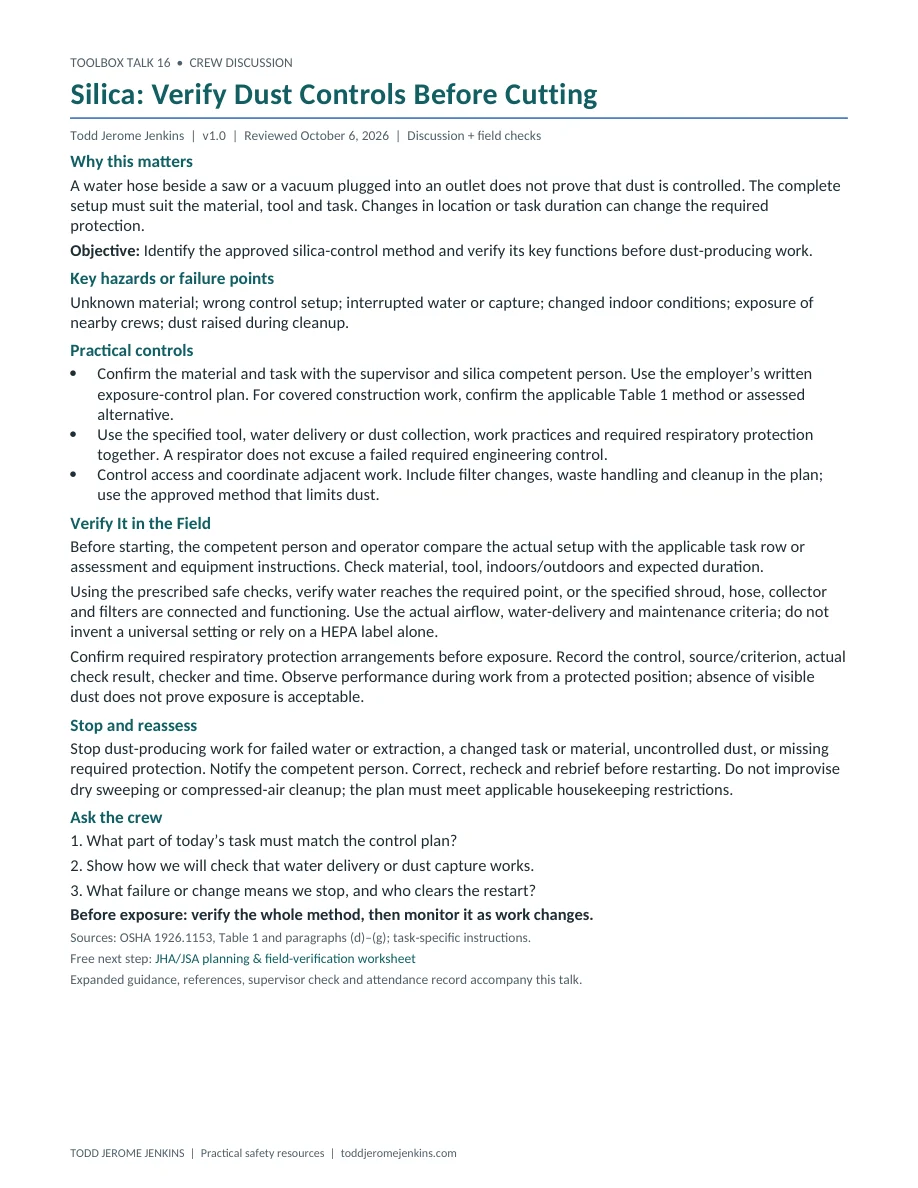
A 5–10 minute crew discussion, plus the time needed for field verification. All six downloads are free without a required signup.
Why this matters
A water hose beside a saw or a vacuum plugged into an outlet does not prove that dust is controlled. The complete setup must suit the material, tool and task. Changes in location or task duration can change the required protection.
Learning objective: Identify the approved silica-control method and verify its key functions before dust-producing work.
Key hazards or failure points
Unknown material; wrong control setup; interrupted water or capture; changed indoor conditions; exposure of nearby crews; dust raised during cleanup.
Practical controls
- Confirm the material and task with the supervisor and silica competent person. Use the employer’s written exposure-control plan. For covered construction work, confirm the applicable Table 1 method or assessed alternative.
- Use the specified tool, water delivery or dust collection, work practices and required respiratory protection together. A respirator does not excuse a failed required engineering control.
- Control access and coordinate adjacent work. Include filter changes, waste handling and cleanup in the plan; use the approved method that limits dust.
Verify It in the Field
Before starting, the competent person and operator compare the actual setup with the applicable task row or assessment and equipment instructions. Check material, tool, indoors/outdoors and expected duration.
Using the prescribed safe checks, verify water reaches the required point, or the specified shroud, hose, collector and filters are connected and functioning. Use the actual airflow, water-delivery and maintenance criteria; do not invent a universal setting or rely on a HEPA label alone.
Confirm required respiratory protection arrangements before exposure. Record the control, source/criterion, actual check result, checker and time. Observe performance during work from a protected position; absence of visible dust does not prove exposure is acceptable.
Use the separate field check to record the source and criterion, safe method, checker, actual result and time. Mark VERIFIED, HOLD/NOT VERIFIED, or N/A with a reason. Check every required control; the examples below do not clear the whole task.
| Control | Safe verification | Evidence to record |
|---|---|---|
| Water-fed method | Check the exact tool instructions and task method; verify delivery safely before cutting. | Delivery at the required location/function recorded; interruption means stop. |
| Extraction method | Match the shroud, hose, collector, filter and required performance criteria. | Specified system and prescribed indicators confirmed; substitutes reviewed before use. |
| Exposure plan | Compare location, duration, access and respiratory requirements with the plan. | Applicable method and competent-person review recorded; changes referred for reassessment. |
Stop and reassess
Stop dust-producing work for failed water or extraction, a changed task or material, uncontrolled dust, or missing required protection. Notify the competent person. Correct, recheck and rebrief before restarting. Do not improvise dry sweeping or compressed-air cleanup; the plan must meet applicable housekeeping restrictions.
Crew discussion questions
- What part of today’s task must match the control plan?
- Show how we will check that water delivery or dust capture works.
- What failure or change means we stop, and who clears the restart?
Before exposure: verify the whole method, then monitor it as work changes.
A situation to discuss
Illustrative situation: a crew replaces a damaged vacuum with another unit that has a HEPA filter. That label alone does not show that the substitute supplies the required airflow or works with the tool’s shroud. The operator and competent person check the complete method before cutting resumes.
Leader preparation and practical detail
Start with the exact operation
Cutting, drilling and grinding are not interchangeable entries in a control plan. Identify the actual tool and method, where the work occurs and how long the relevant task will be performed. If using Table 1, implement the full applicable entry; otherwise use the exposure-assessment route required by the standard. [1], [2]
Define evidence before switching on
Write down what the control must do and where its criterion comes from. The operator may check connections and prescribed function indicators; the competent person confirms that the setup implements the plan. Electrical and mechanical hazards still apply during testing. Do not defeat guards, handle moving components or deliberately create an uncontrolled dust cloud to check capture. OSHA’s construction FAQs allow reliance on manufacturer representations of specified dust-collector performance; employers still need proper selection, use and maintenance. The field check is not an instruction to invent an airflow test. [2]
Include the end of the task
Cleaning a filter or brushing a floor can create a new exposure after cutting ends. Plan these steps and nearby-worker protection as deliberately as the main task. OSHA’s construction rule restricts dry sweeping or brushing and compressed-air cleanup where they could add silica exposure, subject to stated exceptions. An exception must be evaluated under the rule, not assumed because an alternative is inconvenient. [1]
Short supervisor field check
- Material/task identified and applicable control method documented.
- Table 1 conditions or alternative assessment match actual work.
- Complete water/extraction setup checked to source criteria.
- Required respiratory protection, access restrictions and adjacent-work coordination ready.
- Cleanup, failure response and competent-person restart review agreed.
Use the separate form to document evidence, restrictions, corrective-action owner, recheck and required restart approval. An unresolved required control means hold the affected work. Missing evidence is not a pass. Complete all task-specific inspections and permits.
Attendance and follow-through
The separate attendance sheet records participants, language support, questions, actions and late-arrival rebriefs. Attendance does not establish competence or prove controls function. Keep completed records private under the employer’s procedures.
Technical scope and references
This talk focuses on construction under 1926.1153, including its scope and exceptions. General industry and maritime use a separate silica standard; do not apply construction Table 1 automatically to those operations. The construction standard requires a written exposure-control plan and a designated competent person for covered work. Required respirator use must be supported by the applicable respiratory-protection program. [1], [2]
References checked October 6, 2026. Apply the jurisdiction, task, employer program and equipment instructions that govern the work. No site-specific manual, permit, engineering determination or product SDS has been approved by this general resource.
- OSHA 29 CFR 1926.1153 — Respirable crystalline silica — Construction; includes scope exception and alternative methods.
- OSHA — Frequently Asked Questions for the Construction Silica Standard — Advisory explanation; requirements remain in the standard.
Connect this discussion to your JHA/JSA
Use How to Conduct a Job Safety Analysis to connect today’s work steps, hazards and controls. Revisit Pre-Job JHA/JSA: What Changed Today? whenever conditions change.
Related Todd Jerome Jenkins video: Does Training Make You an OSHA Competent Person?.
Related published crew resources: Respiratory Hazards: Know What You’re Breathing; Hazard Communication: Labels, SDS & the Task.
Put one check into practice
Download the free JHA/JSA planning and field-verification worksheet. For today’s task, record an important control, its source and the evidence needed before exposure. Complete the remaining required checks through your task plan.