Download the free crew talk
The one-page talk, editable Word version, and guidance below are open to everyone. No account required.
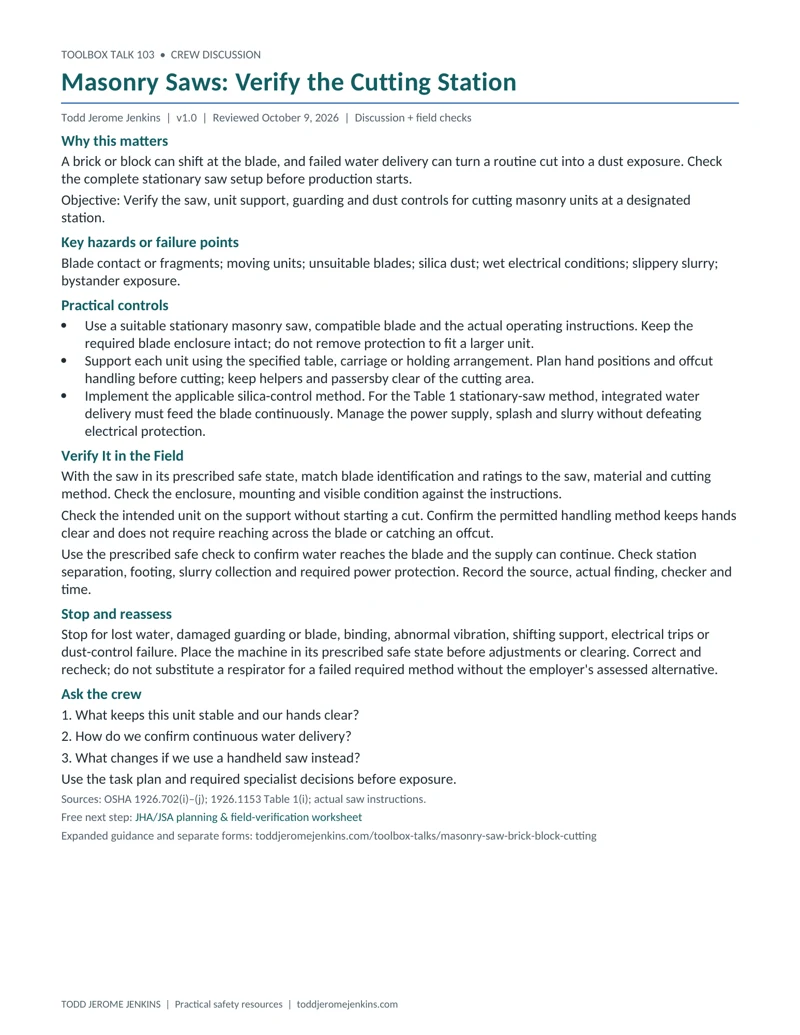
Preview the one-page crew talk
Supporting documents
Included with free Safety & Systems membership.
Supervisor field check
A separate check to verify conditions and controls before work. Includes a one-page PDF and editable Word file.
Attendance sheet
A separate sign-in sheet to record the crew discussion. Includes a one-page PDF and editable Word file.
Need the crew records? Join free to use these supporting documents and the Safety & Systems Academy. No payment details. Email updates are optional.
Get supporting documents — free membershipAlready a member? Use the same link to sign in.
A 5–10 minute crew discussion, plus time to verify the actual controls. The crew talk and Word version are public. Separate supervisor and attendance records are included with free Safety & Systems membership.
Why this matters
A brick or block can shift at the blade, and failed water delivery can turn a routine cut into a dust exposure. Check the complete stationary saw setup before production starts.
Learning objective
Verify the saw, unit support, guarding and dust controls for cutting masonry units at a designated station.
Key hazards or failure points
Blade contact or fragments; moving units; unsuitable blades; silica dust; wet electrical conditions; slippery slurry; bystander exposure.
Practical controls
- Use a suitable stationary masonry saw, compatible blade and the actual operating instructions. Keep the required blade enclosure intact; do not remove protection to fit a larger unit.
- Support each unit using the specified table, carriage or holding arrangement. Plan hand positions and offcut handling before cutting; keep helpers and passersby clear of the cutting area.
- Implement the applicable silica-control method. For the Table 1 stationary-saw method, integrated water delivery must feed the blade continuously. Manage the power supply, splash and slurry without defeating electrical protection.
Verify It in the Field
- With the saw in its prescribed safe state, match blade identification and ratings to the saw, material and cutting method. Check the enclosure, mounting and visible condition against the instructions.
- Check the intended unit on the support without starting a cut. Confirm the permitted handling method keeps hands clear and does not require reaching across the blade or catching an offcut.
- Use the prescribed safe check to confirm water reaches the blade and the supply can continue. Check station separation, footing, slurry collection and required power protection. Record the source, actual finding, checker and time.
Stop and reassess
Stop for lost water, damaged guarding or blade, binding, abnormal vibration, shifting support, electrical trips or dust-control failure. Place the machine in its prescribed safe state before adjustments or clearing. Correct and recheck; do not substitute a respirator for a failed required method without the employer's assessed alternative.
Crew discussion questions
- What keeps this unit stable and our hands clear?
- How do we confirm continuous water delivery?
- What changes if we use a handheld saw instead?
For each required control, record its acceptance source and criterion, safe verification method, responsible checker, actual result and time. Use VERIFIED, HOLD/NOT VERIFIED, or N/A with a reason. A tick alone is not evidence. Complete all applicable task inspections; do not enter danger or improvise a test to fill out a form.
Leader preparation and practical detail
Keep this station distinct from a concrete cut
This talk covers stationary saw cutting of individual masonry units. TBT89 addresses cutting concrete with other saw configurations and concealed-service or structural-release questions. The related Masonry Work JHA includes this wet-saw station within a broader wall-construction example; it does not authorize every cutting method.
Check the protective enclosure
OSHA 1926.702(i) requires a semicircular blade enclosure whose design retains blade fragments. Verify the correct enclosure and its condition; a splash guard or improvised screen is not automatically equivalent. No model instructions were supplied, so blade diameter, speed, mounting and holding details must come from the actual equipment.
Use the exact silica method
Table 1(i) of 1926.1153 applies to stationary masonry saws. It requires integrated continuous water delivery and operation/maintenance according to the manufacturer; its respiratory columns state none when the full applicable method is implemented. Indoor exhaust and adequate wet-method flow provisions also apply. This does not clear other tasks or nearby exposures, and absence of visible dust is not proof of zero exposure.
Plan cleanup and intervention
Collect slurry before it becomes a dry-dust problem and use the employer's compliant housekeeping method. Maintenance or repair with inadvertent-operation hazards requires the lockout/tagging provisions of 1926.702(j). A stopped blade does not itself establish a safe maintenance state. Keep task-specific eye, face, hearing and other required protection in the station plan.
Short supervisor field check
- Saw, blade and unit size/method compatible.
- Blade enclosure and required mounting sound.
- Unit support and hand/offcut positions planned.
- Water, electrical protection and slurry controls verified.
- Station separated and defects resolved.
Confirm the relevant trained/authorized people, unresolved items, interim protection, correction owner and recheck. Record required release authority and rebrief anyone affected. The separate sheet supports these records; it does not replace a specialist inspection, permit or engineering determination.
Attendance and follow-through
Use the separate attendance sheet for participants, roles, discussion concerns, actions and late-arrival rebriefs. Attendance is not proof of competence, functioning controls or authorization to work. Keep completed records private under employer procedures.
Technical scope and references
Reviewed October 9, 2026 for construction crew preparation. Apply the actual task, jurisdiction and relevant standard provisions. Manufacturer sources below are reference examples, not approval of your equipment. No site-specific design, permit, exposure assessment, product SDS or current model manual was supplied; obtain the applicable documents before work. This discussion does not replace required training.
- OSHA 1926.702(i)–(j) — Masonry-saw enclosure and maintenance/repair hazardous-energy provisions.
- OSHA 1926.1153 — Stationary masonry saw Table 1(i), full control conditions, alternatives and housekeeping.
Connect this discussion to your JHA/JSA
Use the related worked JHA/JSA/AHA example to prepare task steps, hazards and controls. Return to What Changed Today? when the plan or conditions change.
Related Todd Jerome Jenkins article: How to Conduct a Job Safety Analysis.
Related crew discussions
Put one check into practice
Use the free JHA/JSA planning and field-verification worksheet to record today’s change, the required protection and the evidence needed before exposure.